 Add to Chrome
 Add to Firefox
 Add to Edge
Kernel Metric Learning for Clustering Mixed-type Data
Jun 02, 2023
Distance-based clustering and classification are widely used in various fields to group mixed numeric and categorical data. A predefined distance measurement is used to cluster data points based on their dissimilarity. While there exist numerous distance-based measures for data with pure numerical attributes and several ordered and unordered categorical metrics, an optimal distance for mixed-type data is an open problem. Many metrics convert numerical attributes to categorical ones or vice versa. They handle the data points as a single attribute type or calculate a distance between each attribute separately and add them up. We propose a metric that uses mixed kernels to measure dissimilarity, with cross-validated optimal kernel bandwidths. Our approach improves clustering accuracy when utilized for existing distance-based clustering algorithms on simulated and real-world datasets containing pure continuous, categorical, and mixed-type data.

Know Your Clients' behaviours: a cluster analysis of financial transactions
May 14, 2020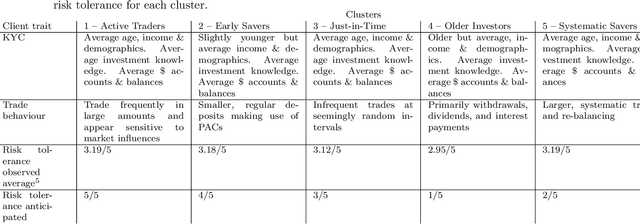
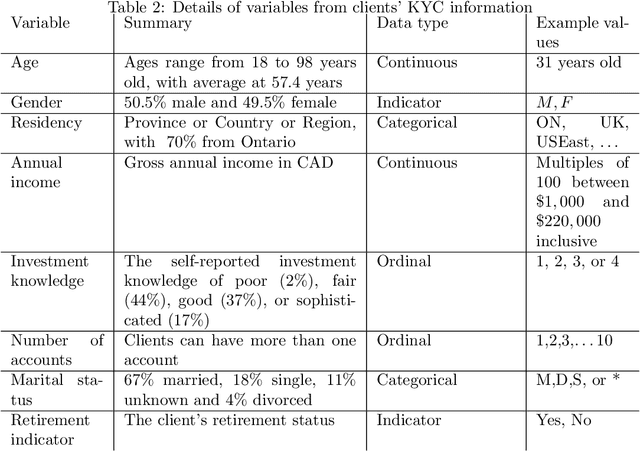
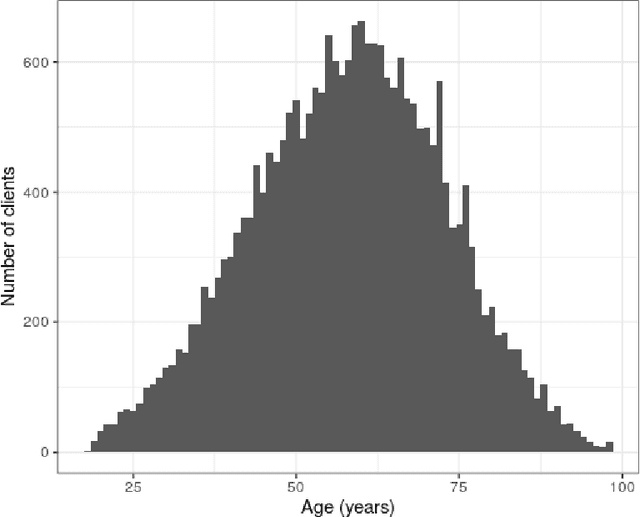
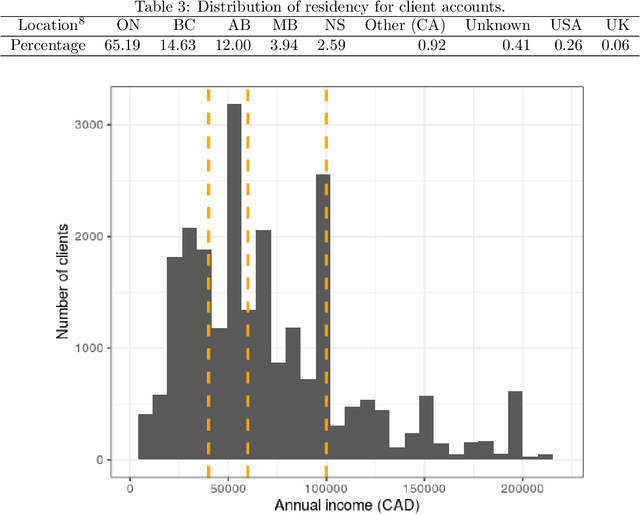
In Canada, financial advisors and dealers are required by provincial securities commissions and self-regulatory organizations--charged with direct regulation over investment dealers and mutual fund dealers--to respectively collect and maintain Know Your Client (KYC) information, such as their age or risk tolerance, for investor accounts. With this information, investors, under their advisor's guidance, make decisions on their investments which are presumed to be beneficial to their investment goals. Our unique dataset is provided by a financial investment dealer with over 50,000 accounts for over 23,000 clients. We use a modified behavioural finance recency, frequency, monetary model for engineering features that quantify investor behaviours, and machine learning clustering algorithms to find groups of investors that behave similarly. We show that the KYC information collected does not explain client behaviours, whereas trade and transaction frequency and volume are most informative. We believe the results shown herein encourage financial regulators and advisors to use more advanced metrics to better understand and predict investor behaviours.