 Add to Chrome
 Add to Firefox
 Add to Edge
Rotate Disks to Reach Farther: Design and Modeling of a Novel Reconfigurable Tendon Driven Manipulator
Aug 18, 2026
Rerouting the tendon path in tendon driven continuum manipulators (TDCMs) enables a broad range of deformation modes. This work presents a Reconfigurable TDCM design which allows independent rotation of intermediate spacer disks, thereby locally rerouting the tendon and achieving non-trivial backbone spatial deformations. Two such designs, (a) Manual Disk Locked (MDL) and (b) Continuous Disk Rotor (CDR) manipulators are presented to achieve disk rotations before and during operation, respectively. A predictive static model based on the piecewise constant strain (PCS) assumption is developed within a potential energy minimization framework, incorporating (a) disk rotations, (b) discrete tendon paths between disk segments, (c) rigid thickness of spacer disks, and (d) elasticity of the tendons. The model is validated against experimental results, demonstrating an average tip error of $1.2\%$ of the manipulator's total length for parallel tendon routing and around $3\%$ for the case when multiple disks are rotated. The computation time is an order of magnitude lower than the state of the art Cosserat rod solver.

Actuation space reduction to facilitate insightful shape matching in a novel reconfigurable tendon driven continuum manipulator
Apr 14, 2026In tendon driven continuum manipulators (TDCMs), reconfiguring the tendon routing enables tailored spatial deformation of the backbone. This work presents a design in which tendons can be rerouted either prior to or after actuation by actively rotating the individual spacer disks. Each disk rotation thus adds a degree of freedom to the actuation space, complicating the mapping from a desired backbone curve to the corresponding actuator inputs. However, when the backbone shape is projected into an intermediate space defined by curvature and torsion (C-T), patterns emerge that highlight which disks are most influential in achieving a global shape. This insight enables a simplified, sequential shape-matching strategy: first, the proximal and intermediate disks are rotated to approximate the global shape; then, the distal disks are adjusted to fine-tune the end-effector position with minimal impact on the overall shape. The proposed actuation framework offers a model-free alternative to conventional control approaches, bypassing the complexities of modeling reconfigurable TDCMs.
Reverse Annealing for Nonnegative/Binary Matrix Factorization
Jul 10, 2020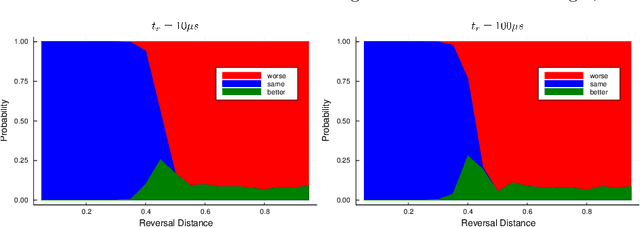
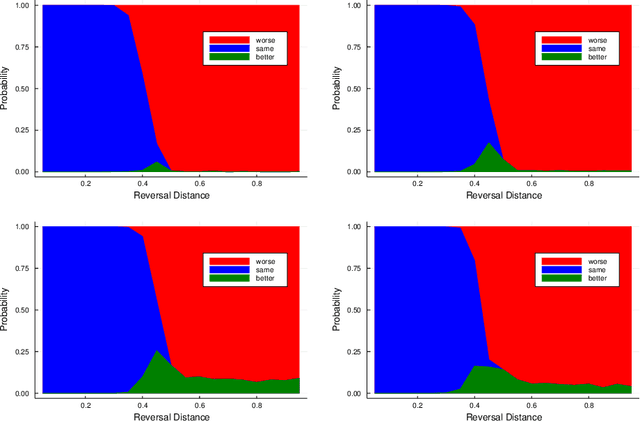
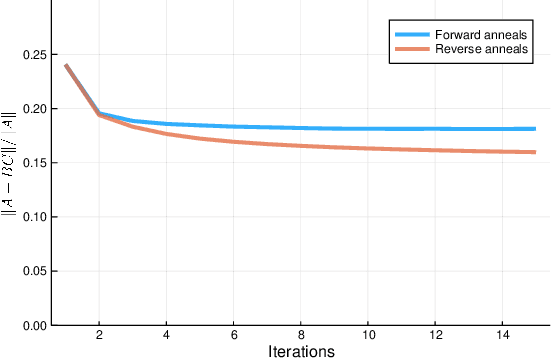
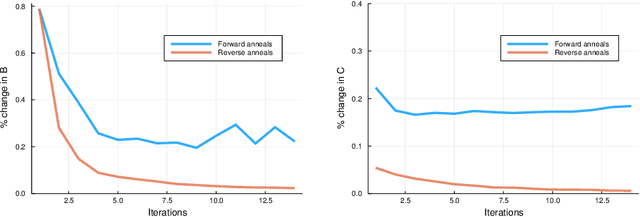
It was recently shown that quantum annealing can be used as an effective, fast subroutine in certain types of matrix factorization algorithms. The quantum annealing algorithm performed best for quick, approximate answers, but performance rapidly plateaued. In this paper, we utilize reverse annealing instead of forward annealing in the quantum annealing subroutine for nonnegative/binary matrix factorization problems. After an initial global search with forward annealing, reverse annealing performs a series of local searches that refine existing solutions. The combination of forward and reverse annealing significantly improves performance compared to forward annealing alone for all but the shortest run times.