 Add to Chrome
 Add to Firefox
 Add to Edge
Selection Hyper-heuristics Can Automatically Adjust the Learning Period to Optimally Solve Pseudo-Boolean Problems
May 28, 2026
The Random Gradient hyper-heuristic was recently shown to be able to learn the optimal neighbourhood size when optimizing the LeadingOnes benchmark via the Randomised Local Search (RLS) meta-heuristic. However, for this to happen, a learning period of a certain length $τ$ had to be used, differently from classic hyper-heuristics, which change their behaviour based on the success of only the previous iteration. In this paper, we show how to automatically set this new parameter value, relieving the user from the non-trivial task of controlling this novel algorithm parameter. We prove that the resulting hyper-heuristic selects the optimal neighbourhood size in a $1-o(1)$ fraction of the iterations and, consequently, optimises the LeadingOnes benchmark in the best possible time (apart from lower-order terms) achievable with these neighborhood sizes.

Hyper-heuristics Can Achieve Optimal Performance for Pseudo-Boolean Optimisation
Jan 23, 2018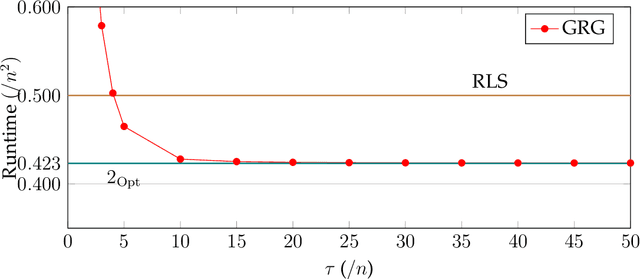
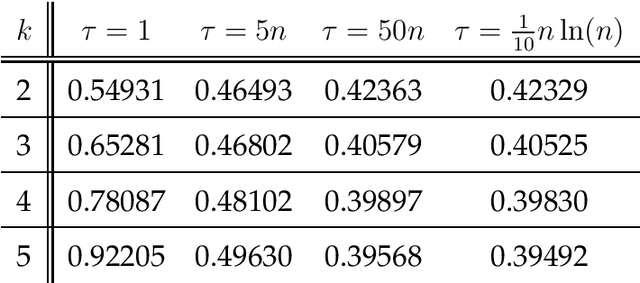
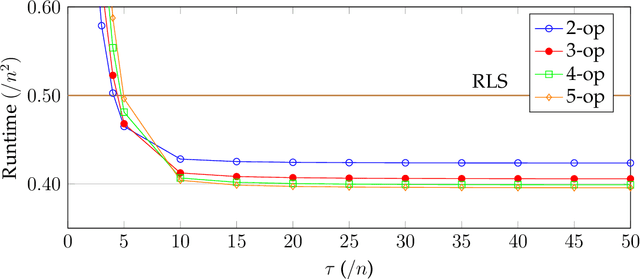
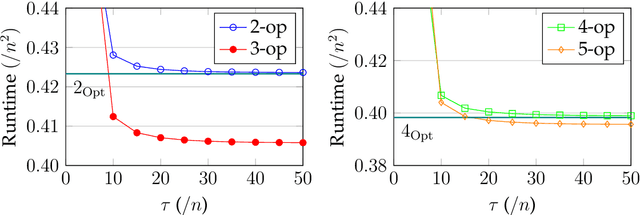
Selection hyper-heuristics are randomised search methodologies which choose and execute heuristics from a set of low-level heuristics. Recent research for the LeadingOnes benchmark function has shown that the standard Simple Random, Permutation, Random Gradient, Greedy and Reinforcement Learning selection mechanisms show no effects of learning. The idea behind the learning mechanisms is to continue to exploit the currently selected heuristic as long as it is successful. However, the probability that a promising heuristic is successful in the next step is relatively low when perturbing a reasonable solution to a combinatorial optimisation problem. In this paper we generalise the `simple' selection-perturbation mechanisms so success can be measured over some fixed period of time tau, rather than in a single iteration. We present a benchmark function where it is necessary to learn to exploit a particular low-level heuristic, rigorously proving that it makes the difference between an efficient and an inefficient algorithm. For LeadingOnes we prove that the Generalised Random Gradient, and the Generalised Greedy Gradient hyper-heuristics achieve optimal performance, while Generalised Greedy, although not as fast, still outperforms Random Local Search. The performance of the former two hyper-heuristics improves as the number of operators to choose from increases, while that of the Generalised Greedy hyper-heuristic does not. Experimental analyses confirm these results for realistic problem sizes and shed some light on the best choices of the parameter tau in various situations.