 Add to Chrome
 Add to Firefox
 Add to Edge
Novel Nonlinear Neural-Network Layers for High Performance and Generalization in Modulation-Recognition Applications
Aug 14, 2023
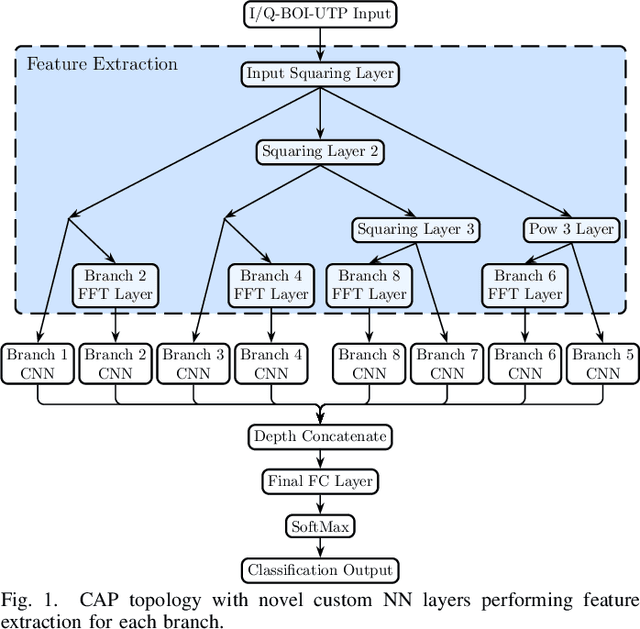
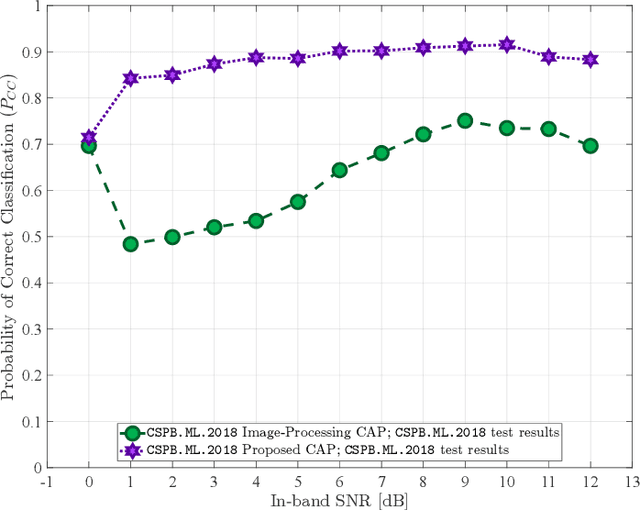
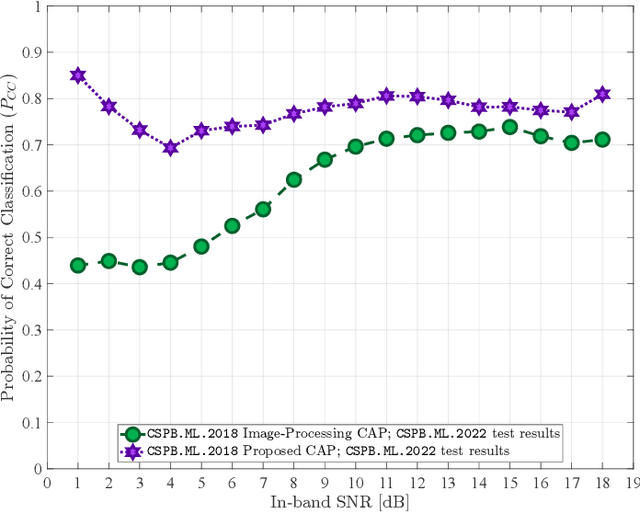
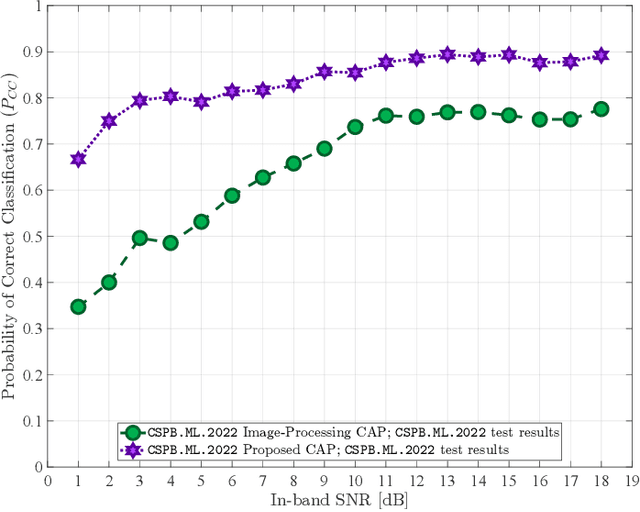
The paper presents a novel type of capsule network (CAP) that uses custom-defined neural network (NN) layers for blind classification of digitally modulated signals using their in-phase/quadrature (I/Q) components. The custom NN layers of the CAP are inspired by cyclostationary signal processing (CSP) techniques and implement feature extraction capabilities that are akin to the calculation of the cyclic cumulant (CC) features employed in conventional CSP-based approaches to blind modulation classification and signal identification. The classification performance and the generalization abilities of the proposed CAP are tested using two distinct datasets that contain similar classes of digitally modulated signals but that have been generated independently, and numerical results obtained reveal that the proposed CAP with novel NN feature extraction layers achieves high classification accuracy while also outperforming alternative deep learning (DL)-based approaches for signal classification in terms of both classification accuracy and generalization abilities.

Physical Layer Secret Key Agreement Using One-Bit Quantization and Low-Density Parity-Check Codes
Jul 08, 2023Physical layer approaches for generating secret encryption keys for wireless systems using channel information have attracted increased interest from researchers in recent years. This paper presents a new approach for calculating log-likelihood ratios (LLRs) for secret key generation that is based on one-bit quantization of channel measurements and the difference between channel estimates at legitimate reciprocal nodes. The studied secret key agreement approach, which implements advantage distillation along with information reconciliation using Slepian-Wolf low-density parity-check (LDPC) codes, is discussed and illustrated with numerical results obtained from simulations. These results show the probability of bit disagreement for keys generated using the proposed LLR calculations compared with alternative LLR calculation methods for key generation based on channel state information. The proposed LLR calculations are shown to be an improvement to the studied approach of physical layer secret key agreement.
On Deep Learning Classification of Digitally Modulated Signals Using Raw I/Q Data
Jul 05, 2023The paper considers the problem of deep-learning-based classification of digitally modulated signals using I/Q data and studies the generalization ability of a trained neural network (NN) to correctly classify digitally modulated signals it has been trained to recognize when the training and testing datasets are distinct. Specifically, we consider both a residual network (RN) and a convolutional neural network (CNN) and use them in conjunction with two different datasets that contain similar classes of digitally modulated signals but that have been generated independently using different means, with one dataset used for training and the other one for testing.
Robust Classification of Digitally Modulated Signals Using Capsule Networks and Cyclic Cumulant Features
Nov 01, 2022The paper studies the problem of robust classification of digitally modulated signals using capsule networks and cyclic cumulant (CC) features extracted by cyclostationary signal processing (CSP). Two distinct datasets that contain similar classes of digitally modulated signals but that have been generated independently are used in the study, which reveals that capsule networks trained using CCs achieve high classification accuracy while also outperforming other deep learning-based approaches in terms of classification accuracy as well as generalization abilities.
Using Capsule Networks to Classify Digitally Modulated Signals with Raw I/Q Data
May 19, 2022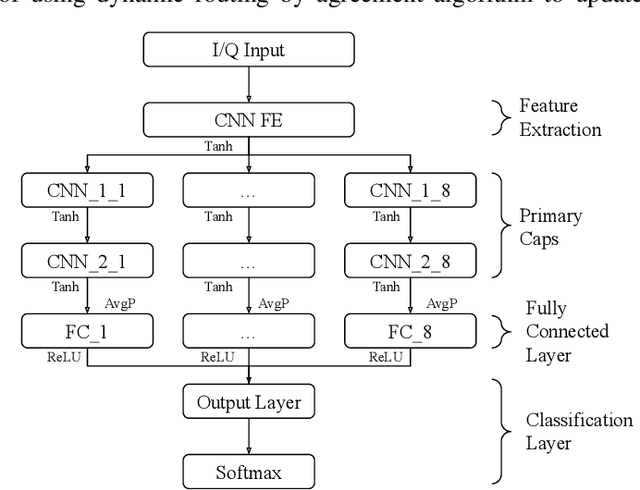
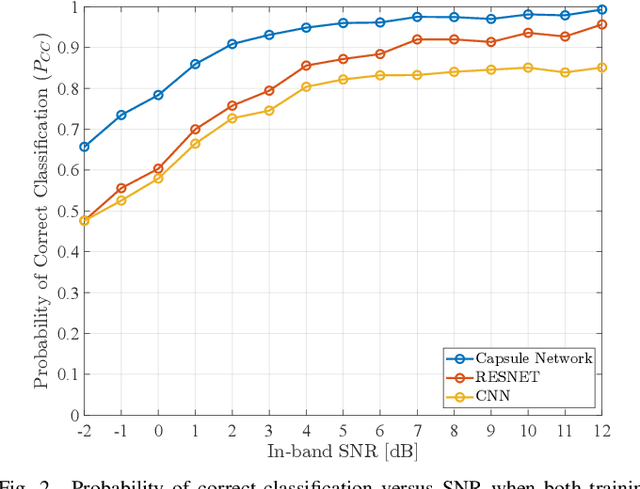


Machine learning has become a powerful tool for solving problems in various engineering and science areas, including the area of communication systems. This paper presents the use of capsule networks for classification of digitally modulated signals using the I/Q signal components. The generalization ability of a trained capsule network to correctly classify the classes of digitally modulated signals that it has been trained to recognize is also studied by using two different datasets that contain similar classes of digitally modulated signals but that have been generated independently. Results indicate that the capsule networks are able to achieve high classification accuracy. However, these networks are susceptible to the datashift problem which will be discussed in this paper.