 Add to Chrome
 Add to Firefox
 Add to Edge
Causal explanations of outliers in systems with lagged time-dependencies
Feb 04, 2026
Root-cause analysis in controlled time dependent systems poses a major challenge in applications. Especially energy systems are difficult to handle as they exhibit instantaneous as well as delayed effects and if equipped with storage, do have a memory. In this paper we adapt the causal root-cause analysis method of Budhathoki et al. [2022] to general time-dependent systems, as it can be regarded as a strictly causal definition of the term "root-cause". Particularly, we discuss two truncation approaches to handle the infinite dependency graphs present in time-dependent systems. While one leaves the causal mechanisms intact, the other approximates the mechanisms at the start nodes. The effectiveness of the different approaches is benchmarked using a challenging data generation process inspired by a problem in factory energy management: the avoidance of peaks in the power consumption. We show that given enough lags our extension is able to localize the root-causes in the feature and time domain. Further the effect of mechanism approximation is discussed.

Bayesian parameter estimation of miss-specified models
Dec 19, 2018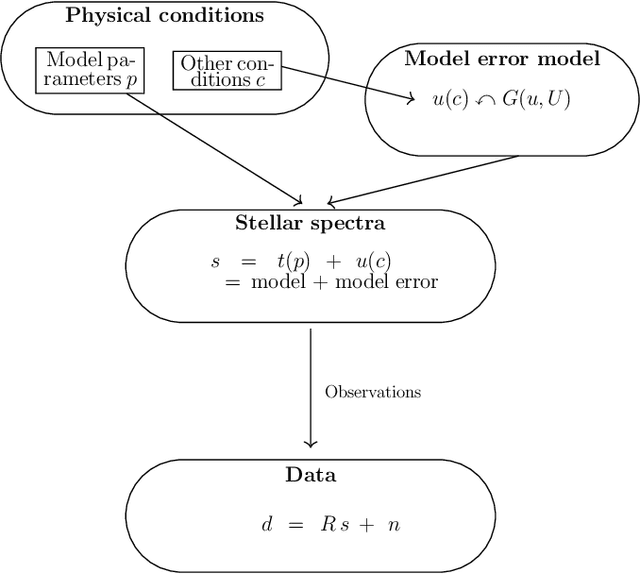
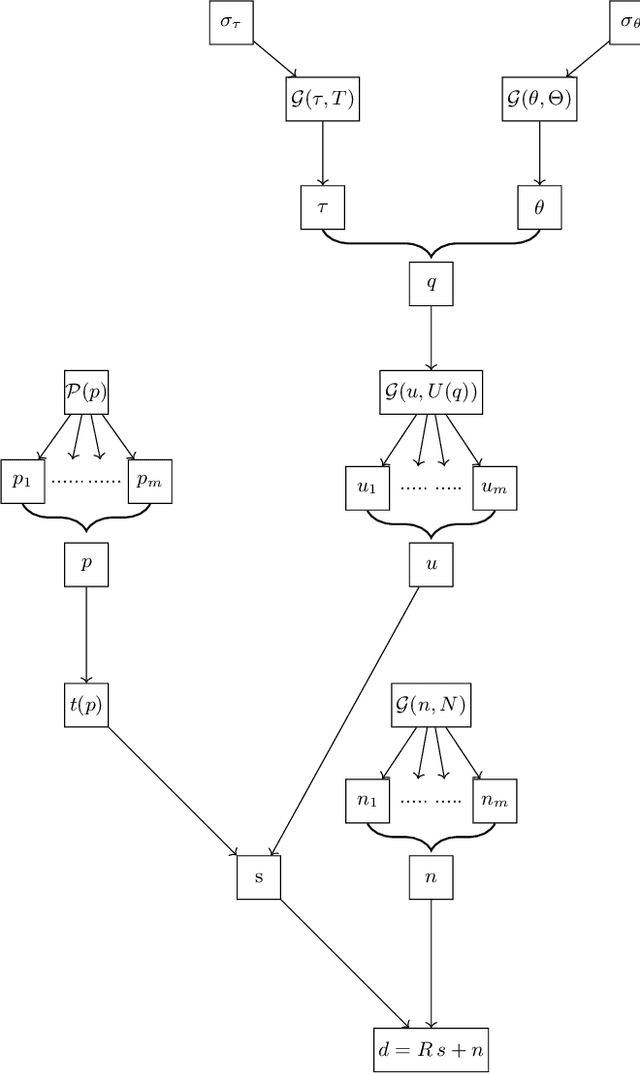
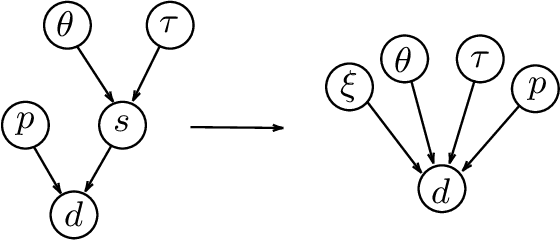
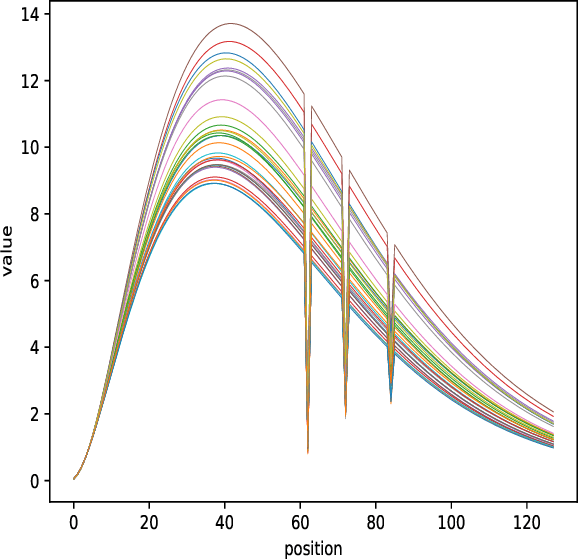
Fitting a simplifying model with several parameters to real data of complex objects is a highly nontrivial task, but enables the possibility to get insights into the objects physics. Here, we present a method to infer the parameters of the model, the model error as well as the statistics of the model error. This method relies on the usage of many data sets in a simultaneous analysis in order to overcome the problems caused by the degeneracy between model parameters and model error. Errors in the modeling of the measurement instrument can be absorbed in the model error allowing for applications with complex instruments.