 Add to Chrome
 Add to Firefox
 Add to Edge
High-Fidelity Synthetic Transmission Electron Microscopy Image Generation Using Diffusion Probabilistic Models for Data-Limited Semiconductor Metrology
Jun 23, 2026
Advanced semiconductor nodes drastically increased demand for Transmission Electron Microscopy (TEM), yet destructive sample preparation, slow imaging and high costs severely limit the availability of diverse datasets needed for downstream machine learning (ML). Synthetic data generation is becoming essential, but current generative models often miss TEM-specific noise, structural detail, and stochastic variability crucial for evaluation. We present a Denoising Diffusion Probabilistic Model (DDPM) framework for synthetic TEM image generation under extreme data scarcity. A progressive patch-based training strategy scales from low-resolution patches to full images, enabling from-scratch training with only 15 samples. We integrate a custom TrivialAugment adaptation, cross-process domain transfer, classifier guidance, and RePaint-style inpainting, culminating in full-image generation that preserves global structural and spatial relationships in compliance with FAB metrology requirements. Beyond synthesis, we repurpose DDPM feature representations for segmentation, partitioning encoder feature maps to obtain coherent region masks. Our synthetic images achieve up to MS-SSIM > 0.98 and qualitative expert assessment consistent with structural similarity results, facilitating downstream ML training for defect detection, segmentation, and metrology while preserving statistical and physical realism.

Evaluating end-to-end entity linking on domain-specific knowledge bases: Learning about ancient technologies from museum collections
May 23, 2023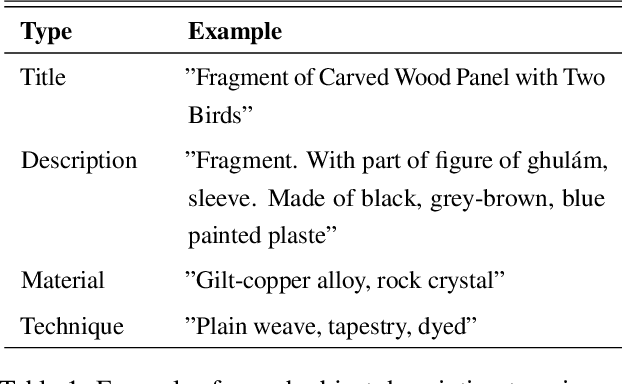
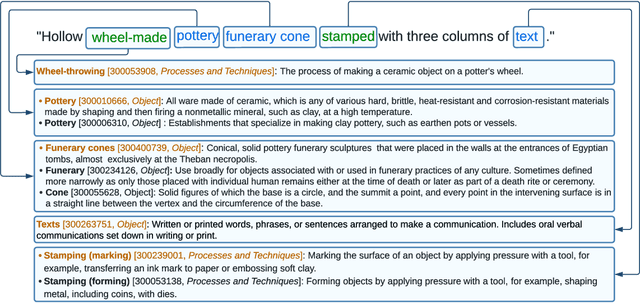
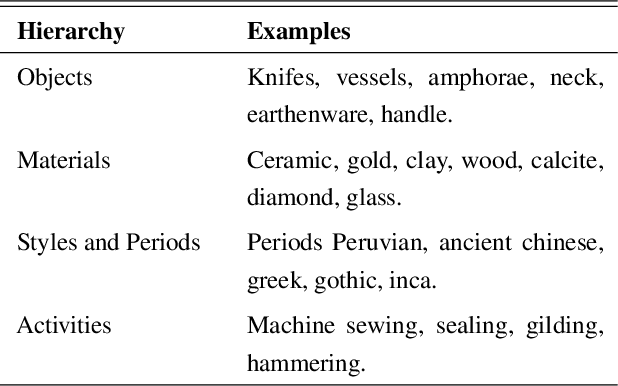
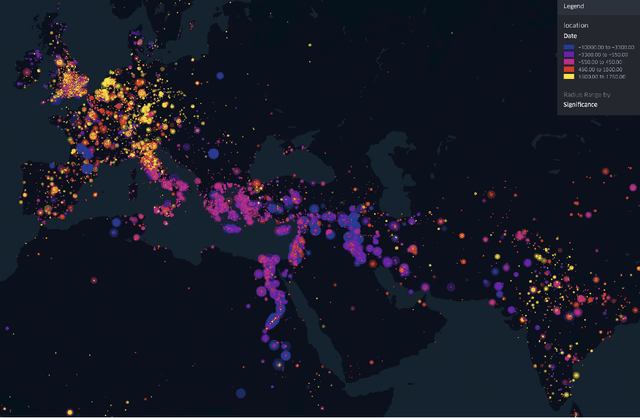
To study social, economic, and historical questions, researchers in the social sciences and humanities have started to use increasingly large unstructured textual datasets. While recent advances in NLP provide many tools to efficiently process such data, most existing approaches rely on generic solutions whose performance and suitability for domain-specific tasks is not well understood. This work presents an attempt to bridge this domain gap by exploring the use of modern Entity Linking approaches for the enrichment of museum collection data. We collect a dataset comprising of more than 1700 texts annotated with 7,510 mention-entity pairs, evaluate some off-the-shelf solutions in detail using this dataset and finally fine-tune a recent end-to-end EL model on this data. We show that our fine-tuned model significantly outperforms other approaches currently available in this domain and present a proof-of-concept use case of this model. We release our dataset and our best model.