 Add to Chrome
 Add to Firefox
 Add to Edge
Maximum Satisfiability of Simple Temporal Problems
Jul 26, 2026
The Simple Temporal Problem (STP) is a core framework for quantitative temporal constraints. As STP data can be inconsistent, we study MAXSTP: compute a maximum-cardinality consistent subset of constraints. This extension is NP-hard, and we analyze its parameterized complexity under measures that capture practically relevant instance features: the number of variables $n$ (instance scale), the maximum coefficient magnitude $k$ (numeric range), and structural parameters of the constraint graph such as treewidth $tw$ (decomposability) and vertex cover size $vc$ (density). We show that MAXSTP is W[1]-hard parameterized by $n$, implying that $n$ and parameters that depend on $n$ (including $tw$ and $vc$) are insufficient for fixed-parameter tractability. For combined parameters, we give an $O^*(k^n)$-time algorithm, yielding single-exponential solvability for fixed $k$. While $k+tw$ remains W[1]-hard, MAXSTP is in XP via an $O^*((n\cdot k)^{tw})$ algorithm. Our results suggest that MAXSTP is often computationally harder than optimizing qualitative CSPs. We verify that many such problems (including RCC-8 and Allen's algebra) are FPT when parameterized by $n$ or $tw$. However, we also demonstrate that FPT algorithms for MAXSTP are indeed possible but with other parameters such as $k + vc$.

Structure-Aware Encodings of Argumentation Properties for Clique-width
Nov 13, 2025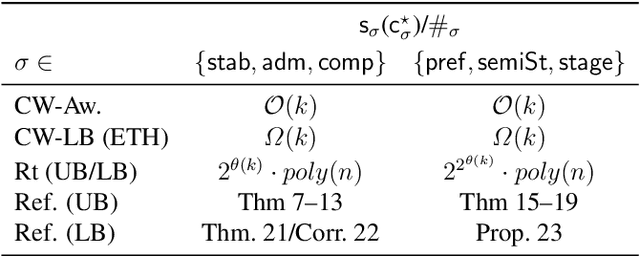
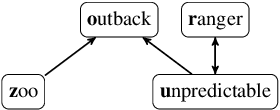
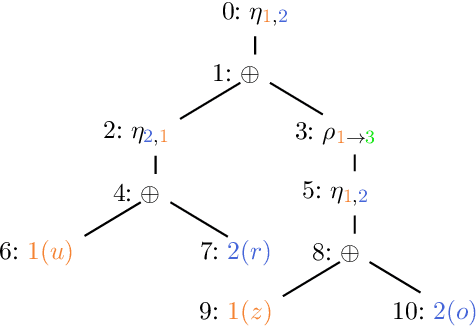
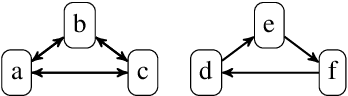
Structural measures of graphs, such as treewidth, are central tools in computational complexity resulting in efficient algorithms when exploiting the parameter. It is even known that modern SAT solvers work efficiently on instances of small treewidth. Since these solvers are widely applied, research interests in compact encodings into (Q)SAT for solving and to understand encoding limitations. Even more general is the graph parameter clique-width, which unlike treewidth can be small for dense graphs. Although algorithms are available for clique-width, little is known about encodings. We initiate the quest to understand encoding capabilities with clique-width by considering abstract argumentation, which is a robust framework for reasoning with conflicting arguments. It is based on directed graphs and asks for computationally challenging properties, making it a natural candidate to study computational properties. We design novel reductions from argumentation problems to (Q)SAT. Our reductions linearly preserve the clique-width, resulting in directed decomposition-guided (DDG) reductions. We establish novel results for all argumentation semantics, including counting. Notably, the overhead caused by our DDG reductions cannot be significantly improved under reasonable assumptions.