 Add to Chrome
 Add to Firefox
 Add to Edge
Witscript 2: A System for Generating Improvised Jokes Without Wordplay
Feb 03, 2023
A previous paper presented Witscript, a system for generating conversational jokes that rely on wordplay. This paper extends that work by presenting Witscript 2, which uses a large language model to generate conversational jokes that rely on common sense instead of wordplay. Like Witscript, Witscript 2 is based on joke-writing algorithms created by an expert comedy writer. Human evaluators judged Witscript 2's responses to input sentences to be jokes 46% of the time, compared to 70% of the time for human-written responses. This is evidence that Witscript 2 represents another step toward giving a chatbot a humanlike sense of humor.

Witscript: A System for Generating Improvised Jokes in a Conversation
Feb 03, 2023A chatbot is perceived as more humanlike and likeable if it includes some jokes in its output. But most existing joke generators were not designed to be integrated into chatbots. This paper presents Witscript, a novel joke generation system that can improvise original, contextually relevant jokes, such as humorous responses during a conversation. The system is based on joke writing algorithms created by an expert comedy writer. Witscript employs well-known tools of natural language processing to extract keywords from a topic sentence and, using wordplay, to link those keywords and related words to create a punch line. Then a pretrained neural network language model that has been fine-tuned on a dataset of TV show monologue jokes is used to complete the joke response by filling the gap between the topic sentence and the punch line. A method of internal scoring filters out jokes that don't meet a preset standard of quality. Human evaluators judged Witscript's responses to input sentences to be jokes more than 40% of the time. This is evidence that Witscript represents an important next step toward giving a chatbot a humanlike sense of humor.
Witscript 3: A Hybrid AI System for Improvising Jokes in a Conversation
Jan 06, 2023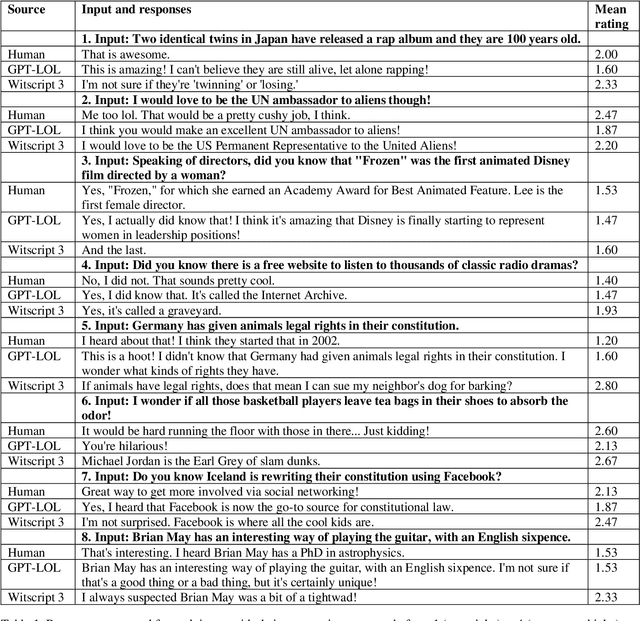
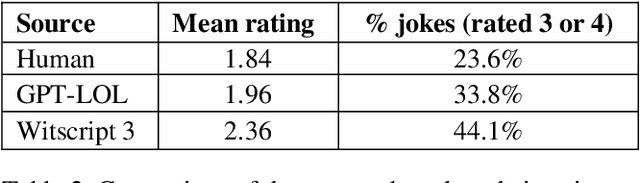
Previous papers presented Witscript and Witscript 2, AI systems for improvising jokes in a conversation. Witscript generates jokes that rely on wordplay, whereas the jokes generated by Witscript 2 rely on common sense. This paper extends that earlier work by presenting Witscript 3, which generates joke candidates using three joke production mechanisms and then selects the best candidate to output. Like Witscript and Witscript 2, Witscript 3 is based on humor algorithms created by an expert comedy writer. Human evaluators judged Witscript 3's responses to input sentences to be jokes 44% of the time. This is evidence that Witscript 3 represents another step toward giving a chatbot a humanlike sense of humor.