 Add to Chrome
 Add to Firefox
 Add to Edge
Entropy-Guided Self-Supervised Learning for Medical Image Classification
May 21, 2026
Accurate and robust medical image classification is paramount for early disease diagnosis and treatment planning. However, challenges such as limited annotated data, high intra-class variability, and subtle inter-class differences often hinder the performance of deep learning models. This paper introduces a synergistic deep learning framework that leverages the strengths of self-supervised learning and transfer learning for enhanced medical image classification. Our approach employs two distinct ConvNeXt-Tiny models: one pre-trained on a large-scale natural image dataset (ImageNet) and another pre-trained using an entropy-guided Masked Autoencoder (MAE) on the target medical dataset. Both models are then fine-tuned on specific medical image classification tasks. A final ensemble strategy, based on averaging predicted probabilities, is utilized to combine the complementary insights from these two models. Rigorous experimental validation across four diverse medical imaging datasets (Breast Ultrasound Images (BUSI), International Skin Imaging Collaboration (ISIC) 2018, Kvasir, and COVID) demonstrates the superior performance and robustness of our ensemble approach. The MAE pre-training significantly improves feature learning on domain-specific data, while the ImageNet pre-training provides strong generalizable features. The ensemble consistently achieves state-of-the-art results, outperforming individual models and existing methods, highlighting the efficacy of combining diverse pre-training strategies for challenging medical image analysis.

A cellular automata approach to local patterns for texture recognition
Jul 15, 2020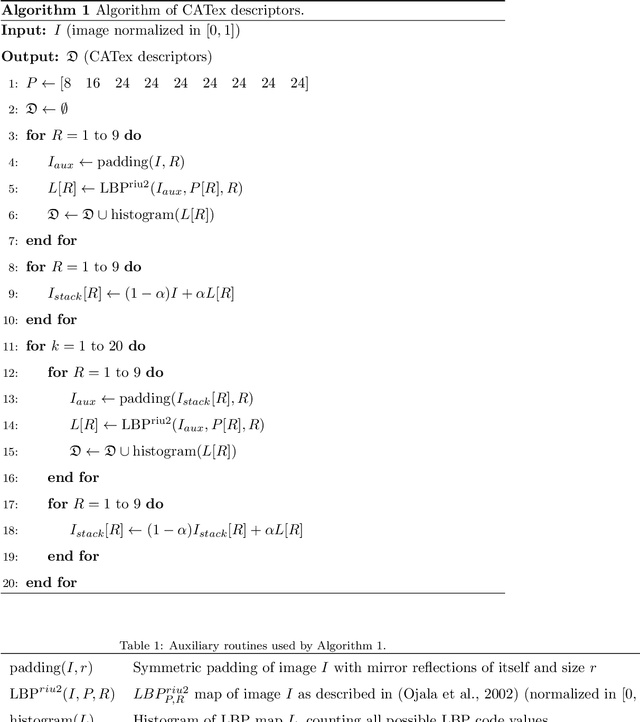
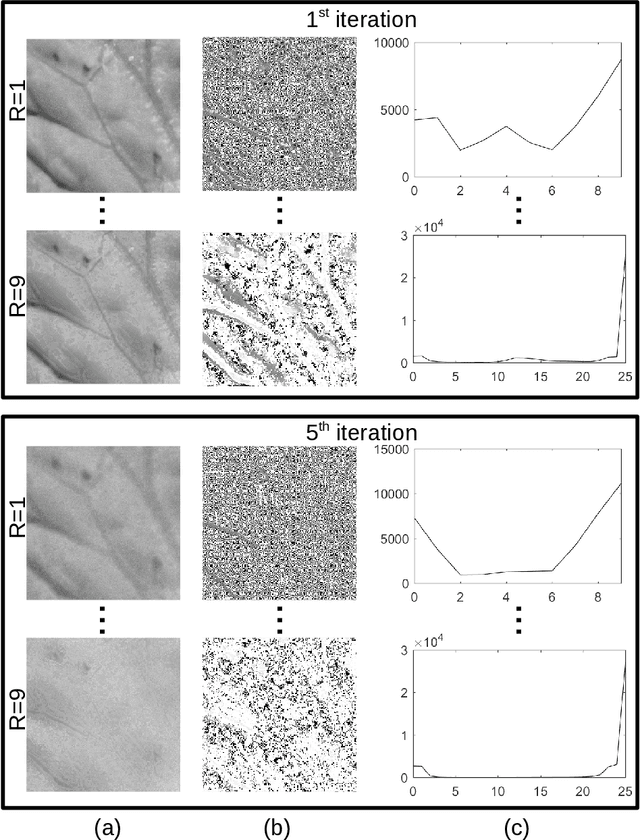
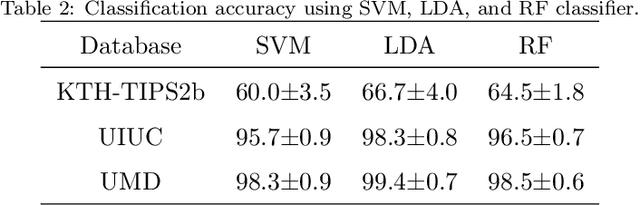
Texture recognition is one of the most important tasks in computer vision and, despite the recent success of learning-based approaches, there is still need for model-based solutions. This is especially the case when the amount of data available for training is not sufficiently large, a common situation in several applied areas, or when computational resources are limited. In this context, here we propose a method for texture descriptors that combines the representation power of complex objects by cellular automata with the known effectiveness of local descriptors in texture analysis. The method formulates a new transition function for the automaton inspired on local binary descriptors. It counterbalances the new state of each cell with the previous state, in this way introducing an idea of "controlled deterministic chaos". The descriptors are obtained from the distribution of cell states. The proposed descriptors are applied to the classification of texture images both on benchmark data sets and a real-world problem, i.e., that of identifying plant species based on the texture of their leaf surfaces. Our proposal outperforms other classical and state-of-the-art approaches, especially in the real-world problem, thus revealing its potential to be applied in numerous practical tasks involving texture recognition at some stage.
Reorganizing local image features with chaotic maps: an application to texture recognition
Jul 15, 2020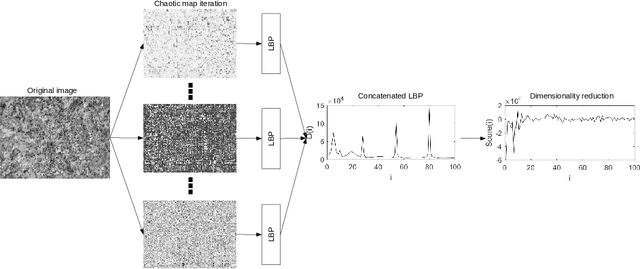
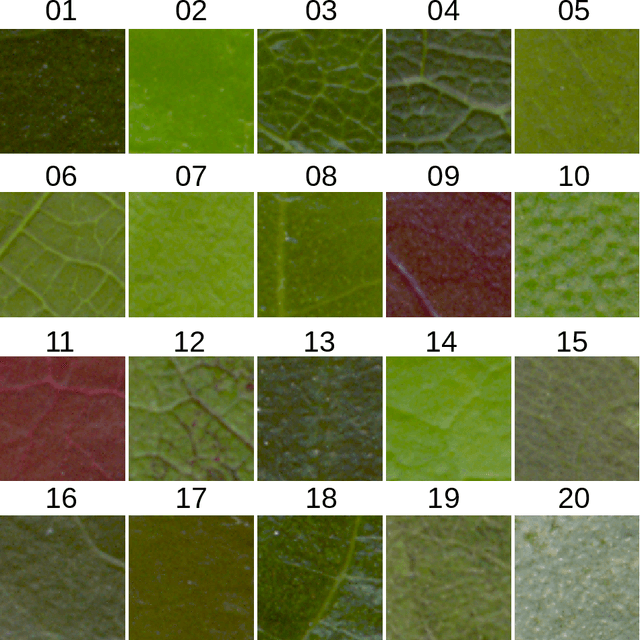
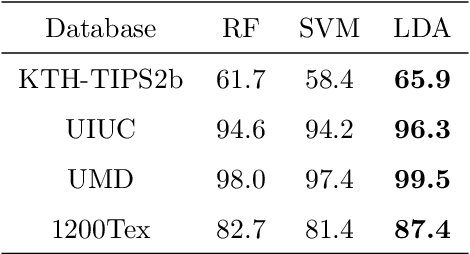
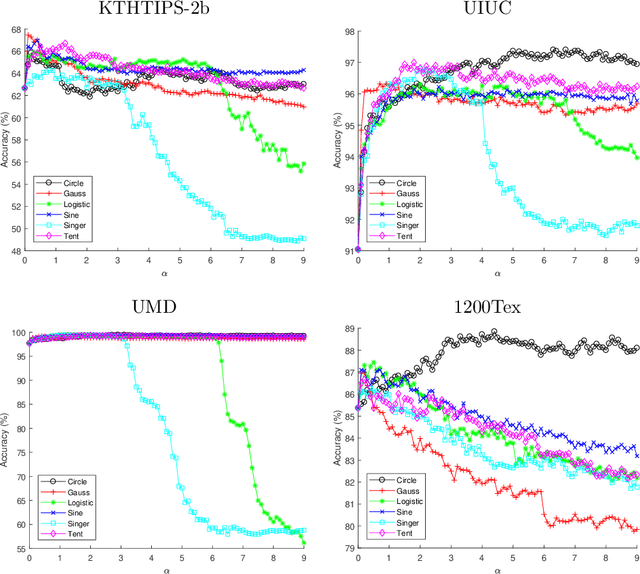
Despite the recent success of convolutional neural networks in texture recognition, model-based descriptors are still competitive, especially when we do not have access to large amounts of annotated data for training and the interpretation of the model is an important issue. Among the model-based approaches, fractal geometry has been one of the most popular, especially in biological applications. Nevertheless, fractals are part of a much broader family of models, which are the non-linear operators, studied in chaos theory. In this context, we propose here a chaos-based local descriptor for texture recognition. More specifically, we map the image into the three-dimensional Euclidean space, iterate a chaotic map over this three-dimensional structure and convert it back to the original image. From such chaos-transformed image at each iteration we collect local descriptors (here we use local binary patters) and those descriptors compose the feature representation of the texture. The performance of our method was verified on the classification of benchmark databases and in the identification of Brazilian plant species based on the texture of the leaf surface. The achieved results confirmed our expectation of a competitive performance, even when compared with some learning-based modern approaches in the literature.