 Add to Chrome
 Add to Firefox
 Add to Edge
Temporal Windows of Integration for Multisensory Wireless Systems as Enablers of Physical AI
Dec 10, 2025
Physical artificial intelligence (AI) refers to the AI that interacts with the physical world in real time. Similar to multisensory perception, Physical AI makes decisions based on multimodal updates from sensors and devices. Physical AI thus operates with a finite spatial footprint of its sensory tributaries. The multimodal updates traverse heterogeneous and unreliable paths, involving wireless links. Throughput or latency guarantees do not ensure correct decision-making, as misaligned, misordered, or stale inputs still yield wrong inferences. Preserving decision-time coherence hinges on three timing primitives at the network-application interface: (i) simultaneity, a short coincidence window that groups measurements as co-temporal, (ii) causality, path-wise delivery that never lets a consequence precede its precursor, and (iii) usefulness, a validity horizon that drops information too stale to influence the current action. In this work, we focus on usefulness and adopt temporal window of integration (TWI)-Causality: the TWI enforces decision-time usefulness by assuming path-wise causal consistency and cross-path simultaneity are handled upstream. We model end-to-end path delay as the sum of sensing/propagation, computation, and access/transmission latencies, and formulate network design as minimizing the validity horizon under a delivery reliability constraint. In effect, this calibrates delay-reliability budgets for a timing-aware system operating over sensors within a finite spatial footprint. The joint choice of horizon and per-path reliability is cast as a convex optimization problem, solved to global optimality to obtain the minimal horizon and per-path allocation of reliability. This is compared favourably to a benchmark based on uniform-after-threshold allocation. Overall, this study contributes to timing-aware Physical AI in next-generation networks.

Uplink Multiplexing of eMBB/URLLC Services Assisted by Reconfigurable Intelligent Surfaces
May 08, 2023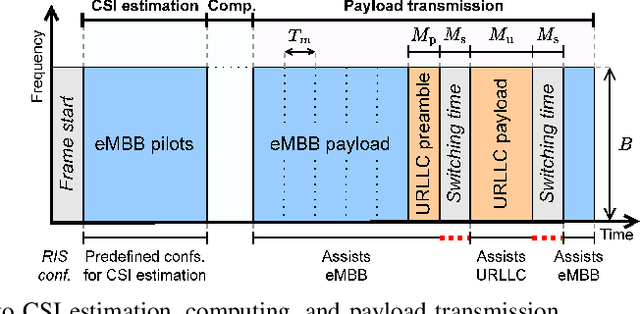
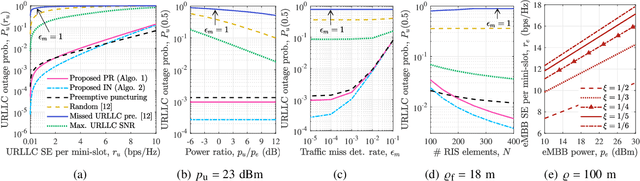
Reconfigurable intelligent surfaces (RISs) with their potential of enabling a programmable environment comprise a promising technology to support the coexistence of enhanced mobile broadband (eMBB) and ultra-reliable-low-latency communication (URLLC) services. In this paper, we propose a RIS-assisted scheme for multiplexing hybrid eMBB-URLLC uplink traffic. Specifically, the scheme relies on the computation of two RIS configurations, given that only eMBB channel state information (CSI) is available. The first configuration optimizes the eMBB quality of service, while the second one mitigates the eMBB interference in the URLLC traffic. Analyzing the outage probability achieved by the scheme, we demonstrate that a RIS can improve the reliability of URLLC transmissions even in the absence of URLLC CSI.
Randomized Control of Wireless Temporal Coherence via Reconfigurable Intelligent Surface
Jan 31, 2023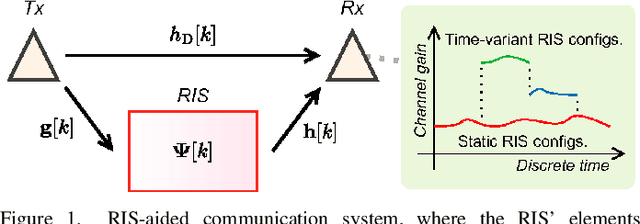
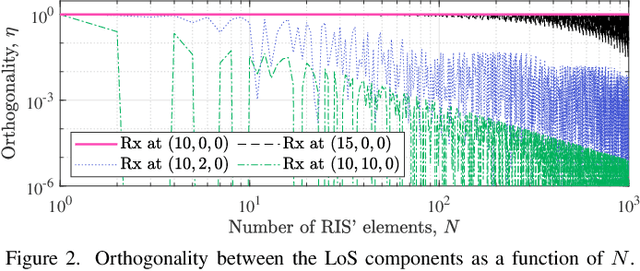
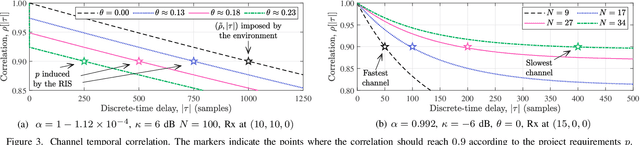
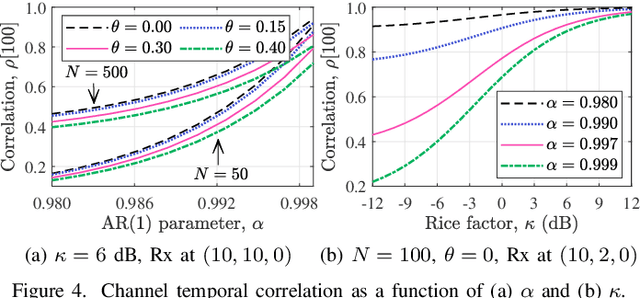
A reconfigurable intelligent surface (RIS) can shape the wireless propagation channel by inducing controlled phase shift variations to the impinging signals. Multiple works have considered the use of RIS by time-varying configurations of reflection coefficients. In this work we use the RIS to control the channel coherence time and introduce a generalized discrete-time-varying channel model for RIS-aided systems. We characterize the temporal variation of channel correlation by assuming that a configuration of RIS' elements changes at every time step. The analysis converges to a randomized framework to control the channel coherence time by setting the number of RIS' elements and their phase shifts. The main result is a framework for a flexible block-fading model, where the number of samples within a coherence block can be dynamically adapted.