 Add to Chrome
 Add to Firefox
 Add to Edge
Structured Masked Diffusion for Joint Multiuser Decoding
May 26, 2026
In joint multiuser decoding, a receiver recovers a set of messages from a single noisy aggregate of many simultaneous transmissions. Classical decoders rely on rule-based mechanisms such as successive interference cancellation, joint belief propagation, or list recovery, all of which become brittle or expensive as ambiguity increases. We propose CIDER, a learned multiuser decoder with masked-diffusion refinement steps. CIDER uses demixing to prevent duplicate-row collapse and uses parity-aware propagation to provide soft guidance from the code constraints. In higher-load regimes, we further improve reliability via a lightweight quality-guided remasking step that selectively re-decodes low-confidence sequences. On commonly used error-correcting codes, CIDER matches or improves on FFT-accelerated joint belief propagation-style decoding in symbol error rate while running more than $6\times$ to over $100\times$ faster, with the speedup widening as the blocklength grows. Code is available at https://github.com/jiyunyoung/CIDER.

Analog-Digital Beam Focusing for Line of Sight Wide-Aperture MIMO with Spherical Wavefronts
Apr 07, 2024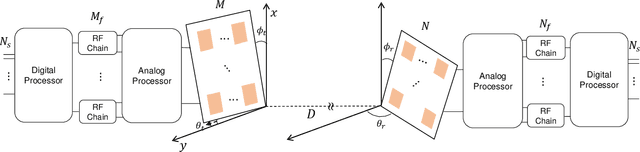
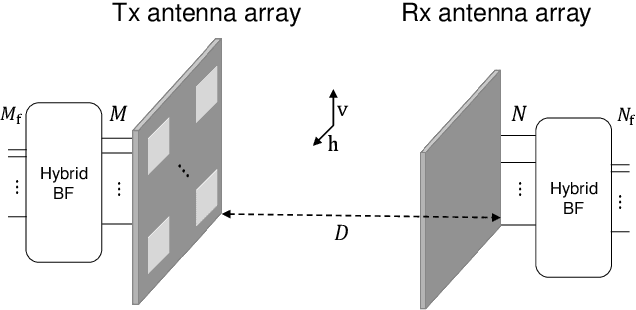
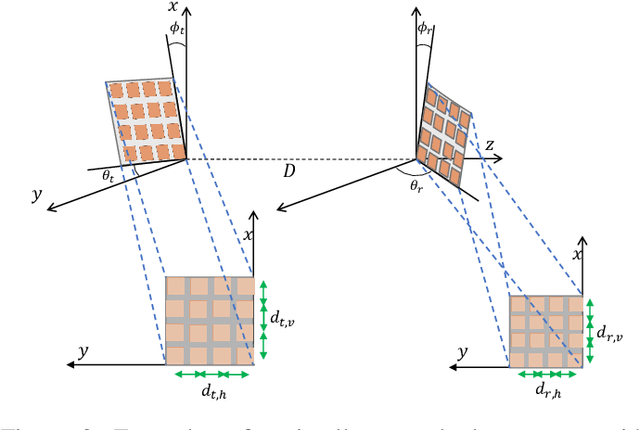
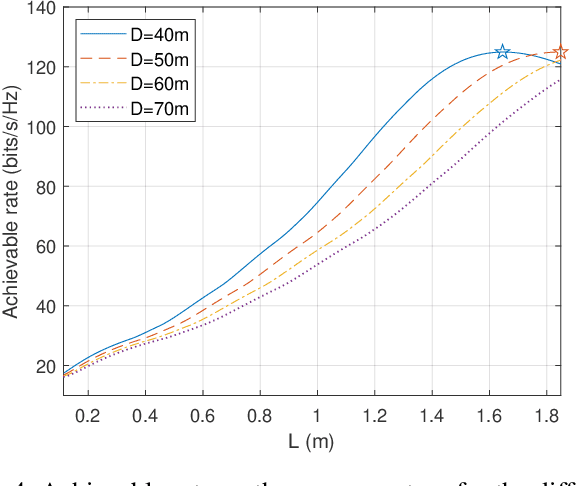
Enhancing high-speed wireless communication in the future relies significantly on harnessing high frequency bands effectively. These bands predominantly operate in line-of-sight (LoS) paths, necessitating well-configured antenna arrays and beamforming techniques for optimal spectrum utilization. Maximizing the potential of LoS multiple-input multiple-output (MIMO) systems, which are crucial for achieving high spectral efficiency, heavily depends on this. As the costs and power demands of mixed-signal devices in high frequency bands make a fully-digital architecture impractical for large-scale MIMO setups, our focus shifts to a hybrid analog-digital hardware configuration. Yet, analog processors' limitations restrict flexibility within arrays, necessitating a nuanced understanding of hardware constraints for optimal antenna configuration design. We explore array design that optimizes the spectral efficiency of hybrid systems, considering hardware constraints. We propose an optimal antenna configuration, leveraging the prolate matrix structure of the LoS channel between two planar arrays. Building on the optimal array configuration, we introduce a low-complexity explicit analog-digital beam focusing scheme that exploits the asymptotic behavior of the LoS channel matrix in the near-field region. Simulation results validate that the proposed antenna configuration and beam focusing scheme achieves near-optimal performance across a range of signal-to-noise ratios with low computational complexity, even under arbitrary rotations relative to the communication link.