 Add to Chrome
 Add to Firefox
 Add to Edge
GSO-SLAM: Bidirectionally Coupled Gaussian Splatting and Direct Visual Odometry
Feb 12, 2026
We propose GSO-SLAM, a real-time monocular dense SLAM system that leverages Gaussian scene representation. Unlike existing methods that couple tracking and mapping with a unified scene, incurring computational costs, or loosely integrate them with well-structured tracking frameworks, introducing redundancies, our method bidirectionally couples Visual Odometry (VO) and Gaussian Splatting (GS). Specifically, our approach formulates joint optimization within an Expectation-Maximization (EM) framework, enabling the simultaneous refinement of VO-derived semi-dense depth estimates and the GS representation without additional computational overhead. Moreover, we present Gaussian Splat Initialization, which utilizes image information, keyframe poses, and pixel associations from VO to produce close approximations to the final Gaussian scene, thereby eliminating the need for heuristic methods. Through extensive experiments, we validate the effectiveness of our method, showing that it not only operates in real time but also achieves state-of-the-art geometric/photometric fidelity of the reconstructed scene and tracking accuracy.

Efficient 3D Perception on Embedded Systems via Interpolation-Free Tri-Plane Lifting and Volume Fusion
Sep 18, 2025Dense 3D convolutions provide high accuracy for perception but are too computationally expensive for real-time robotic systems. Existing tri-plane methods rely on 2D image features with interpolation, point-wise queries, and implicit MLPs, which makes them computationally heavy and unsuitable for embedded 3D inference. As an alternative, we propose a novel interpolation-free tri-plane lifting and volumetric fusion framework, that directly projects 3D voxels into plane features and reconstructs a feature volume through broadcast and summation. This shifts nonlinearity to 2D convolutions, reducing complexity while remaining fully parallelizable. To capture global context, we add a low-resolution volumetric branch fused with the lifted features through a lightweight integration layer, yielding a design that is both efficient and end-to-end GPU-accelerated. To validate the effectiveness of the proposed method, we conduct experiments on classification, completion, segmentation, and detection, and we map the trade-off between efficiency and accuracy across tasks. Results show that classification and completion retain or improve accuracy, while segmentation and detection trade modest drops in accuracy for significant computational savings. On-device benchmarks on an NVIDIA Jetson Orin nano confirm robust real-time throughput, demonstrating the suitability of the approach for embedded robotic perception.
RGBD GS-ICP SLAM
Mar 22, 2024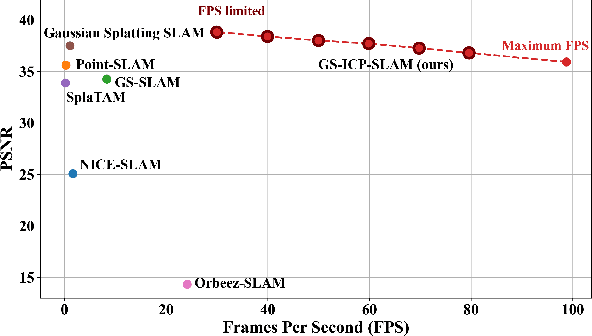

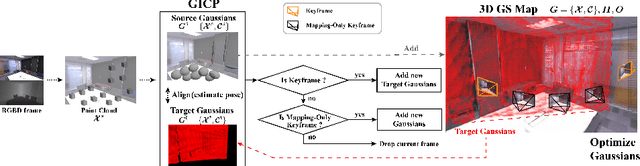
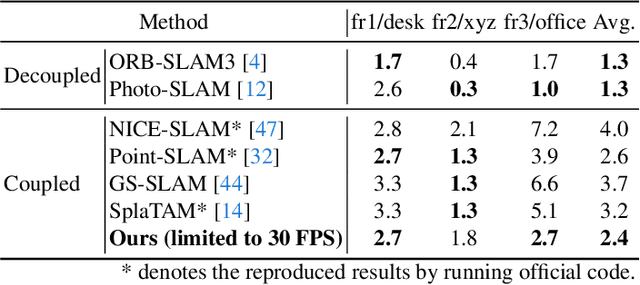
Simultaneous Localization and Mapping (SLAM) with dense representation plays a key role in robotics, Virtual Reality (VR), and Augmented Reality (AR) applications. Recent advancements in dense representation SLAM have highlighted the potential of leveraging neural scene representation and 3D Gaussian representation for high-fidelity spatial representation. In this paper, we propose a novel dense representation SLAM approach with a fusion of Generalized Iterative Closest Point (G-ICP) and 3D Gaussian Splatting (3DGS). In contrast to existing methods, we utilize a single Gaussian map for both tracking and mapping, resulting in mutual benefits. Through the exchange of covariances between tracking and mapping processes with scale alignment techniques, we minimize redundant computations and achieve an efficient system. Additionally, we enhance tracking accuracy and mapping quality through our keyframe selection methods. Experimental results demonstrate the effectiveness of our approach, showing an incredibly fast speed up to 107 FPS (for the entire system) and superior quality of the reconstructed map.