 Add to Chrome
 Add to Firefox
 Add to Edge
Overthinking Loops in Agents: A Structural Risk via MCP Tools
Feb 16, 2026
Tool-using LLM agents increasingly coordinate real workloads by selecting and chaining third-party tools based on text-visible metadata such as tool names, descriptions, and return messages. We show that this convenience creates a supply-chain attack surface: a malicious MCP tool server can be co-registered alongside normal tools and induce overthinking loops, where individually trivial or plausible tool calls compose into cyclic trajectories that inflate end-to-end tokens and latency without any single step looking abnormal. We formalize this as a structural overthinking attack, distinguishable from token-level verbosity, and implement 14 malicious tools across three servers that trigger repetition, forced refinement, and distraction. Across heterogeneous registries and multiple tool-capable models, the attack causes severe resource amplification (up to $142.4\times$ tokens) and can degrade task outcomes. Finally, we find that decoding-time concision controls do not reliably prevent loop induction, suggesting defenses should reason about tool-call structure rather than tokens alone.

Prompt Tuning for Natural Language to SQL with Embedding Fine-Tuning and RAG
Nov 11, 2025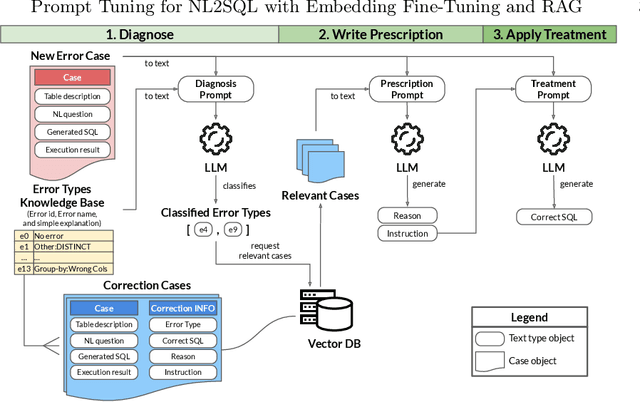
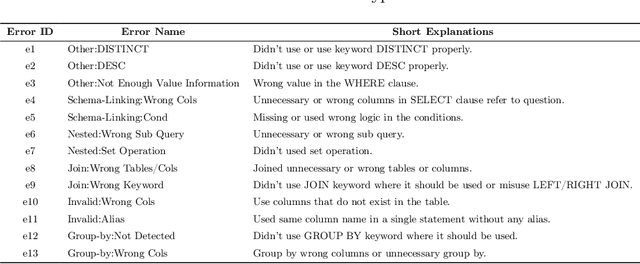
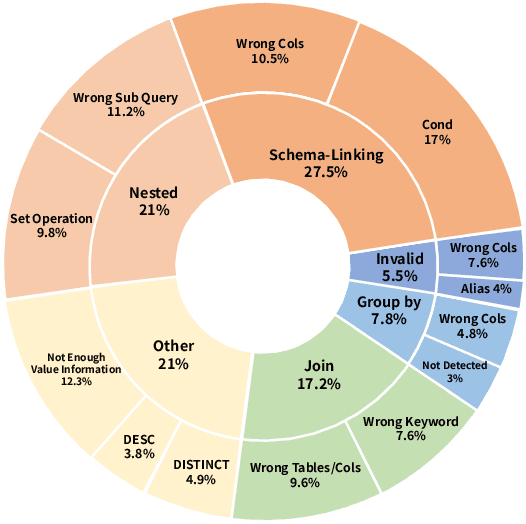
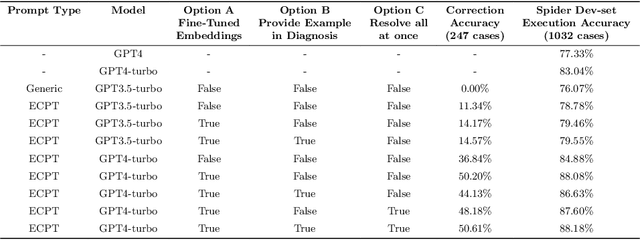
This paper introduces an Error Correction through Prompt Tuning for NL-to-SQL, leveraging the latest advancements in generative pre-training-based LLMs and RAG. Our work addresses the crucial need for efficient and accurate translation of natural language queries into SQL expressions in various settings with the growing use of natural language interfaces. We explore the evolution of NLIDBs from early rule-based systems to advanced neural network-driven approaches. Drawing inspiration from the medical diagnostic process, we propose a novel framework integrating an error correction mechanism that diagnoses error types, identifies their causes, provides fixing instructions, and applies these corrections to SQL queries. This approach is further enriched by embedding fine-tuning and RAG, which harnesses external knowledge bases for improved accuracy and transparency. Through comprehensive experiments, we demonstrate that our framework achieves a significant 12 percent accuracy improvement over existing baselines, highlighting its potential to revolutionize data access and handling in contemporary data-driven environments.