 Add to Chrome
 Add to Firefox
 Add to Edge
Adversarial Attacks on Online Handwriting using Salience-based Temporal Editing
Jul 14, 2026
Deep learning models for online handwriting recognition have been shown effective and are increasingly deployed in practical applications. However, their vulnerability to adversarial attacks is still a challenge. Existing adversarial methods are predominantly designed for image-based inputs and typically rely on additive spatial perturbations. When applied to online handwriting, which is inherently represented as a time series of pen trajectories, such perturbations often introduce high-frequency jitter and visibly unnatural stroke artifacts. In this work, we propose a novel adversarial attack framework for online handwriting recognition based on salience-guided temporal editing. Instead of adding noise, the proposed method generates adversarial examples by inserting and deleting points at time steps selected according to temporal salience, preserving the shape and smoothness of the original handwriting. Temporal salience is estimated using gradient-based activation mapping, which guides edits toward time steps that strongly support the original class prediction. We evaluate the proposed approach on the Unipen and CASIA-OLHWDB datasets under both white-box and one-shot black-box attack settings. Experimental results demonstrate that while conventional image-based attacks achieve strong white-box performance, they exhibit poor transferability across models. In contrast, the proposed temporal editing attack achieves stronger one-shot black-box transferability while preserving the visual structure of the handwriting. These results indicate that temporal editing is a relevant threat model for online handwriting recognition, particularly in one-shot black-box transfer settings.

Model Selection with a Shapelet-based Distance Measure for Multi-source Transfer Learning in Time Series Classification
Sep 30, 2024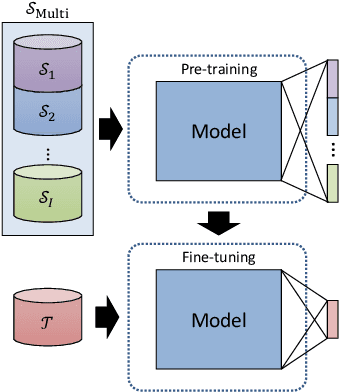
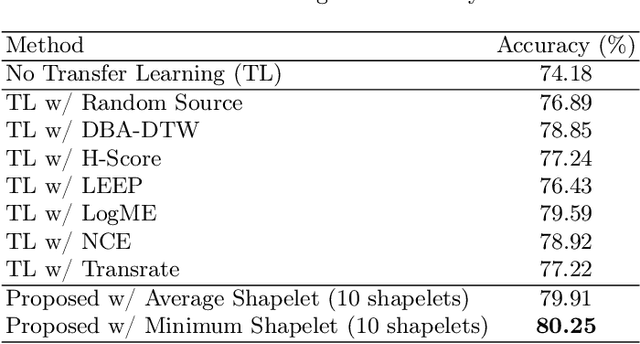
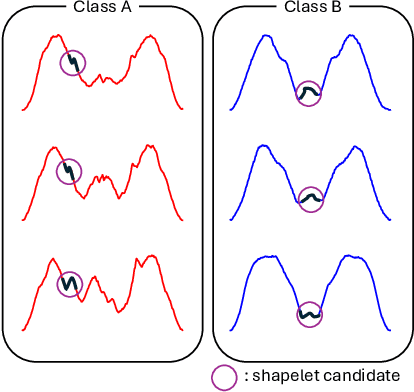
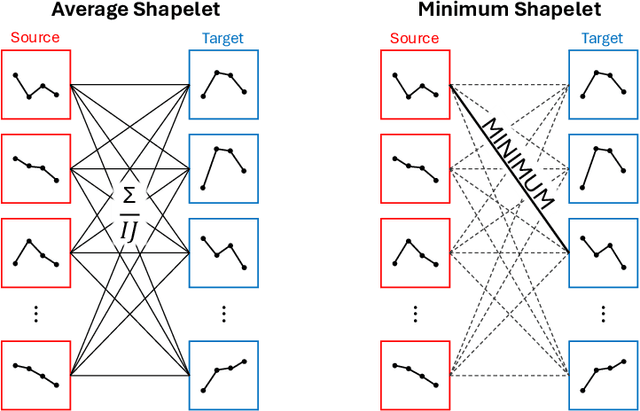
Transfer learning is a common practice that alleviates the need for extensive data to train neural networks. It is performed by pre-training a model using a source dataset and fine-tuning it for a target task. However, not every source dataset is appropriate for each target dataset, especially for time series. In this paper, we propose a novel method of selecting and using multiple datasets for transfer learning for time series classification. Specifically, our method combines multiple datasets as one source dataset for pre-training neural networks. Furthermore, for selecting multiple sources, our method measures the transferability of datasets based on shapelet discovery for effective source selection. While traditional transferability measures require considerable time for pre-training all the possible sources for source selection of each possible architecture, our method can be repeatedly used for every possible architecture with a single simple computation. Using the proposed method, we demonstrate that it is possible to increase the performance of temporal convolutional neural networks (CNN) on time series datasets.