 Add to Chrome
 Add to Firefox
 Add to Edge
Task-Oriented Formation Decision via Reinforcement Learning: Herding an Attacking Swarm
Aug 10, 2026
Multi-robot systems can accomplish tasks that are difficult for a single robot by organizing into task-specific formations. Different from existing studies on multi-robot shape formation, we here study the task-oriented formation decision problem, with a focus on the herding task. This task is challenging due to the attackers' superior maneuverability and their unknown strategies. To address these challenges, we propose the following novel results. First, we encode the formation shape using a low-dimensional parameter vector. This parametric representation reformulates the formation decision as a parameter optimization problem, thereby resolving the limited flexibility of predefined shapes. By optimizing these formation parameters, the defenders' maneuverability disadvantage is mitigated through a formation shape that continuously adapts to task requirements. Second, we develop a reinforcement learning-based policy to regulate the formation parameters. Trained offline in simulations covering diverse attacking strategies, the learned policy can effectively handle adversarial unpredictability during online deployment. Comparative simulations against three baselines demonstrate that our method can successfully accomplish challenging herding tasks. Additional scalability simulations further verify its applicability to simulated scenarios involving dozens of robots. We also validate the practical feasibility of our method on a physical robotic platform with 3 attackers and 7 defenders.

Multi-Robot Pursuit in Parameterized Formation via Imitation Learning
Oct 31, 2024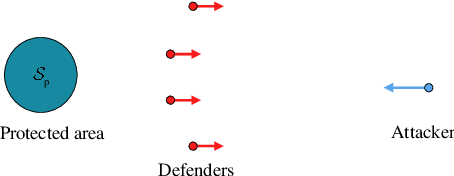
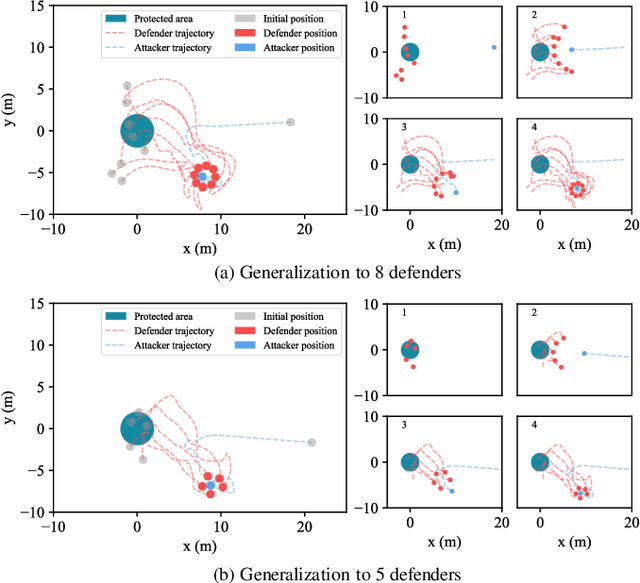
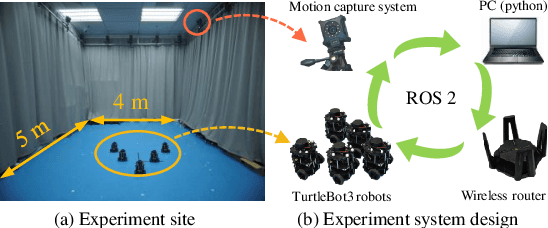
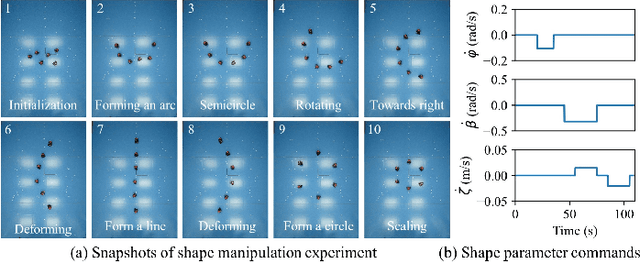
This paper studies the problem of multi-robot pursuit of how to coordinate a group of defending robots to capture a faster attacker before it enters a protected area. Such operation for defending robots is challenging due to the unknown avoidance strategy and higher speed of the attacker, coupled with the limited communication capabilities of defenders. To solve this problem, we propose a parameterized formation controller that allows defending robots to adapt their formation shape using five adjustable parameters. Moreover, we develop an imitation-learning based approach integrated with model predictive control to optimize these shape parameters. We make full use of these two techniques to enhance the capture capabilities of defending robots through ongoing training. Both simulation and experiment are provided to verify the effectiveness and robustness of our proposed controller. Simulation results show that defending robots can rapidly learn an effective strategy for capturing the attacker, and moreover the learned strategy remains effective across varying numbers of defenders. Experiment results on real robot platforms further validated these findings.