 Add to Chrome
 Add to Firefox
 Add to Edge
Learning Emotion-discriminative Representations for Zero-Shot Cross-lingual Speech Emotion Recognition
Jun 04, 2026
Zero-shot cross-lingual speech emotion recognition (SER) remains challenging due to distribution mismatches across languages and the lack of emotion annotations in target language. Under such conditions, models trained solely on source-language data frequently suffer from degraded generalization when evaluated on unseen target languages. To address this limitation, we propose an emotion-discriminative representation learning method that integrates supervised contrastive learning and speaker adversarial learning. The contrastive learning promotes cross-lingual emotion alignment, while speaker adversarial learning suppresses speaker-related cues to encourage speaker-invariant representations. Experimental results under a zero-shot cross-lingual SER setting demonstrate that the proposed method significantly improves SER performance over conventional training strategies.

Advancing Electrolaryngeal Speech Enhancement Through Speech-Text Representation Learning
Jun 01, 2026Objective: laryngectomees depend on an electromechanical device to generate electrolaryngeal (EL) speech. Compared with normal speech, EL speech suffers from severe distortion, limited phonetic variation, unnatural prosody, and temporal shifts, degrading naturalness and intelligibility. Although sequence-to-sequence (seq2seq) voice conversion (VC) based EL-speech-to-normal-speech conversion (EL2SP) is promising, substantial mismatches between EL and normal speech inevitably cause cumulative mapping errors that limit performance. To address this, we describe a novel representation learning framework integrating speech and text representations to improve mapping and reconstruction quality within a seq2seq VC model. Methods: our methodology comprises two main stages: 1) representation integration and learning, and 2) reconstruction training. A network capable of incorporating auxiliary text information is first constructed with pretrained modules to learn speech--text-based integrated representations. Then, an autoencoder-style reconstruction strategy finalizes EL2SP model to inherit these representations without increasing model complexity. We introduce three fusion strategies including middle-, input-, and hybrid-level fusion strategies that progressively enhance learning. Moreover, besides standard seq2seq VC objectives, an additional reconstruction loss on the integrated representation is introduced to refine representation transfer. Results: experiments under different EL2SP datasets consistently demonstrate that our methods, combined with data augmentations, outperform baselines relying solely on speech representations. Furthermore, progressive improvements with system design depth validate the effectiveness of our methods. Significance: the proposed methods provide an extensible and practical methodology for EL speech enhancement and assistive communication technologies.
* 15 pages, 7 figures. Accepted to IEEE TBME
Improved Architecture for High-resolution Piano Transcription to Efficiently Capture Acoustic Characteristics of Music Signals
Sep 29, 2024Automatic music transcription (AMT), aiming to convert musical signals into musical notation, is one of the important tasks in music information retrieval. Recently, previous works have applied high-resolution labels, i.e., the continuous onset and offset times of piano notes, as training targets, achieving substantial improvements in transcription performance. However, there still remain some issues to be addressed, e.g., the harmonics of notes are sometimes recognized as false positive notes, and the size of AMT model tends to be larger to improve the transcription performance. To address these issues, we propose an improved high-resolution piano transcription model to well capture specific acoustic characteristics of music signals. First, we employ the Constant-Q Transform as the input representation to better adapt to musical signals. Moreover, we have designed two architectures: the first is based on a convolutional recurrent neural network (CRNN) with dilated convolution, and the second is an encoder-decoder architecture that combines CRNN with a non-autoregressive Transformer decoder. We conduct systematic experiments for our models. Compared to the high-resolution AMT system used as a baseline, our models effectively achieve 1) consistent improvement in note-level metrics, and 2) the significant smaller model size, which shed lights on future work.
Two-stage Framework for Robust Speech Emotion Recognition Using Target Speaker Extraction in Human Speech Noise Conditions
Sep 29, 2024

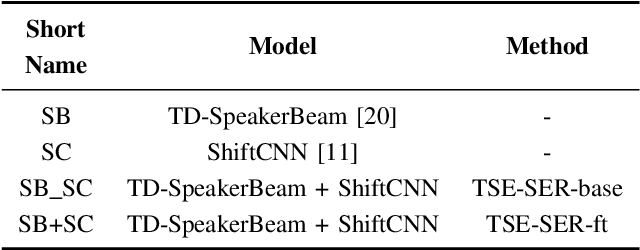

Developing a robust speech emotion recognition (SER) system in noisy conditions faces challenges posed by different noise properties. Most previous studies have not considered the impact of human speech noise, thus limiting the application scope of SER. In this paper, we propose a novel two-stage framework for the problem by cascading target speaker extraction (TSE) method and SER. We first train a TSE model to extract the speech of target speaker from a mixture. Then, in the second stage, we utilize the extracted speech for SER training. Additionally, we explore a joint training of TSE and SER models in the second stage. Our developed system achieves a 14.33% improvement in unweighted accuracy (UA) compared to a baseline without using TSE method, demonstrating the effectiveness of our framework in mitigating the impact of human speech noise. Moreover, we conduct experiments considering speaker gender, showing that our framework performs particularly well in different-gender mixture.