 Add to Chrome
 Add to Firefox
 Add to Edge
Shortcut Features as Top Eigenfunctions of NTK: A Linear Neural Network Case and More
Feb 03, 2026
One of the chronic problems of deep-learning models is shortcut learning. In a case where the majority of training data are dominated by a certain feature, neural networks prefer to learn such a feature even if the feature is not generalizable outside the training set. Based on the framework of Neural Tangent Kernel (NTK), we analyzed the case of linear neural networks to derive some important properties of shortcut learning. We defined a feature of a neural network as an eigenfunction of NTK. Then, we found that shortcut features correspond to features with larger eigenvalues when the shortcuts stem from the imbalanced number of samples in the clustered distribution. We also showed that the features with larger eigenvalues still have a large influence on the neural network output even after training, due to data variances in the clusters. Such a preference for certain features remains even when a margin of a neural network output is controlled, which shows that the max-margin bias is not the only major reason for shortcut learning. These properties of linear neural networks are empirically extended for more complex neural networks as a two-layer fully-connected ReLU network and a ResNet-18.

Convergence Analysis of Federated Learning Methods Using Backward Error Analysis
Mar 05, 2025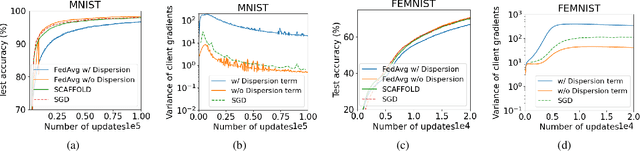
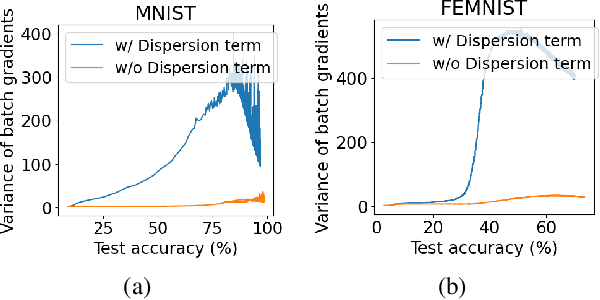
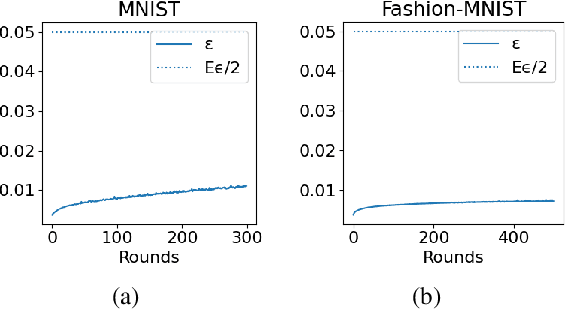
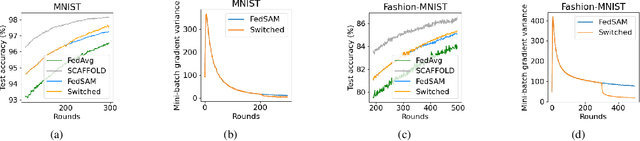
Backward error analysis allows finding a modified loss function, which the parameter updates really follow under the influence of an optimization method. The additional loss terms included in this modified function is called implicit regularizer. In this paper, we attempt to find the implicit regularizer for various federated learning algorithms on non-IID data distribution, and explain why each method shows different convergence behavior. We first show that the implicit regularizer of FedAvg disperses the gradient of each client from the average gradient, thus increasing the gradient variance. We also empirically show that the implicit regularizer hampers its convergence. Similarly, we compute the implicit regularizers of FedSAM and SCAFFOLD, and explain why they converge better. While existing convergence analyses focus on pointing out the advantages of FedSAM and SCAFFOLD, our approach can explain their limitations in complex non-convex settings. In specific, we demonstrate that FedSAM can partially remove the bias in the first-order term of the implicit regularizer in FedAvg, whereas SCAFFOLD can fully eliminate the bias in the first-order term, but not in the second-order term. Consequently, the implicit regularizer can provide a useful insight on the convergence behavior of federated learning from a different theoretical perspective.