 Add to Chrome
 Add to Firefox
 Add to Edge
ConlangBench: Exploring Language Knowledge and Learning in LLMs through Diverse Constructed Languages
Aug 05, 2026
Constructed languages (conlangs) are intentionally created human languages with a rich tradition of linguistic creativity. Despite their potential for studying language learning in large language models (LLMs), existing conlangs remain largely underexplored in LLM research. We present ConlangBench, the first large-scale benchmark for evaluating and training LLMs on 21 existing conlangs. We collect over 21M conlang-English parallel sentence pairs (including 430K pairs across the 20 non-Esperanto conlangs) and 321K vocabulary entries. In bidirectional translation experiments, we find that models perform better on a posteriori conlangs, whose vocabularies are derived from natural languages, reflecting the design characteristics of conlangs. Training on ConlangBench also shows that models can learn all eight conlangs for which sufficient parallel corpora are available, while their learning curves vary depending on how the conlangs were created. Our findings suggest that conlangs provide a unique testbed for investigating how LLMs acquire low-resource languages.

Right at My Level: A Unified Multilingual Framework for Proficiency-Aware Text Simplification
Apr 07, 2026Text simplification supports second language (L2) learning by providing comprehensible input, consistent with the Input Hypothesis. However, constructing personalized parallel corpora is costly, while existing large language model (LLM)-based readability control methods rely on pre-labeled sentence corpora and primarily target English. We propose Re-RIGHT, a unified reinforcement learning framework for adaptive multilingual text simplification without parallel corpus supervision. We first show that prompting-based lexical simplification at target proficiency levels (CEFR, JLPT, TOPIK, and HSK) performs poorly at easier levels and for non-English languages, even with state-of-the-art LLMs such as GPT-5.2 and Gemini 2.5. To address this, we collect 43K vocabulary-level data across four languages (English, Japanese, Korean, and Chinese) and train a compact 4B policy model using Re-RIGHT, which integrates three reward modules: vocabulary coverage, semantic preservation, and coherence. Compared to the stronger LLM baselines, Re-RIGHT achieves higher lexical coverage at target proficiency levels while maintaining original meaning and fluency.
Do Language Models Associate Sound with Meaning? A Multimodal Study of Sound Symbolism
Nov 16, 2025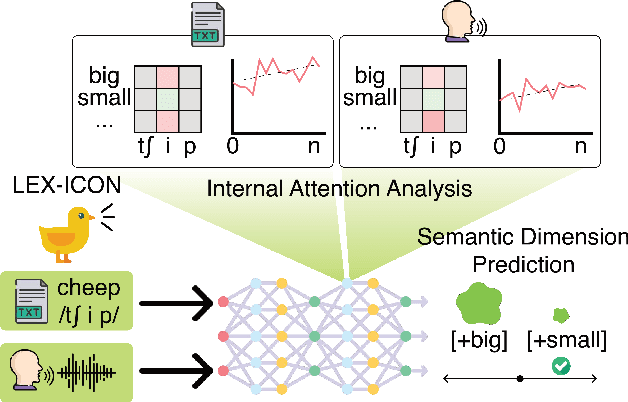

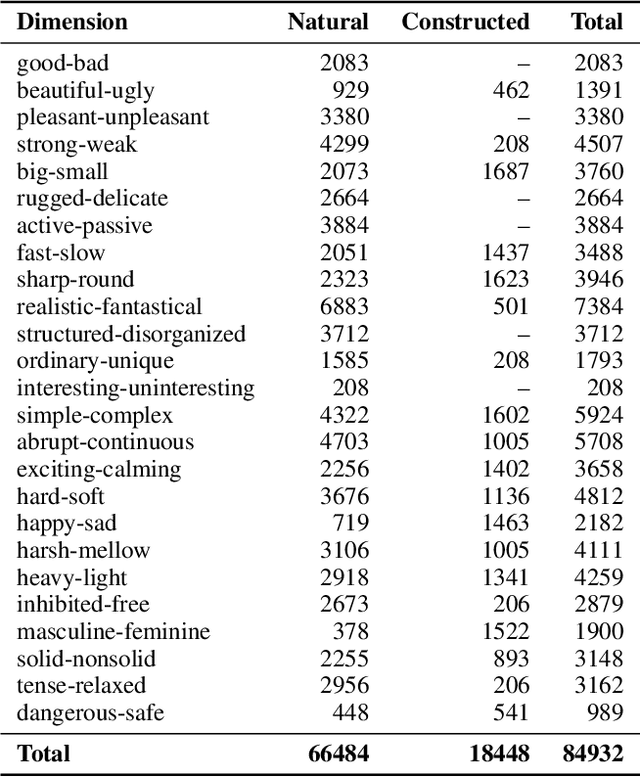
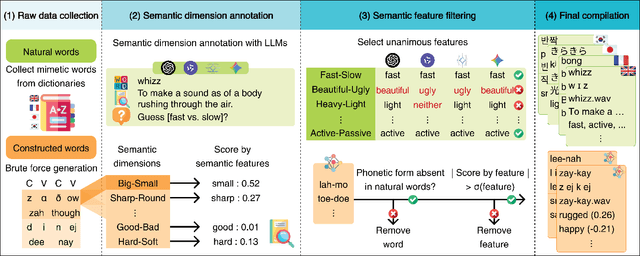
Sound symbolism is a linguistic concept that refers to non-arbitrary associations between phonetic forms and their meanings. We suggest that this can be a compelling probe into how Multimodal Large Language Models (MLLMs) interpret auditory information in human languages. We investigate MLLMs' performance on phonetic iconicity across textual (orthographic and IPA) and auditory forms of inputs with up to 25 semantic dimensions (e.g., sharp vs. round), observing models' layer-wise information processing by measuring phoneme-level attention fraction scores. To this end, we present LEX-ICON, an extensive mimetic word dataset consisting of 8,052 words from four natural languages (English, French, Japanese, and Korean) and 2,930 systematically constructed pseudo-words, annotated with semantic features applied across both text and audio modalities. Our key findings demonstrate (1) MLLMs' phonetic intuitions that align with existing linguistic research across multiple semantic dimensions and (2) phonosemantic attention patterns that highlight models' focus on iconic phonemes. These results bridge domains of artificial intelligence and cognitive linguistics, providing the first large-scale, quantitative analyses of phonetic iconicity in terms of MLLMs' interpretability.