 Add to Chrome
 Add to Firefox
 Add to Edge
ConAlign: Conditional Alignment Framework for Balancing Biased and Unbiased Recommendation
Jul 27, 2026
Industry recommender systems trained on observational data suffer from various biases that create filter bubbles, causing user interests to collapse into narrow categories and severely degrading long-term engagement. While utilizing unbiased uniform data for debiasing has shown promise, existing methods remain impractical for industrial deployment due to limitations such as neglect of factual (biased) recommendation performance and the substantial computational overhead. To overcome these limitations, we propose ConAlign (Conditional Alignment Framework), a conditional debiasing approach for industrial deployment. The key innovation of ConAlign lies in a discrete gating-based conditional alignment mechanism that selectively transfers knowledge from the biased tower to the unbiased tower. Following a selective intervention paradigm rather than universal correction, it seamlessly balances factual accuracy and unbiased preference estimation while supporting real-time streaming adaptation. To the best of our knowledge, ConAlign is the first streaming debiasing recommendation framework successfully deployed in a large-scale industrial recommendation system that utilizes a small fraction of unbiased random traffic for debiasing. Extensive offline experiments on three real-world datasets rigorously validate the effectiveness of our proposed framework. Furthermore, large-scale online A/B testing on Kuaishou demonstrates significant improvements in long-term user engagement and interest diversity, with negligible latency overhead.

Neural Network Structure Design based on N-Gauss Activation Function
Jun 01, 2021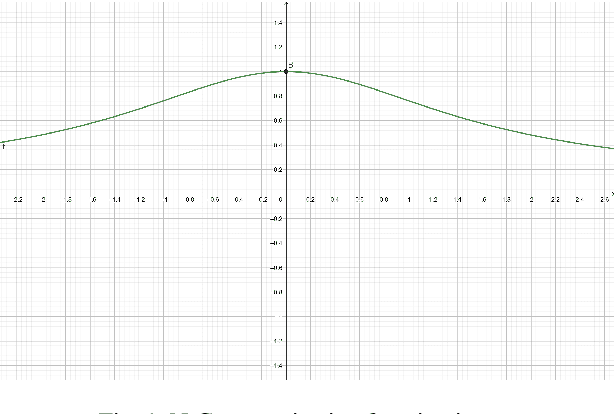
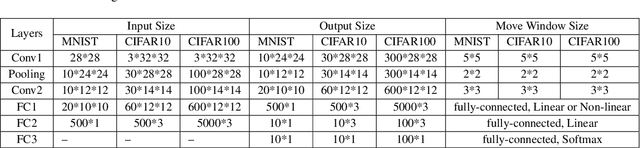

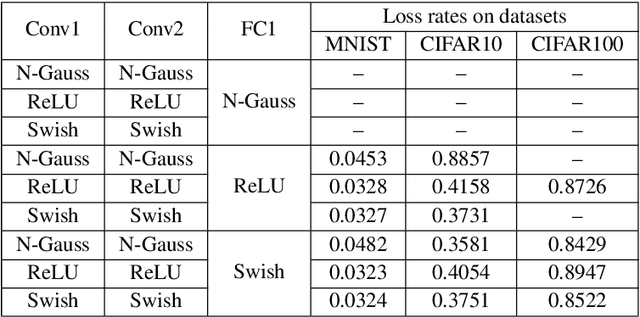
Recent work has shown that the activation function of the convolutional neural network can meet the Lipschitz condition, then the corresponding convolutional neural network structure can be constructed according to the scale of the data set, and the data set can be trained more deeply, more accurately and more effectively. In this article, we have accepted the experimental results and introduced the core block N-Gauss, N-Gauss, and Swish (Conv1, Conv2, FC1) neural network structure design to train MNIST, CIFAR10, and CIFAR100 respectively. Experiments show that N-Gauss gives full play to the main role of nonlinear modeling of activation functions, so that deep convolutional neural networks have hierarchical nonlinear mapping learning capabilities. At the same time, the training ability of N-Gauss on simple one-dimensional channel small data sets is equivalent to the performance of ReLU and Swish.