 Add to Chrome
 Add to Firefox
 Add to Edge
Shape-of-You: Fused Gromov-Wasserstein Optimal Transport for Semantic Correspondence in-the-Wild
Mar 12, 2026
Semantic correspondence is essential for handling diverse in-the-wild images lacking explicit correspondence annotations. While recent 2D foundation models offer powerful features, adapting them for unsupervised learning via nearest-neighbor pseudo-labels has key limitations: it operates locally, ignoring structural relationships, and consequently its reliance on 2D appearance fails to resolve geometric ambiguities arising from symmetries or repetitive features. In this work, we address this by reformulating pseudo-label generation as a Fused Gromov-Wasserstein (FGW) problem, which jointly optimizes inter-feature similarity and intra-structural consistency. Our framework, Shape-of-You (SoY), leverages a 3D foundation model to define this intra-structure in the geometric space, resolving abovementioned ambiguity. However, since FGW is a computationally prohibitive quadratic problem, we approximate it through anchor-based linearization. The resulting probabilistic transport plan provides a structurally consistent but noisy supervisory signal. Thus, we introduce a soft-target loss dynamically blending guidance from this plan with network predictions to build a learning framework robust to this noise. SoY achieves state-of-the-art performance on SPair-71k and AP-10k datasets, establishing a new benchmark in semantic correspondence without explicit geometric annotations. Code is available at Shape-of-You.

FUN-AD: Fully Unsupervised Learning for Anomaly Detection with Noisy Training Data
Nov 25, 2024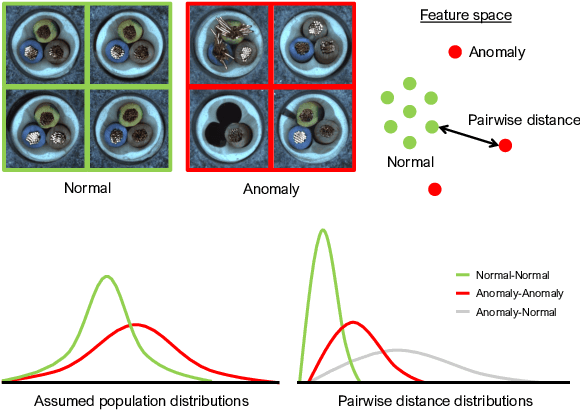


While the mainstream research in anomaly detection has mainly followed the one-class classification, practical industrial environments often incur noisy training data due to annotation errors or lack of labels for new or refurbished products. To address these issues, we propose a novel learning-based approach for fully unsupervised anomaly detection with unlabeled and potentially contaminated training data. Our method is motivated by two observations, that i) the pairwise feature distances between the normal samples are on average likely to be smaller than those between the anomaly samples or heterogeneous samples and ii) pairs of features mutually closest to each other are likely to be homogeneous pairs, which hold if the normal data has smaller variance than the anomaly data. Building on the first observation that nearest-neighbor distances can distinguish between confident normal samples and anomalies, we propose a pseudo-labeling strategy using an iteratively reconstructed memory bank (IRMB). The second observation is utilized as a new loss function to promote class-homogeneity between mutually closest pairs thereby reducing the ill-posedness of the task. Experimental results on two public industrial anomaly benchmarks and semantic anomaly examples validate the effectiveness of FUN-AD across different scenarios and anomaly-to-normal ratios. Our code is available at https://github.com/HY-Vision-Lab/FUNAD.