 Add to Chrome
 Add to Firefox
 Add to Edge
Empirical Likelihood with Generative AI
May 29, 2026
Moment conditions are widely used to identify parameters in models where the full likelihood is either unknown or intentionally left unspecified. Empirical likelihood methods address this problem by assigning probability weights to the observed data so that the sample moment conditions hold exactly. Building on this idea, we propose a nonparametric Bayesian framework based on exponentially tilted empirical likelihood. This Bayesian formulation is particularly appealing in settings where prior information is more naturally specified on the observables rather than on the underlying parameters. Such settings arise in the presence of auxiliary data sources or synthetic data generated by modern generative AI models.Inference proceeds by projecting posterior draws from a Dirichlet process onto the moment-restricted model, yielding a computationally efficient procedure that is naturally amenable to parallelization. We establish new Bernstein--von Mises and consistency theorems for the resulting projection posterior under both vanishing-prior and persistent-prior regimes. In an application to return prediction using overnight news headlines, we show that AI-generated auxiliary data can provide a useful source of indirect regularization when informative priors on the parameter itself are unavailable.

Dynamic Treatment on Networks
May 07, 2026In networks, effective dynamic treatment allocation requires deciding both whom to treat and also when, so as to amplify policy impact through spillovers. An early intervention at a well-connected node can trigger cascades that change which nodes are worth targeting in the next period. Existing treatment strategies under network interference are largely static while dynamic treatment frameworks typically ignore network structure altogether. We integrate these perspectives and propose Q-Ising, a three-stage pipeline that (i) estimates network adoption dynamics via a Bayesian dynamic Ising model from a single observed panel, (ii) augments treatment adoption histories with continuous posterior latent states, and (iii) learns a dynamic policy via offline reinforcement learning. The Bayesian mechanism enables uncertainty quantification over dynamic decisions, yielding posterior ensemble policies with interpretable spillover estimates. We provide a finite-sample regret upper bound that decomposes into standard offline-RL uncertainty, network abstraction error, and first stage error in Ising state estimation. We apply our method to data from Indian village microfinance networks and synthetic stochastic block models under simulated heterogeneous susceptible-infected-susceptible (SIS) dynamics and demonstrate that adaptive targeting outperforms static centrality benchmarks.
Robust Bayesian Optimization via Tempered Posteriors
Jan 11, 2026Bayesian optimization (BO) iteratively fits a Gaussian process (GP) surrogate to accumulated evaluations and selects new queries via an acquisition function such as expected improvement (EI). In practice, BO often concentrates evaluations near the current incumbent, causing the surrogate to become overconfident and to understate predictive uncertainty in the region guiding subsequent decisions. We develop a robust GP-based BO via tempered posterior updates, which downweight the likelihood by a power $α\in (0,1]$ to mitigate overconfidence under local misspecification. We establish cumulative regret bounds for tempered BO under a family of generalized improvement rules, including EI, and show that tempering yields strictly sharper worst-case regret guarantees than the standard posterior $(α=1)$, with the most favorable guarantees occurring near the classical EI choice. Motivated by our theoretic findings, we propose a prequential procedure for selecting $α$ online: it decreases $α$ when realized prediction errors exceed model-implied uncertainty and returns $α$ toward one as calibration improves. Empirical results demonstrate that tempering provides a practical yet theoretically grounded tool for stabilizing BO surrogates under localized sampling.
Sparse Bayesian Multidimensional Item Response Theory
Oct 26, 2023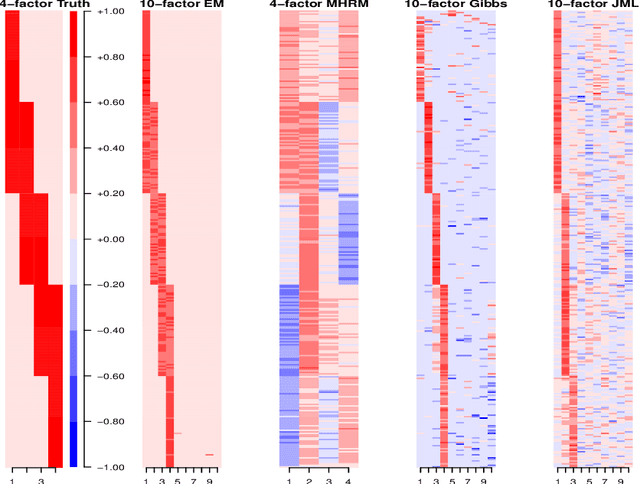
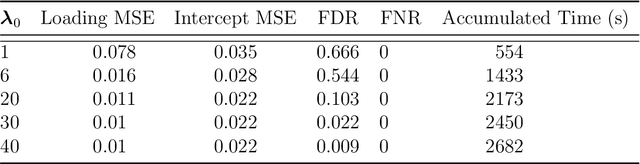
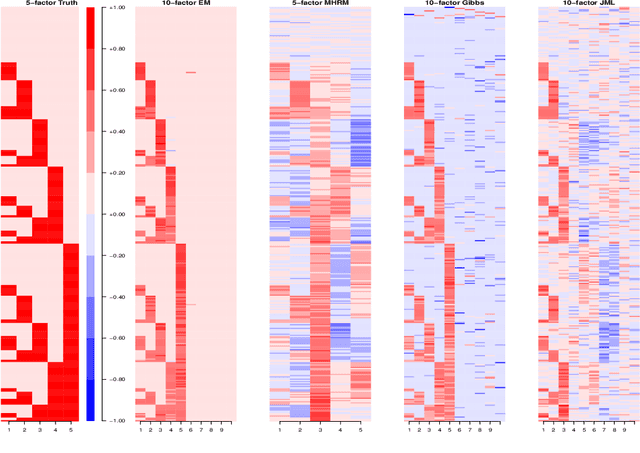
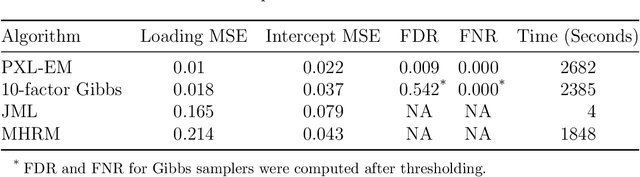
Multivariate Item Response Theory (MIRT) is sought-after widely by applied researchers looking for interpretable (sparse) explanations underlying response patterns in questionnaire data. There is, however, an unmet demand for such sparsity discovery tools in practice. Our paper develops a Bayesian platform for binary and ordinal item MIRT which requires minimal tuning and scales well on relatively large datasets due to its parallelizable features. Bayesian methodology for MIRT models has traditionally relied on MCMC simulation, which cannot only be slow in practice, but also often renders exact sparsity recovery impossible without additional thresholding. In this work, we develop a scalable Bayesian EM algorithm to estimate sparse factor loadings from binary and ordinal item responses. We address the seemingly insurmountable problem of unknown latent factor dimensionality with tools from Bayesian nonparametrics which enable estimating the number of factors. Rotations to sparsity through parameter expansion further enhance convergence and interpretability without identifiability constraints. In our simulation study, we show that our method reliably recovers both the factor dimensionality as well as the latent structure on high-dimensional synthetic data even for small samples. We demonstrate the practical usefulness of our approach on two datasets: an educational item response dataset and a quality-of-life measurement dataset. Both demonstrations show that our tool yields interpretable estimates, facilitating interesting discoveries that might otherwise go unnoticed under a pure confirmatory factor analysis setting. We provide an easy-to-use software which is a useful new addition to the MIRT toolkit and which will hopefully serve as the go-to method for practitioners.