 Add to Chrome
 Add to Firefox
 Add to Edge
Reducing Bias and Variance: Generative Semantic Guidance and Bi-Layer Ensemble for Image Clustering
May 13, 2026
Image clustering aims to partition unlabeled image datasets into distinct groups. A core aspect of this task is constructing and leveraging prior knowledge to guide the clustering process. Recent approaches introduce semantic descriptions as prior information, most of which typically relying on matching-based techniques with predefined vocabularies. However, the limited matching space restricts their adaptability to downstream clustering tasks. Moreover, these methods primarily focus on reducing bias to improve performance, frequently overlooking the importance of variance reduction. To address these limitations, we propose GSEC (Image Clustering based on Generative Semantic Guidance and Bi-Layer Ensemble), a framework designed to reduce bias through generative semantic guidance and mitigate variance via ensemble learning. Our method employs Multimodal Large Language Models to generate semantic descriptions and derive image embeddings via weighted averaging. Additionally, a bi-layer ensemble strategy integrates cross-modal information through BatchEnsemble in the inner layer and aligns outputs via an alignment mechanism in the outer layer. Comparative experiments demonstrate that GSEC outperforms 18 state-of-the-art methods across six benchmark datasets, while further analysis confirms its effectiveness in simultaneously reducing both bias and variance. The code is available at https://github.com/2017LI/GSEC.git.

Beyond MSE: Ordinal Cross-Entropy for Probabilistic Time Series Forecasting
Nov 13, 2025Time series forecasting is an important task that involves analyzing temporal dependencies and underlying patterns (such as trends, cyclicality, and seasonality) in historical data to predict future values or trends. Current deep learning-based forecasting models primarily employ Mean Squared Error (MSE) loss functions for regression modeling. Despite enabling direct value prediction, this method offers no uncertainty estimation and exhibits poor outlier robustness. To address these limitations, we propose OCE-TS, a novel ordinal classification approach for time series forecasting that replaces MSE with Ordinal Cross-Entropy (OCE) loss, preserving prediction order while quantifying uncertainty through probability output. Specifically, OCE-TS begins by discretizing observed values into ordered intervals and deriving their probabilities via a parametric distribution as supervision signals. Using a simple linear model, we then predict probability distributions for each timestep. The OCE loss is computed between the cumulative distributions of predicted and ground-truth probabilities, explicitly preserving ordinal relationships among forecasted values. Through theoretical analysis using influence functions, we establish that cross-entropy (CE) loss exhibits superior stability and outlier robustness compared to MSE loss. Empirically, we compared OCE-TS with five baseline models-Autoformer, DLinear, iTransformer, TimeXer, and TimeBridge-on seven public time series datasets. Using MSE and Mean Absolute Error (MAE) as evaluation metrics, the results demonstrate that OCE-TS consistently outperforms benchmark models. The code will be published.
RI-Loss: A Learnable Residual-Informed Loss for Time Series Forecasting
Nov 13, 2025

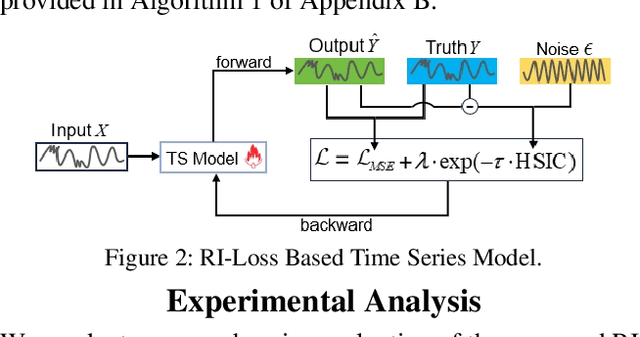
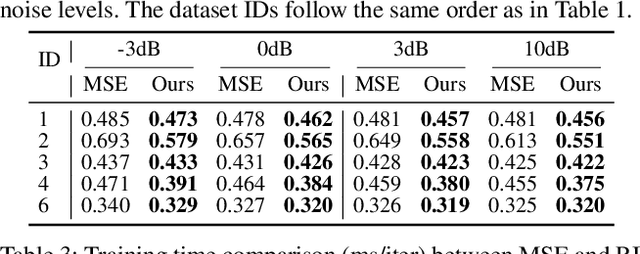
Time series forecasting relies on predicting future values from historical data, yet most state-of-the-art approaches-including transformer and multilayer perceptron-based models-optimize using Mean Squared Error (MSE), which has two fundamental weaknesses: its point-wise error computation fails to capture temporal relationships, and it does not account for inherent noise in the data. To overcome these limitations, we introduce the Residual-Informed Loss (RI-Loss), a novel objective function based on the Hilbert-Schmidt Independence Criterion (HSIC). RI-Loss explicitly models noise structure by enforcing dependence between the residual sequence and a random time series, enabling more robust, noise-aware representations. Theoretically, we derive the first non-asymptotic HSIC bound with explicit double-sample complexity terms, achieving optimal convergence rates through Bernstein-type concentration inequalities and Rademacher complexity analysis. This provides rigorous guarantees for RI-Loss optimization while precisely quantifying kernel space interactions. Empirically, experiments across eight real-world benchmarks and five leading forecasting models demonstrate improvements in predictive performance, validating the effectiveness of our approach. Code will be made publicly available to ensure reproducibility.
k-HyperEdge Medoids for Clustering Ensemble
Dec 11, 2024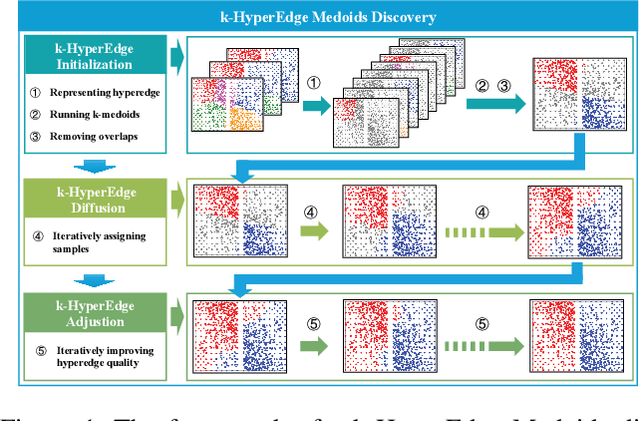
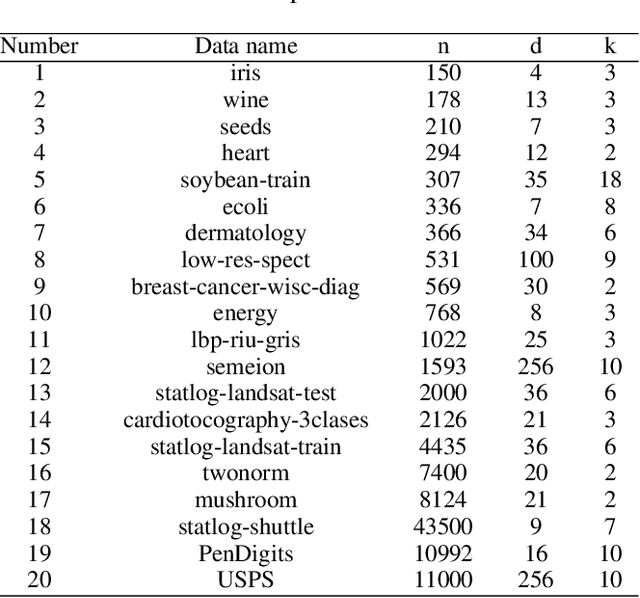
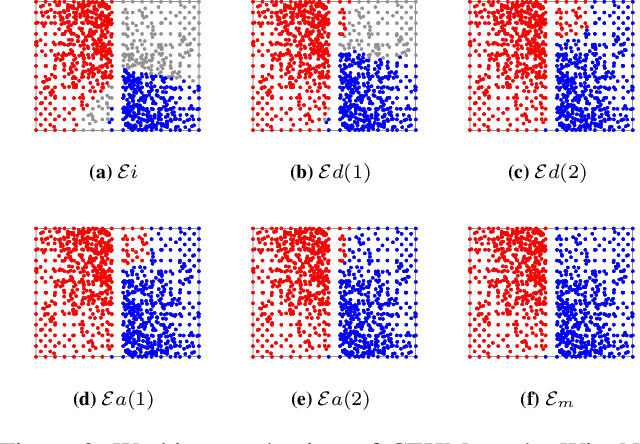
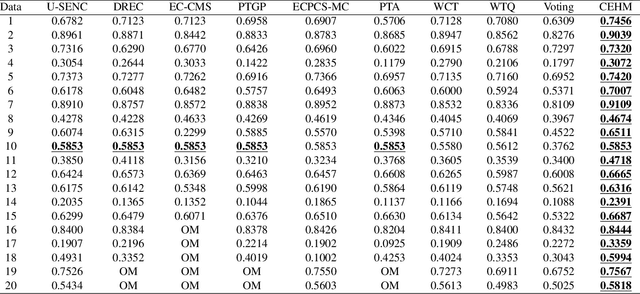
Clustering ensemble has been a popular research topic in data science due to its ability to improve the robustness of the single clustering method. Many clustering ensemble methods have been proposed, most of which can be categorized into clustering-view and sample-view methods. The clustering-view method is generally efficient, but it could be affected by the unreliability that existed in base clustering results. The sample-view method shows good performance, while the construction of the pairwise sample relation is time-consuming. In this paper, the clustering ensemble is formulated as a k-HyperEdge Medoids discovery problem and a clustering ensemble method based on k-HyperEdge Medoids that considers the characteristics of the above two types of clustering ensemble methods is proposed. In the method, a set of hyperedges is selected from the clustering view efficiently, then the hyperedges are diffused and adjusted from the sample view guided by a hyperedge loss function to construct an effective k-HyperEdge Medoid set. The loss function is mainly reduced by assigning samples to the hyperedge with the highest degree of belonging. Theoretical analyses show that the solution can approximate the optimal, the assignment method can gradually reduce the loss function, and the estimation of the belonging degree is statistically reasonable. Experiments on artificial data show the working mechanism of the proposed method. The convergence of the method is verified by experimental analysis of twenty data sets. The effectiveness and efficiency of the proposed method are also verified on these data, with nine representative clustering ensemble algorithms as reference.
Deep Embedding Clustering Driven by Sample Stability
Jan 29, 2024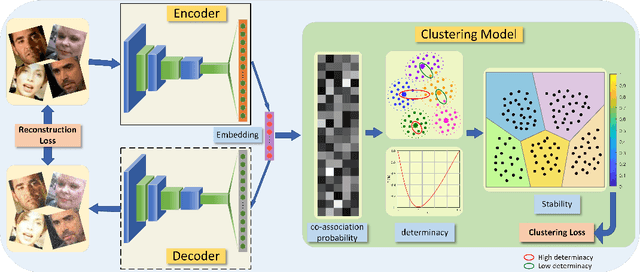
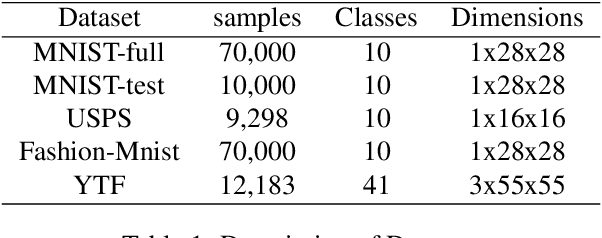
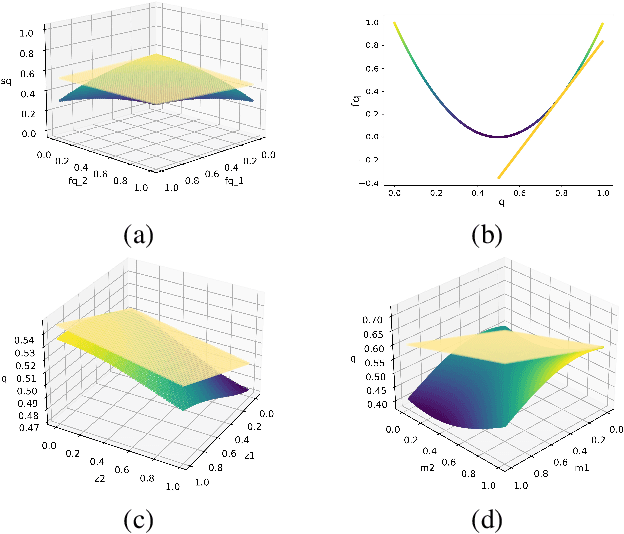
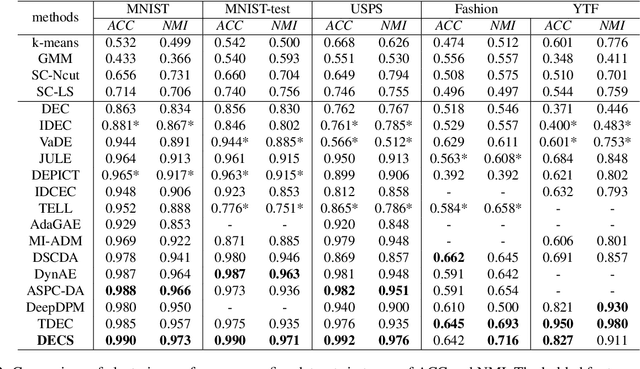
Deep clustering methods improve the performance of clustering tasks by jointly optimizing deep representation learning and clustering. While numerous deep clustering algorithms have been proposed, most of them rely on artificially constructed pseudo targets for performing clustering. This construction process requires some prior knowledge, and it is challenging to determine a suitable pseudo target for clustering. To address this issue, we propose a deep embedding clustering algorithm driven by sample stability (DECS), which eliminates the requirement of pseudo targets. Specifically, we start by constructing the initial feature space with an autoencoder and then learn the cluster-oriented embedding feature constrained by sample stability. The sample stability aims to explore the deterministic relationship between samples and all cluster centroids, pulling samples to their respective clusters and keeping them away from other clusters with high determinacy. We analyzed the convergence of the loss using Lipschitz continuity in theory, which verifies the validity of the model. The experimental results on five datasets illustrate that the proposed method achieves superior performance compared to state-of-the-art clustering approaches.