 Add to Chrome
 Add to Firefox
 Add to Edge
Modular Multi-Task Learning for Chemical Reaction Prediction
Feb 11, 2026
Adapting large language models (LLMs) trained on broad organic chemistry to smaller, domain-specific reaction datasets is a key challenge in chemical and pharmaceutical R&D. Effective specialisation requires learning new reaction knowledge while preserving general chemical understanding across related tasks. Here, we evaluate Low-Rank Adaptation (LoRA) as a parameter-efficient alternative to full fine-tuning for organic reaction prediction on limited, complex datasets. Using USPTO reaction classes and challenging C-H functionalisation reactions, we benchmark forward reaction prediction, retrosynthesis and reagent prediction. LoRA achieves accuracy comparable to full fine-tuning while effectively mitigating catastrophic forgetting and better preserving multi-task performance. Both fine-tuning approaches generalise beyond training distributions, producing plausible alternative solvent predictions. Notably, C-H functionalisation fine-tuning reveals that LoRA and full fine-tuning encode subtly different reactivity patterns, suggesting more effective reaction-specific adaptation with LoRA. As LLMs continue to scale, our results highlight the practicality of modular, parameter-efficient fine-tuning strategies for their flexible deployment for chemistry applications.

Specialising and Analysing Instruction-Tuned and Byte-Level Language Models for Organic Reaction Prediction
May 17, 2024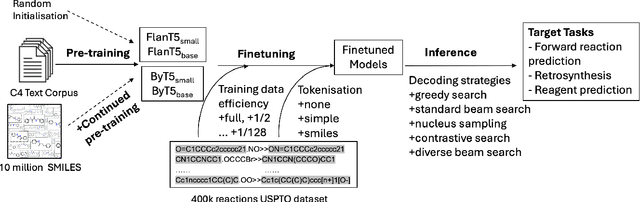
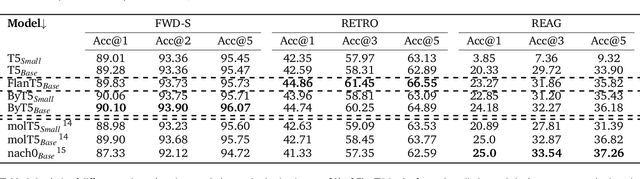
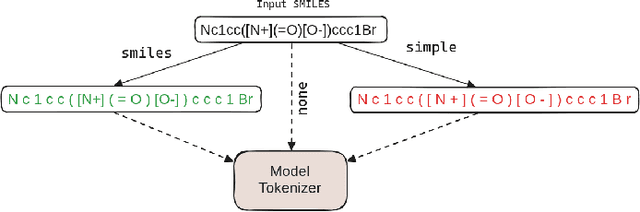
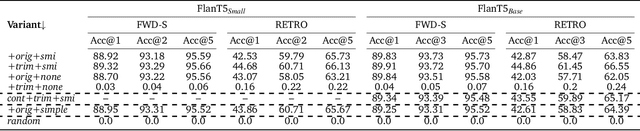
Transformer-based encoder-decoder models have demonstrated impressive results in chemical reaction prediction tasks. However, these models typically rely on pretraining using tens of millions of unlabelled molecules, which can be time-consuming and GPU-intensive. One of the central questions we aim to answer in this work is: Can FlanT5 and ByT5, the encode-decoder models pretrained solely on language data, be effectively specialised for organic reaction prediction through task-specific fine-tuning? We conduct a systematic empirical study on several key issues of the process, including tokenisation, the impact of (SMILES-oriented) pretraining, fine-tuning sample efficiency, and decoding algorithms at inference. Our key findings indicate that although being pretrained only on language tasks, FlanT5 and ByT5 provide a solid foundation to fine-tune for reaction prediction, and thus become `chemistry domain compatible' in the process. This suggests that GPU-intensive and expensive pretraining on a large dataset of unlabelled molecules may be useful yet not essential to leverage the power of language models for chemistry. All our models achieve comparable Top-1 and Top-5 accuracy although some variation across different models does exist. Notably, tokenisation and vocabulary trimming slightly affect final performance but can speed up training and inference; The most efficient greedy decoding strategy is very competitive while only marginal gains can be achieved from more sophisticated decoding algorithms. In summary, we evaluate FlanT5 and ByT5 across several dimensions and benchmark their impact on organic reaction prediction, which may guide more effective use of these state-of-the-art language models for chemistry-related tasks in the future.