 Add to Chrome
 Add to Firefox
 Add to Edge
Effective vocabulary expanding of multilingual language models for extremely low-resource languages
Feb 10, 2026
Multilingual pre-trained language models(mPLMs) offer significant benefits for many low-resource languages. To further expand the range of languages these models can support, many works focus on continued pre-training of these models. However, few works address how to extend mPLMs to low-resource languages that were previously unsupported. To tackle this issue, we expand the model's vocabulary using a target language corpus. We then screen out a subset from the model's original vocabulary, which is biased towards representing the source language(e.g. English), and utilize bilingual dictionaries to initialize the representations of the expanded vocabulary. Subsequently, we continue to pre-train the mPLMs using the target language corpus, based on the representations of these expanded vocabulary. Experimental results show that our proposed method outperforms the baseline, which uses randomly initialized expanded vocabulary for continued pre-training, in POS tagging and NER tasks, achieving improvements by 0.54% and 2.60%, respectively. Furthermore, our method demonstrates high robustness in selecting the training corpora, and the models' performance on the source language does not degrade after continued pre-training.

Unsupervised Cross-Lingual Part-of-Speech Tagging with Monolingual Corpora Only
Feb 10, 2026Due to the scarcity of part-of-speech annotated data, existing studies on low-resource languages typically adopt unsupervised approaches for POS tagging. Among these, POS tag projection with word alignment method transfers POS tags from a high-resource source language to a low-resource target language based on parallel corpora, making it particularly suitable for low-resource language settings. However, this approach relies heavily on parallel corpora, which are often unavailable for many low-resource languages. To overcome this limitation, we propose a fully unsupervised cross-lingual part-of-speech(POS) tagging framework that relies solely on monolingual corpora by leveraging unsupervised neural machine translation(UNMT) system. This UNMT system first translates sentences from a high-resource language into a low-resource one, thereby constructing pseudo-parallel sentence pairs. Then, we train a POS tagger for the target language following the standard projection procedure based on word alignments. Moreover, we propose a multi-source projection technique to calibrate the projected POS tags on the target side, enhancing to train a more effective POS tagger. We evaluate our framework on 28 language pairs, covering four source languages (English, German, Spanish and French) and seven target languages (Afrikaans, Basque, Finnis, Indonesian, Lithuanian, Portuguese and Turkish). Experimental results show that our method can achieve performance comparable to the baseline cross-lingual POS tagger with parallel sentence pairs, and even exceeds it for certain target languages. Furthermore, our proposed multi-source projection technique further boosts performance, yielding an average improvement of 1.3% over previous methods.
Incorporating Lexical and Syntactic Knowledge for Unsupervised Cross-Lingual Transfer
Apr 25, 2024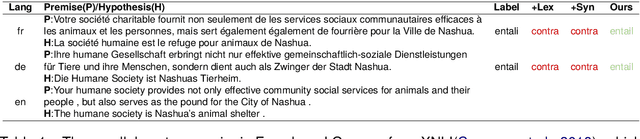
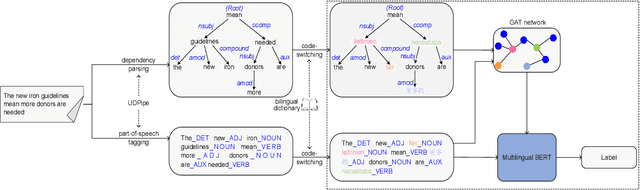

Unsupervised cross-lingual transfer involves transferring knowledge between languages without explicit supervision. Although numerous studies have been conducted to improve performance in such tasks by focusing on cross-lingual knowledge, particularly lexical and syntactic knowledge, current approaches are limited as they only incorporate syntactic or lexical information. Since each type of information offers unique advantages and no previous attempts have combined both, we attempt to explore the potential of this approach. In this paper, we present a novel framework called "Lexicon-Syntax Enhanced Multilingual BERT" that combines both lexical and syntactic knowledge. Specifically, we use Multilingual BERT (mBERT) as the base model and employ two techniques to enhance its learning capabilities. The code-switching technique is used to implicitly teach the model lexical alignment information, while a syntactic-based graph attention network is designed to help the model encode syntactic structure. To integrate both types of knowledge, we input code-switched sequences into both the syntactic module and the mBERT base model simultaneously. Our extensive experimental results demonstrate this framework can consistently outperform all baselines of zero-shot cross-lingual transfer, with the gains of 1.0~3.7 points on text classification, named entity recognition (ner), and semantic parsing tasks. Keywords:cross-lingual transfer, lexicon, syntax, code-switching, graph attention network