 Add to Chrome
 Add to Firefox
 Add to Edge
Teacher-Aware Evolution of Heuristic Programs from Learned Optimization Policies
May 11, 2026
LLM-based automatic heuristic design has shown promise for generating executable heuristics for combinatorial optimization, but existing methods mainly rely on delayed endpoint performance. We propose a \emph{teacher-aware evolutionary framework} that uses independently trained learned optimization policies as behavioral teachers. Instead of deploying or imitating the teacher, our method queries it on states visited by candidate heuristic programs and uses its action preferences as local feedback for evolution. The resulting search discovers static executable heuristics guided by both task performance and teacher-derived behavioral signals. Experiments on scheduling, routing, and graph optimization benchmarks show that our method improves over performance-driven LLM heuristic evolution baselines while requiring no neural inference at deployment. These results suggest that learned optimization policies can be repurposed as behavioral feedback sources for automatic heuristic discovery.

Can Language Models Pretend Solvers? Logic Code Simulation with LLMs
Mar 28, 2024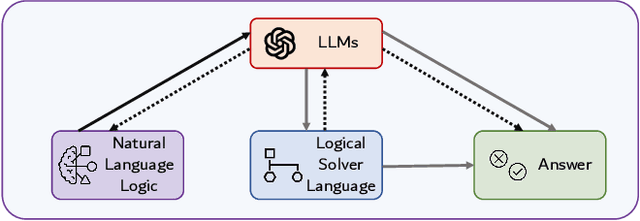
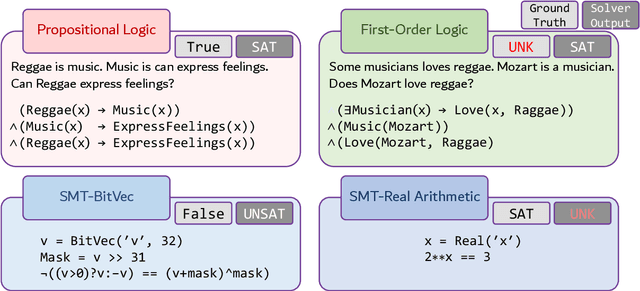
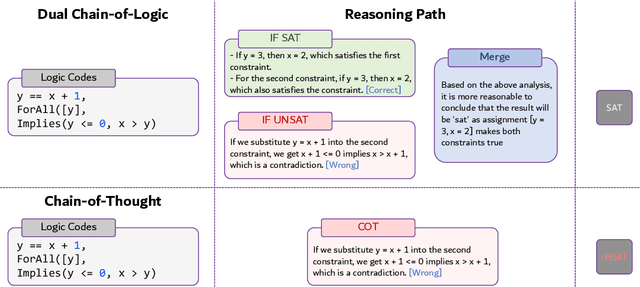
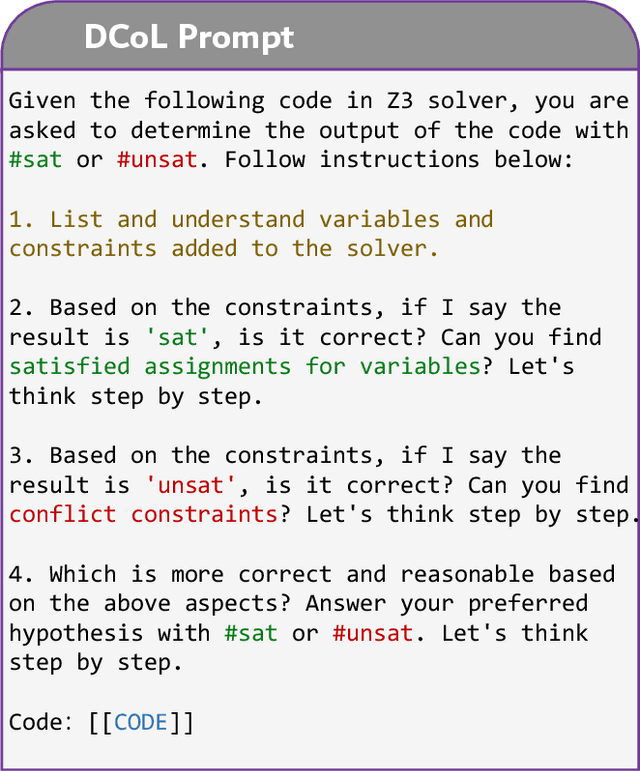
Transformer-based large language models (LLMs) have demonstrated significant potential in addressing logic problems. capitalizing on the great capabilities of LLMs for code-related activities, several frameworks leveraging logical solvers for logic reasoning have been proposed recently. While existing research predominantly focuses on viewing LLMs as natural language logic solvers or translators, their roles as logic code interpreters and executors have received limited attention. This study delves into a novel aspect, namely logic code simulation, which forces LLMs to emulate logical solvers in predicting the results of logical programs. To further investigate this novel task, we formulate our three research questions: Can LLMs efficiently simulate the outputs of logic codes? What strength arises along with logic code simulation? And what pitfalls? To address these inquiries, we curate three novel datasets tailored for the logic code simulation task and undertake thorough experiments to establish the baseline performance of LLMs in code simulation. Subsequently, we introduce a pioneering LLM-based code simulation technique, Dual Chains of Logic (DCoL). This technique advocates a dual-path thinking approach for LLMs, which has demonstrated state-of-the-art performance compared to other LLM prompt strategies, achieving a notable improvement in accuracy by 7.06% with GPT-4-Turbo.