 Add to Chrome
 Add to Firefox
 Add to Edge
ROSCell: A ROS2-Based Framework for Automated Formation and Orchestration of Multi-Robot Systems
Mar 24, 2026
Modern manufacturing under High-Mix-Low-Volume requirements increasingly relies on flexible and adaptive matrix production systems, which depend on interconnected heterogeneous devices and rapid task reconfiguration. To address these needs, we present ROSCell, a ROS2-based framework that enables the flexible formation and management of a computing continuum across various devices. ROSCell allows users to package existing robotic software as deployable skills and, with simple requests, assemble isolated cells, automatically deploy skill instances, and coordinate their communication to meet task objectives. It provides a scalable and low-overhead foundation for adaptive multi-robot computing in dynamic production environments. Experimental results show that, in the idle state, ROSCell substantially reduces CPU, memory, and network overhead compared to K3s-based solutions on edge devices, highlighting its energy efficiency and cost-effectiveness for large-scale deployment in production settings. The source code, examples, and documentation will be provided on Github.

A comparison of extended object tracking with multi-modal sensors in indoor environment
Nov 27, 2024


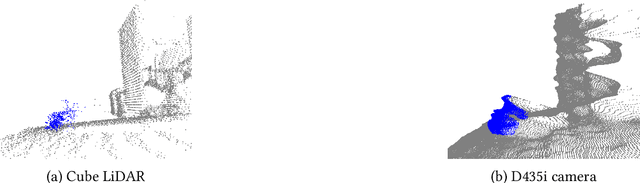
This paper presents a preliminary study of an efficient object tracking approach, comparing the performance of two different 3D point cloud sensory sources: LiDAR and stereo cameras, which have significant price differences. In this preliminary work, we focus on single object tracking. We first developed a fast heuristic object detector that utilizes prior information about the environment and target. The resulting target points are subsequently fed into an extended object tracking framework, where the target shape is parameterized using a star-convex hypersurface model. Experimental results show that our object tracking method using a stereo camera achieves performance similar to that of a LiDAR sensor, with a cost difference of more than tenfold.