 Add to Chrome
 Add to Firefox
 Add to Edge
Efficient Privacy-Preserving Range Filtered Approximate Nearest Neighbor Search
Aug 17, 2026
Range-filtered approximate nearest neighbor search (RFANNS) is an important primitive for vector databases; it retrieves vectors that are similar to a query and satisfy a numerical range predicate, but existing RFANNS indexes expose vectors, attributes, and queries in plaintext. This assumption is unsuitable for outsourced vector databases, where sensitive data and queries must be protected from an honest-but-curious cloud server. To the best of our knowledge, this is the first study that systematically formulates and evaluates privacy-preserving RFANNS over outsourced encrypted vector databases. Our approach separates range localization from encrypted vector search: an authorized user maps the query range to a compact set of nodes in a local N-ary attribute tree, and the server searches only the corresponding proximity graph sub-indices over encrypted vectors. To reduce expensive encrypted comparisons, we use a filter-and-refine pipeline that first retrieves coarse candidates with approximate distance-comparison-preserving encryption and then reranks a small candidate set with exact distance-comparison encryption. We then analyze the computation, storage, communication, and leakage of the protocol. Experiments on four widely used vector datasets show that our method improves the QPS-Recall trade-off over representative secure adaptations of existing RFANNS approaches, scaling effectively to large datasets.

Efficient Coreset Selection via K-Nearest Neighbor Graphs
Aug 17, 2026Coreset selection reduces the cost of model training by replacing a large training set with a small representative subset. Existing gradient-approximation coreset methods such as CRAIG and cluster-based variants can preserve model accuracy. Still, their selection stages often rely on dense pairwise distances or large item-cluster bound matrices, leading to high time and memory costs on large datasets. This paper proposes KNNG-CS, a lightweight coreset selection method based on a $K$-nearest neighbor graph. KNNG-CS exploits local neighborhood structures to estimate the importance of each data item and greedily selects representative nodes without maintaining a quadratic distance matrix. The method requires only linear storage in the number of edges. Experiments on four real-world datasets show that KNNG-CS achieves accuracy comparable to representative gradient-approximation coreset methods, while reducing selection time by $2.3\times$-$41.2\times$ and peak memory to $0.3\%$-$7.5\%$ of the baselines.
FROG: Efficient Range-Filtering Approximate Nearest Neighbor Search on GPUs
Aug 17, 2026Range-filtering approximate nearest neighbor search (RFANNS) is a fundamental operation in modern vector databases. Given a query vector $q$ and a numerical range predicate, RFANNS returns the $k$-approximate nearest neighbors ($k$-ANN) of the query $q$ among the objects whose attributes satisfy the range predicate. However, existing RFANNS methods are not well suited to high-throughput GPU execution. CPU indexes offer limited parallel scalability, generic GPU filtering is highly selectivity-dependent, and GPU indexes built from locally optimized subgraphs can incur long search trajectories and redundant distance computations. To address these limitations, we present FROG, a GPU-oriented RFANNS index that replaces multiple locally optimal substructure building with a globally aware, vertex-centric design. It organizes diverse expansion neighbor candidates for each vertex in a GPU-friendly structure and rapidly identifies the expansion neighbors used for computation at query time. Moreover, GPU-oriented algorithms and implementations are developed for both index construction and query processing. Experiments on six datasets show that FROG improves mixed-selectivity query throughput by 14.7--37.7$\times$ over 44-core CPU baselines and 4.5--7.6$\times$ over the strongest GPU baseline. It also accelerates index construction by 2.4--14.8$\times$ over the GPU baseline.
Generalized Range Filtering Approximate Nearest Neighbor Search: Containment and Overlap [Technical Report]
May 26, 2026Approximate nearest neighbor (ANN) search with range filters has recently garnered significant attention. This paper delves into a generalized form of this problem, i.e., ANN search with exact range-range (RR) predicates on a range-valued attribute, named RR filtering ANN (RRANN). Specifically, given $n$ vectors in $\mathbb{R}^d$, each vector $v_i$ is associated with a numeric range $[l_i, r_i]$, symbolizing aspects like a price range or time interval. An RRANN query $(v_q, l_q, r_q)$ aims at finding $k$ vectors closest to $v_q$ within the vectors satisfying an arbitrary RR predicate defined between the query range $[l_q, r_q]$ and the object range $[l_i, r_i]$. The RR predicate remains unspecified, enabling user-defined conditions. It may encompass containment ($[l_i, r_i] \subseteq [l_q, r_q]$ or $[l_q, r_q] \subseteq [l_i, r_i]$), overlap ($l_i \le l_q \le r_i \le r_q$ or $l_q \le l_i \le r_q \le r_i$), or a disjunction of them. RRANN has broad applications in queries related to price ranges or time intervals, and it generalizes existing variants of ANN search with range filters. However, existing dedicated approaches for these problems lack the capacity to support queries with arbitrary RR predicates. Hence, we introduce a new approach, labeled multi-segment tree graph. It efficiently handles arbitrary RR predicates by avoiding traversal through non-predicate-satisfied nodes, and keeps equivalent index size and construction time to state-of-the-art methods for RFANN. Extensive experiments on real-world data demonstrate the efficacy of our approach in RRANN queries, achieving up to 12.5x speedups with the same accuracy as the baselines. Moreover, our approach attains comparable RFANN search performance and notably superior IFANN and TSANN search performance compared to the respective state-of-the-art approaches. Our code is available at https://github.com/FanEDG/MSTG.
Beyond Linear LLM Invocation: An Efficient and Effective Semantic Filter Paradigm
Mar 05, 2026Large language models (LLMs) are increasingly used for semantic query processing over large corpora. A set of semantic operators derived from relational algebra has been proposed to provide a unified interface for expressing such queries, among which the semantic filter operator serves as a cornerstone. Given a table T with a natural language predicate e, for each tuple in the relation, the execution of a semantic filter proceeds by constructing an input prompt that combines the predicate e with its content, querying the LLM, and obtaining the binary decision. However, this tuple-by-tuple evaluation necessitates a complete linear scan of the table, incurring prohibitive latency and token costs. Although recent work has attempted to optimize semantic filtering, it still does not break the linear LLM invocation barriers. To address this, we propose Clustering-Sampling-Voting (CSV), a new framework that reduces LLM invocations to sublinear complexity while providing error guarantees. CSV embeds tuples into semantic clusters, samples a small subset for LLM evaluation, and infers cluster-level labels via two proposed voting strategies: UniVote, which aggregates labels uniformly, and SimVote, which weights votes by semantic similarity. Moreover, CSV triggers re-clustering on ambiguous clusters to ensure robustness across diverse datasets. The results conducted on real-world datasets demonstrate that CSV reduces the number of LLM calls by 1.28-355x compared to the state-of-the-art approaches, while maintaining comparable effectiveness in terms of Accuracy and F1 score.
Dynamic Attention Mechanism in Spatiotemporal Memory Networks for Object Tracking
Mar 21, 2025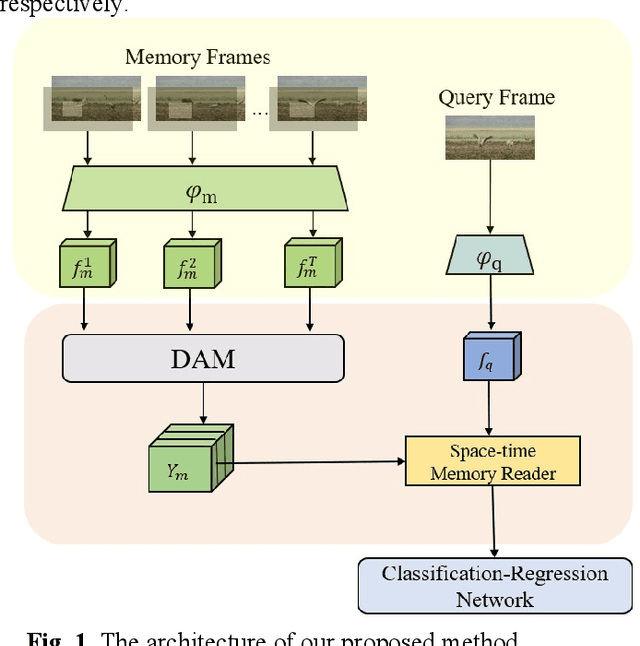
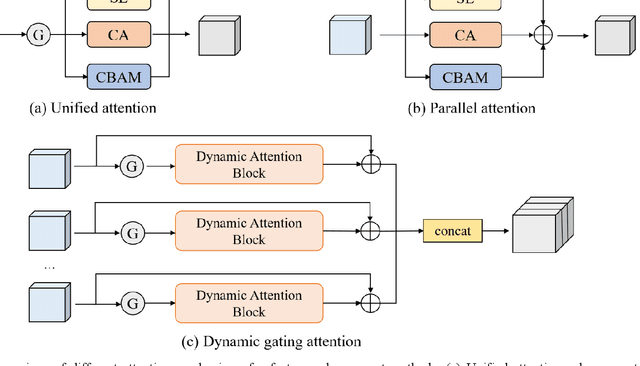
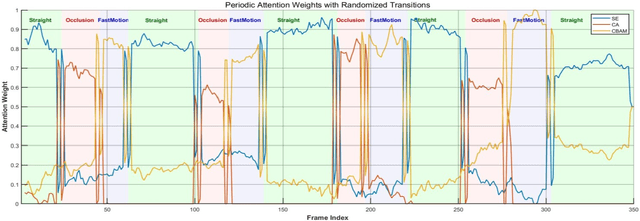
Mainstream visual object tracking frameworks predominantly rely on template matching paradigms. Their performance heavily depends on the quality of template features, which becomes increasingly challenging to maintain in complex scenarios involving target deformation, occlusion, and background clutter. While existing spatiotemporal memory-based trackers emphasize memory capacity expansion, they lack effective mechanisms for dynamic feature selection and adaptive fusion. To address this gap, we propose a Dynamic Attention Mechanism in Spatiotemporal Memory Network (DASTM) with two key innovations: 1) A differentiable dynamic attention mechanism that adaptively adjusts channel-spatial attention weights by analyzing spatiotemporal correlations between the templates and memory features; 2) A lightweight gating network that autonomously allocates computational resources based on target motion states, prioritizing high-discriminability features in challenging scenarios. Extensive evaluations on OTB-2015, VOT 2018, LaSOT, and GOT-10K benchmarks demonstrate our DASTM's superiority, achieving state-of-the-art performance in success rate, robustness, and real-time efficiency, thereby offering a novel solution for real-time tracking in complex environments.