 Add to Chrome
 Add to Firefox
 Add to Edge
GeMA: Learning Latent Manifold Frontiers for Benchmarking Complex Systems
Mar 17, 2026
Benchmarking the performance of complex systems such as rail networks, renewable generation assets and national economies is central to transport planning, regulation and macroeconomic analysis. Classical frontier methods, notably Data Envelopment Analysis (DEA) and Stochastic Frontier Analysis (SFA), estimate an efficient frontier in the observed input-output space and define efficiency as distance to this frontier, but rely on restrictive assumptions on the production set and only indirectly address heterogeneity and scale effects. We propose Geometric Manifold Analysis (GeMA), a latent manifold frontier framework implemented via a productivity-manifold variational autoencoder (ProMan-VAE). Instead of specifying a frontier function in the observed space, GeMA represents the production set as the boundary of a low-dimensional manifold embedded in the joint input-output space. A split-head encoder learns latent variables that capture technological structure and operational inefficiency. Efficiency is evaluated with respect to the learned manifold, endogenous peer groups arise as clusters in latent technology space, a quotient construction supports scale-invariant benchmarking, and a local certification radius, derived from the decoder Jacobian and a Lipschitz bound, quantifies the geometric robustness of efficiency scores. We validate GeMA on synthetic data with non-convex frontiers, heterogeneous technologies and scale bias, and on four real-world case studies: global urban rail systems (COMET), British rail operators (ORR), national economies (Penn World Table) and a high-frequency wind-farm dataset. Across these domains GeMA behaves comparably to established methods when classical assumptions hold, and provides additional insight in settings with pronounced heterogeneity, non-convexity or size-related bias.

Automated Body Composition Analysis Using DAFS Express on 2D MRI Slices at L3 Vertebral Level
Sep 11, 2024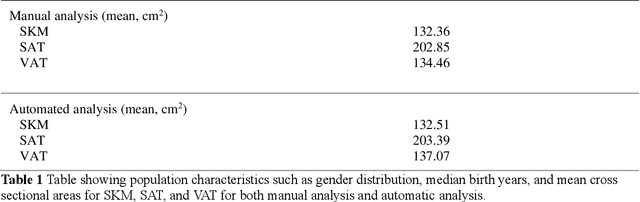


Body composition analysis is vital in assessing health conditions such as obesity, sarcopenia, and metabolic syndromes. MRI provides detailed images of skeletal muscle (SKM), visceral adipose tissue (VAT), and subcutaneous adipose tissue (SAT), but their manual segmentation is labor-intensive and limits clinical applicability. This study validates an automated tool for MRI-based 2D body composition analysis- (Data Analysis Facilitation Suite (DAFS) Express), comparing its automated measurements with expert manual segmentations using UK Biobank data. A cohort of 399 participants from the UK Biobank dataset was selected, yielding 423 single L3 slices for analysis. DAFS Express performed automated segmentations of SKM, VAT, and SAT, which were then manually corrected by expert raters for validation. Evaluation metrics included Jaccard coefficients, Dice scores, Intraclass Correlation Coefficients (ICCs), and Bland-Altman Plots to assess segmentation agreement and reliability. High agreements were observed between automated and manual segmentations with mean Jaccard scores: SKM 99.03%, VAT 95.25%, and SAT 99.57%; and mean Dice scores: SKM 99.51%, VAT 97.41%, and SAT 99.78%. Cross-sectional area comparisons showed consistent measurements with automated methods closely matching manual measurements for SKM and SAT, and slightly higher values for VAT (SKM: Auto 132.51 cm^2, Manual 132.36 cm^2; VAT: Auto 137.07 cm^2, Manual 134.46 cm^2; SAT: Auto 203.39 cm^2, Manual 202.85 cm^2). ICCs confirmed strong reliability (SKM: 0.998, VAT: 0.994, SAT: 0.994). Bland-Altman plots revealed minimal biases, and boxplots illustrated distribution similarities across SKM, VAT, and SAT areas. On average DAFS Express took 18 seconds per DICOM. This underscores its potential to streamline image analysis processes in research and clinical settings, enhancing diagnostic accuracy and efficiency.