 Add to Chrome
 Add to Firefox
 Add to Edge
VeRe-Flow: Guiding Flow Matching toward Clean Speech via Velocity Contrastive Regularization and Representation Alignment for Noise-Robust Bandwidth Expansion
Jun 28, 2026
Noise-robust bandwidth expansion aims to reconstruct high-fidelity wideband speech from noisy low-resolution inputs. While flow matching has shown strong performance in speech generation, accurately recovering clean speech from noisy inputs remains challenging due to the ambiguity of velocity estimation under noise. In this work, we propose VeRe-Flow, a clean-guided flow matching framework that introduces multi-level clean supervision to guide the generative process toward clean speech. At the velocity level, we introduce velocity contrastive regularization, which attracts the predicted velocity toward the clean trajectory while repelling it from noisy trajectories. At the representation level, we incorporate representation alignment that aligns intermediate features with clean self-supervised learning representations. The results demonstrate that the proposed method achieves the lowest LSD and highest DNSMOS OVRL among all baselines, and the highest MOS among generative baselines.

How Far Do SSL Speech Models Listen for Tone? Temporal Focus of Tone Representation under Low-resource Transfer
Nov 15, 2025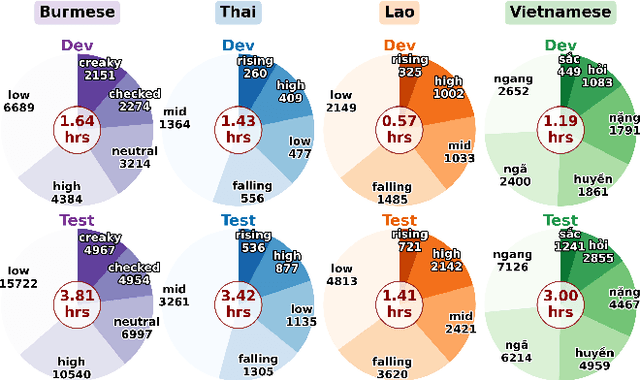
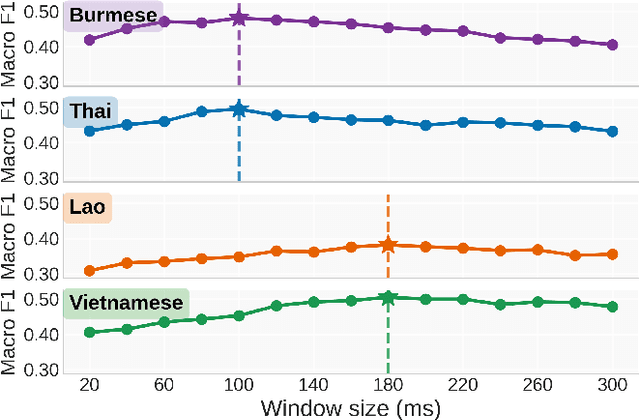
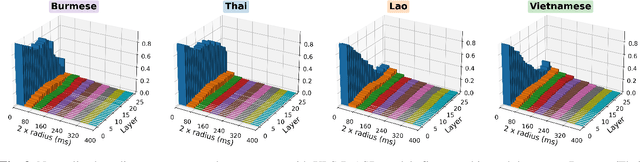
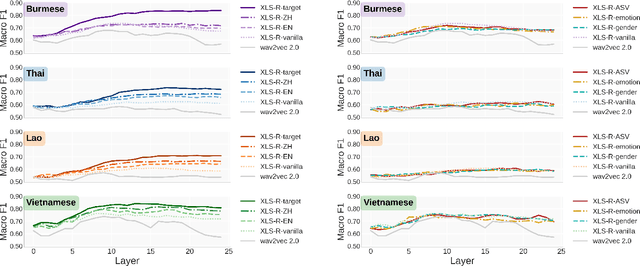
Lexical tone is central to many languages but remains underexplored in self-supervised learning (SSL) speech models, especially beyond Mandarin. We study four languages with complex and diverse tone systems: Burmese, Thai, Lao, and Vietnamese, to examine how far such models listen for tone and how transfer operates in low-resource conditions. As a baseline reference, we estimate the temporal span of tone cues to be about 100 ms in Burmese and Thai, and about 180 ms in Lao and Vietnamese. Probes and gradient analyses on fine-tuned SSL models reveal that tone transfer varies by downstream task: automatic speech recognition fine-tuning aligns spans with language-specific tone cues, while prosody- and voice-related tasks bias the model toward overly long spans. These findings indicate that tone transfer is shaped by downstream task, highlighting task effects on temporal focus in tone modeling.
Anti-Spoofing Using Transfer Learning with Variational Information Bottleneck
Apr 04, 2022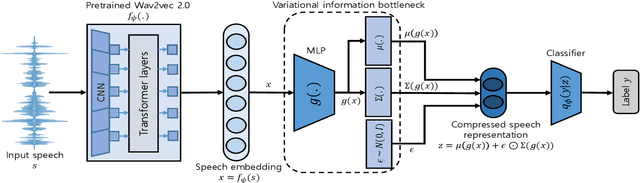
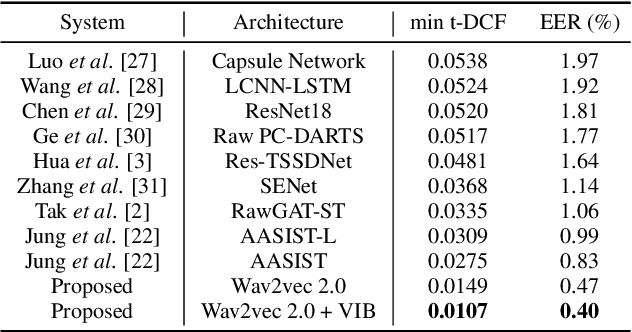
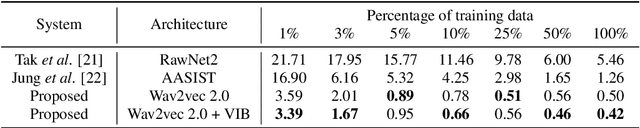
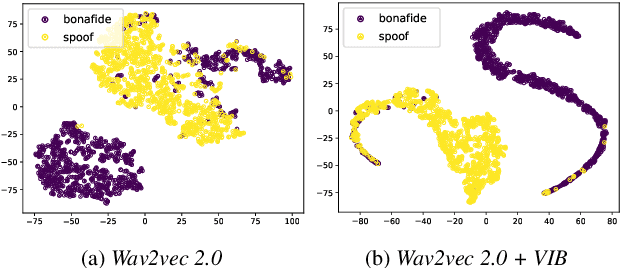
Recent advances in sophisticated synthetic speech generated from text-to-speech (TTS) or voice conversion (VC) systems cause threats to the existing automatic speaker verification (ASV) systems. Since such synthetic speech is generated from diverse algorithms, generalization ability with using limited training data is indispensable for a robust anti-spoofing system. In this work, we propose a transfer learning scheme based on the wav2vec 2.0 pretrained model with variational information bottleneck (VIB) for speech anti-spoofing task. Evaluation on the ASVspoof 2019 logical access (LA) database shows that our method improves the performance of distinguishing unseen spoofed and genuine speech, outperforming current state-of-the-art anti-spoofing systems. Furthermore, we show that the proposed system improves performance in low-resource and cross-dataset settings of anti-spoofing task significantly, demonstrating that our system is also robust in terms of data size and data distribution.