 Add to Chrome
 Add to Firefox
 Add to Edge
ReToP: Learning to Rewrite Electronic Health Records for Clinical Prediction
Jan 27, 2026
Electronic Health Records (EHRs) provide crucial information for clinical decision-making. However, their high-dimensionality, heterogeneity, and sparsity make clinical prediction challenging. Large Language Models (LLMs) allowed progress towards addressing this challenge by leveraging parametric medical knowledge to enhance EHR data for clinical prediction tasks. Despite the significant achievements made so far, most of the existing approaches are fundamentally task-agnostic in the sense that they deploy LLMs as EHR encoders or EHR completion modules without fully integrating signals from the prediction tasks. This naturally hinders task performance accuracy. In this work, we propose Rewrite-To-Predict (ReToP), an LLM-based framework that addresses this limitation through an end-to-end training of an EHR rewriter and a clinical predictor. To cope with the lack of EHR rewrite training data, we generate synthetic pseudo-labels using clinical-driven feature selection strategies to create diverse patient rewrites for fine-tuning the EHR rewriter. ReToP aligns the rewriter with prediction objectives using a novel Classifier Supervised Contribution (CSC) score that enables the EHR rewriter to generate clinically relevant rewrites that directly enhance prediction. Our ReToP framework surpasses strong baseline models across three clinical tasks on MIMIC-IV. Moreover, the analysis of ReToP shows its generalizability to unseen datasets and tasks with minimal fine-tuning while preserving faithful rewrites and emphasizing task-relevant predictive features.
* Accepted by WSDM 2026

Studying Catastrophic Forgetting in Neural Ranking Models
Jan 18, 2021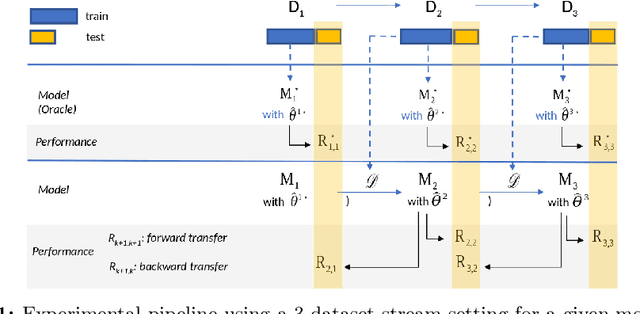
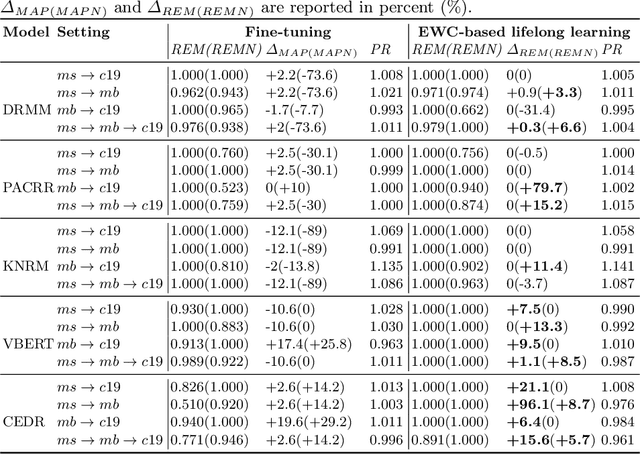
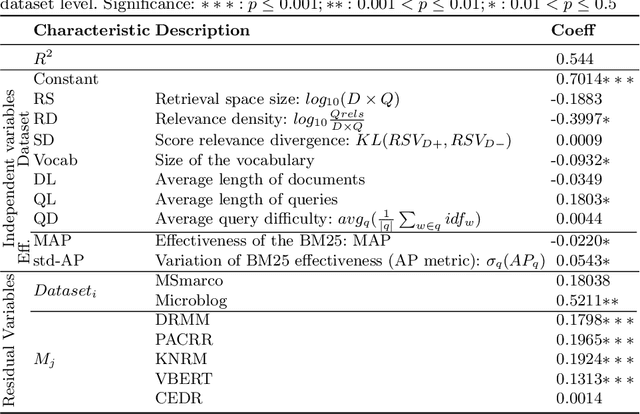
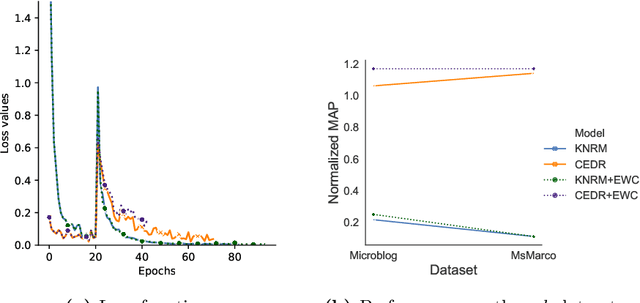
Several deep neural ranking models have been proposed in the recent IR literature. While their transferability to one target domain held by a dataset has been widely addressed using traditional domain adaptation strategies, the question of their cross-domain transferability is still under-studied. We study here in what extent neural ranking models catastrophically forget old knowledge acquired from previously observed domains after acquiring new knowledge, leading to performance decrease on those domains. Our experiments show that the effectiveness of neuralIR ranking models is achieved at the cost of catastrophic forgetting and that a lifelong learning strategy using a cross-domain regularizer success-fully mitigates the problem. Using an explanatory approach built on a regression model, we also show the effect of domain characteristics on the rise of catastrophic forgetting. We believe that the obtained results can be useful for both theoretical and practical future work in neural IR.