 Add to Chrome
 Add to Firefox
 Add to Edge
Calibrating Urban Traffic Simulation from Sparse Road Observations via Genetic Optimization
Jun 02, 2026
Urban traffic simulation is a critical tool for infrastructure planning, including the placement of electric vehicle charging stations. However, realistic traffic simulation across many cities is hindered by two fundamental data limitations: detailed real-world traffic measurements are available for only a small fraction of road segments in most cities, and employment distribution data critical for modeling commuter traffic is rarely available at the resolution needed for simulation. This paper presents a genetic algorithm-based framework that directly addresses both limitations, calibrating urban traffic simulations from sparse road observations without requiring detailed job location data. Using the SUMO traffic simulation platform for Greensboro, North Carolina, our approach optimizes job distributions and gate-traffic parameters to align simulated traffic with a small sample of roads with known traffic-flow rates. We demonstrate that this approach produces simulated traffic that correlates well with real-world measurements, generalizes to road segments withheld from training, and produces job distributions that show promising qualitative agreement with census employment data despite never directly training on that employment data. This work demonstrates that realistic urban traffic simulation can be achieved from minimal real-world observations, offering a scalable and data-light approach to simulation calibration that reduces the barrier to deploying traffic models across diverse cities.

Leveraging BART to Assess CS1 C++ Programming Assignments using Rubric-based Criteria
Jun 02, 2026This paper investigates rubric-aware, multitask fine-tuning of transformer models for automated grading of introductory C++ programming assignments, with the goal of producing grade predictions that better reflect instructor grading behavior than general-purpose LLMs. Using multi-semester CS1 data, student submissions are paired with numeric scores, letter-grade buckets, and assignment rubrics, then preprocessed into unified sequences for transformer input. A BART encoder-decoder with LoRA adaptation is trained to jointly predict numeric grades and grade buckets, augmented with a distribution-matching term to align predicted and empirical grade distributions, an evaluation dimension often overlooked in prior work. Experiments compare single-task and multitask training, hard one-hot versus fuzzy and boundary-based soft labels, and rubric versus no-rubric conditions, with additional T5 and pairwise-pretrained variants. Results show that multitask BART with boundary-based soft labels and rubric context achieves lower mean absolute error and stronger grade-distribution alignment than single-task, hard-label, or code-only baselines. Fully fine-tuned T5 further improves distributional fidelity, while pairwise pretraining reduces numeric error at the cost of minority-class sensitivity. Collectively, the findings suggest that calibration-aware, rubric-guided training produces more instructor-like grading behavior than accuracy-optimized alternatives.
Human-Alignment, Calibration, and Activation Patterns in Large Language Model Uncertainty
May 29, 2026Uncertainty Quantification is a large and growing subfield of large language model behavioral analysis. Primarily to recognize and combat hallucination, the field has largely focused on measuring and improving calibration, the accuracy of uncertainty judgments to task efficacy. In this work, we investigate the relatively underexplored question of how similar large language model uncertainty is to human uncertainty. We investigate the presence and strength of human-similar uncertainty signals, deemed uncertainty alignment, in large language model overt behavior and internal activation patterns. We identify whether the models show evidence of simultaneous alignment and calibration on a variety of datasets covering both multiple choice and open ended factual recall. And we characterize the effect of instruct fine-tuning on each of these facets.
KARMA: Karma-Aligned Reward Model Adaptation
May 26, 2026Human communication depends on implicit social signals where effectiveness is shaped by tone, context, and conversational norms rather than semantic content alone. We introduce KARMA (Karma-Aligned Reward Model Adaptation), a framework for LLM learning of context-sensitive conversational behavior from large-scale social interaction data. KARMA trains a reward model on Reddit conversations to predict response valuation conditioned on context, and uses this signal to fine-tune language models via reinforcement learning to improve performance on pragmatics-mediated tasks. Critically, we find that the highest performing reward model does not lead to better downstream model alignment: a reward model relying exclusively on conversational context was a worse predictor of Reddit karma but yielded substantially better downstream performance. We evaluate the effects of KARMA applied to a downstream model with and without direct exposure to the social media data. The resulting models show improved pragmatics-mediated behaviors with largely mitigated undesirable side effects. Factuality is consistently diminished by KARMA across all conditions, including when the downstream model has no direct exposure to Reddit data, suggesting that this tension is embedded in the reward signal itself rather than introduced by noisy training data.
Reinforcement Learning from Meta-Evaluation: Aligning Language Models Without Ground-Truth Labels
Jan 29, 2026Most reinforcement learning (RL) methods for training large language models (LLMs) require ground-truth labels or task-specific verifiers, limiting scalability when correctness is ambiguous or expensive to obtain. We introduce Reinforcement Learning from Meta-Evaluation (RLME), which optimizes a generator using reward derived from an evaluator's answers to natural-language meta-questions (e.g., "Is the answer correct?" or "Is the reasoning logically consistent?"). RLME treats the evaluator's probability of a positive judgment as a reward and updates the generator via group-relative policy optimization, enabling learning without labels. Across a suite of experiments, we show that RLME achieves accuracy and sample efficiency comparable to label-based training, enables controllable trade-offs among multiple objectives, steers models toward reliable reasoning patterns rather than post-hoc rationalization, and generalizes to open-domain settings where ground-truth labels are unavailable, broadening the domains in which LLMs may be trained with RL.
Human-Alignment and Calibration of Inference-Time Uncertainty in Large Language Models
Aug 11, 2025There has been much recent interest in evaluating large language models for uncertainty calibration to facilitate model control and modulate user trust. Inference time uncertainty, which may provide a real-time signal to the model or external control modules, is particularly important for applying these concepts to improve LLM-user experience in practice. While many of the existing papers consider model calibration, comparatively little work has sought to evaluate how closely model uncertainty aligns to human uncertainty. In this work, we evaluate a collection of inference-time uncertainty measures, using both established metrics and novel variations, to determine how closely they align with both human group-level uncertainty and traditional notions of model calibration. We find that numerous measures show evidence of strong alignment to human uncertainty, even despite the lack of alignment to human answer preference. For those successful metrics, we find moderate to strong evidence of model calibration in terms of both correctness correlation and distributional analysis.
Investigating Human-Aligned Large Language Model Uncertainty
Mar 16, 2025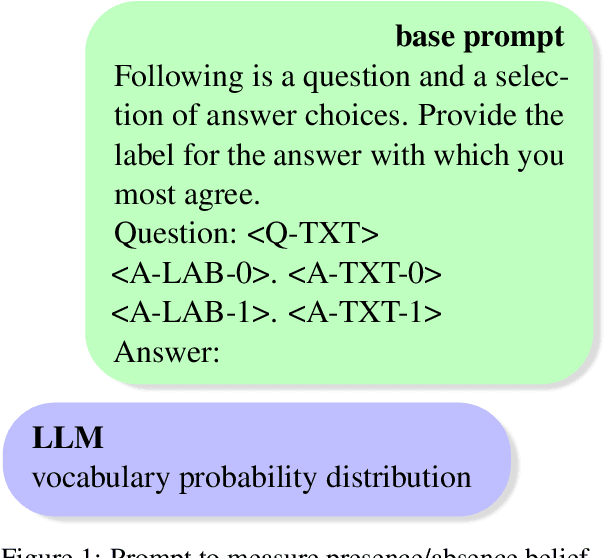
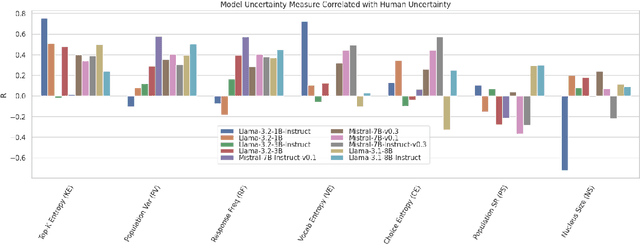
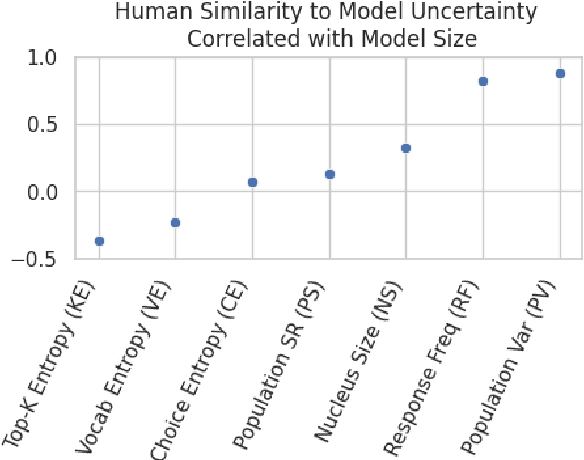
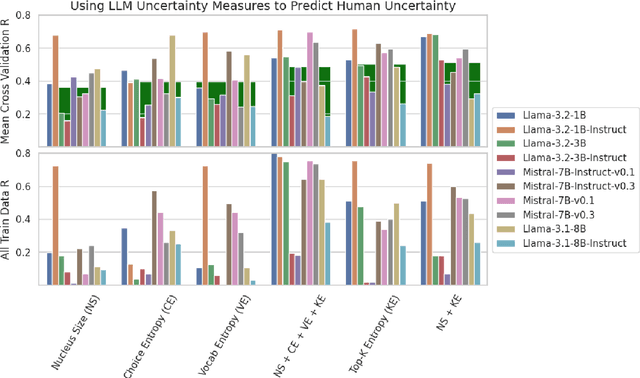
Recent work has sought to quantify large language model uncertainty to facilitate model control and modulate user trust. Previous works focus on measures of uncertainty that are theoretically grounded or reflect the average overt behavior of the model. In this work, we investigate a variety of uncertainty measures, in order to identify measures that correlate with human group-level uncertainty. We find that Bayesian measures and a variation on entropy measures, top-k entropy, tend to agree with human behavior as a function of model size. We find that some strong measures decrease in human-similarity with model size, but, by multiple linear regression, we find that combining multiple uncertainty measures provide comparable human-alignment with reduced size-dependency.
Basic Category Usage in Vision Language Models
Mar 16, 2025The field of psychology has long recognized a basic level of categorization that humans use when labeling visual stimuli, a term coined by Rosch in 1976. This level of categorization has been found to be used most frequently, to have higher information density, and to aid in visual language tasks with priming in humans. Here, we investigate basic level categorization in two recently released, open-source vision-language models (VLMs). This paper demonstrates that Llama 3.2 Vision Instruct (11B) and Molmo 7B-D both prefer basic level categorization consistent with human behavior. Moreover, the models' preferences are consistent with nuanced human behaviors like the biological versus non-biological basic level effects and the well established expert basic level shift, further suggesting that VLMs acquire cognitive categorization behaviors from the human data on which they are trained.
RL + Transformer = A General-Purpose Problem Solver
Jan 24, 2025

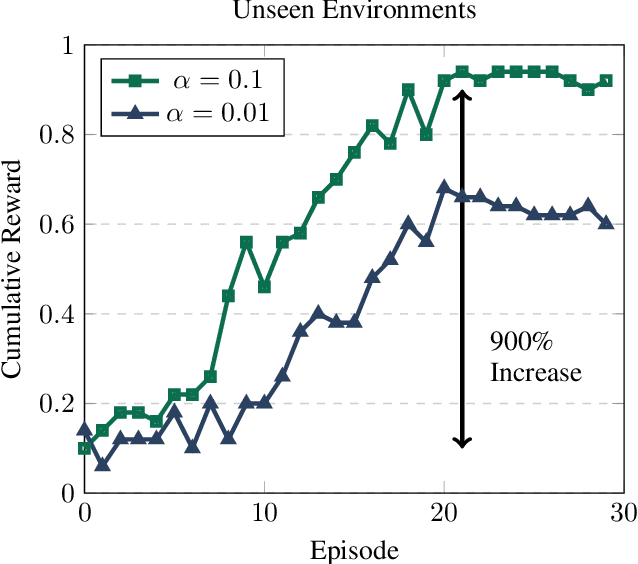
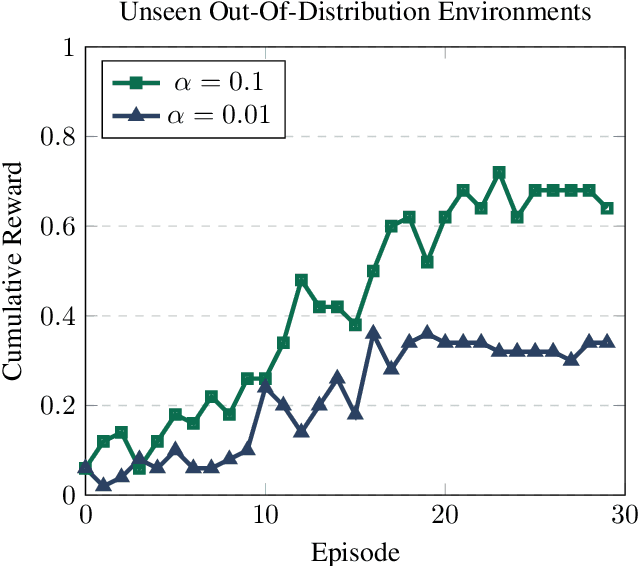
What if artificial intelligence could not only solve problems for which it was trained but also learn to teach itself to solve new problems (i.e., meta-learn)? In this study, we demonstrate that a pre-trained transformer fine-tuned with reinforcement learning over multiple episodes develops the ability to solve problems that it has never encountered before - an emergent ability called In-Context Reinforcement Learning (ICRL). This powerful meta-learner not only excels in solving unseen in-distribution environments with remarkable sample efficiency, but also shows strong performance in out-of-distribution environments. In addition, we show that it exhibits robustness to the quality of its training data, seamlessly stitches together behaviors from its context, and adapts to non-stationary environments. These behaviors demonstrate that an RL-trained transformer can iteratively improve upon its own solutions, making it an excellent general-purpose problem solver.
Investigating Expert-in-the-Loop LLM Discourse Patterns for Ancient Intertextual Analysis
Sep 03, 2024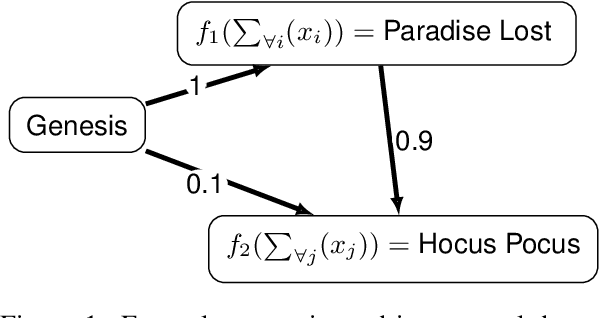
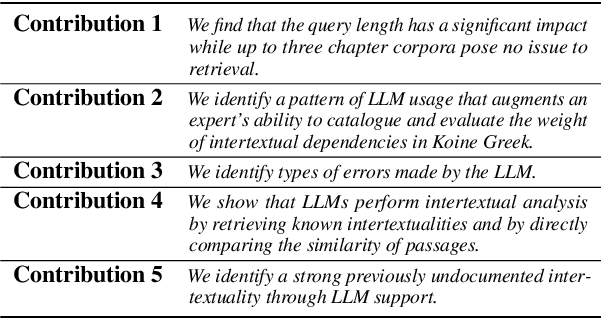
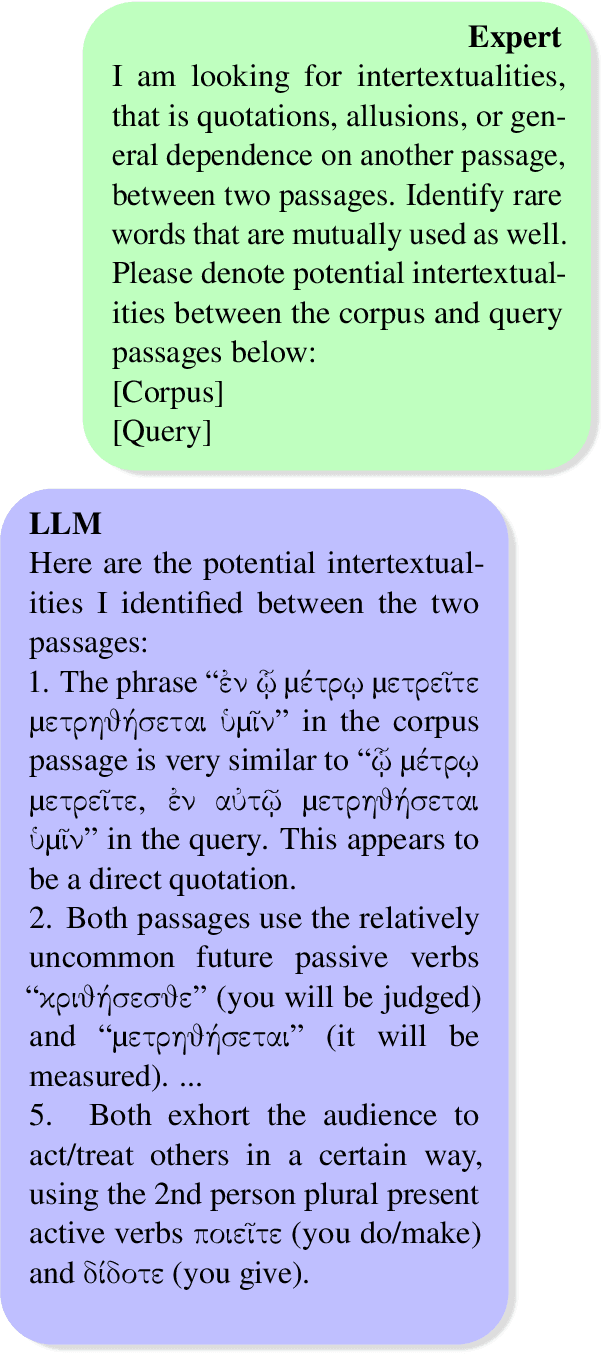
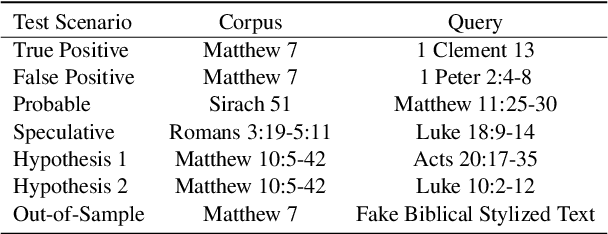
This study explores the potential of large language models (LLMs) for identifying and examining intertextual relationships within biblical, Koine Greek texts. By evaluating the performance of LLMs on various intertextuality scenarios the study demonstrates that these models can detect direct quotations, allusions, and echoes between texts. The LLM's ability to generate novel intertextual observations and connections highlights its potential to uncover new insights. However, the model also struggles with long query passages and the inclusion of false intertextual dependences, emphasizing the importance of expert evaluation. The expert-in-the-loop methodology presented offers a scalable approach for intertextual research into the complex web of intertextuality within and beyond the biblical corpus.