 Add to Chrome
 Add to Firefox
 Add to Edge
Biased Generalization in Diffusion Models
Mar 03, 2026
Generalization in generative modeling is defined as the ability to learn an underlying distribution from a finite dataset and produce novel samples, with evaluation largely driven by held-out performance and perceived sample quality. In practice, training is often stopped at the minimum of the test loss, taken as an operational indicator of generalization. We challenge this viewpoint by identifying a phase of biased generalization during training, in which the model continues to decrease the test loss while favoring samples with anomalously high proximity to training data. By training the same network on two disjoint datasets and comparing the mutual distances of generated samples and their similarity to training data, we introduce a quantitative measure of bias and demonstrate its presence on real images. We then study the mechanism of bias, using a controlled hierarchical data model where access to exact scores and ground-truth statistics allows us to precisely characterize its onset. We attribute this phenomenon to the sequential nature of feature learning in deep networks, where coarse structure is learned early in a data-independent manner, while finer features are resolved later in a way that increasingly depends on individual training samples. Our results show that early stopping at the test loss minimum, while optimal under standard generalization criteria, may be insufficient for privacy-critical applications.

How transformers learn structured data: insights from hierarchical filtering
Aug 27, 2024
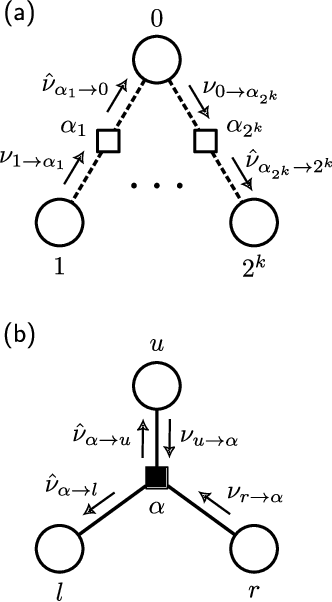
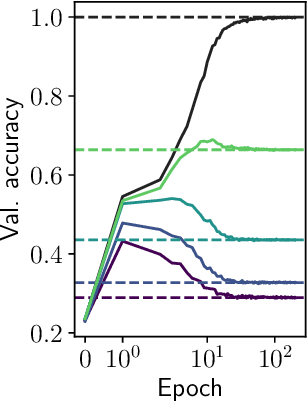
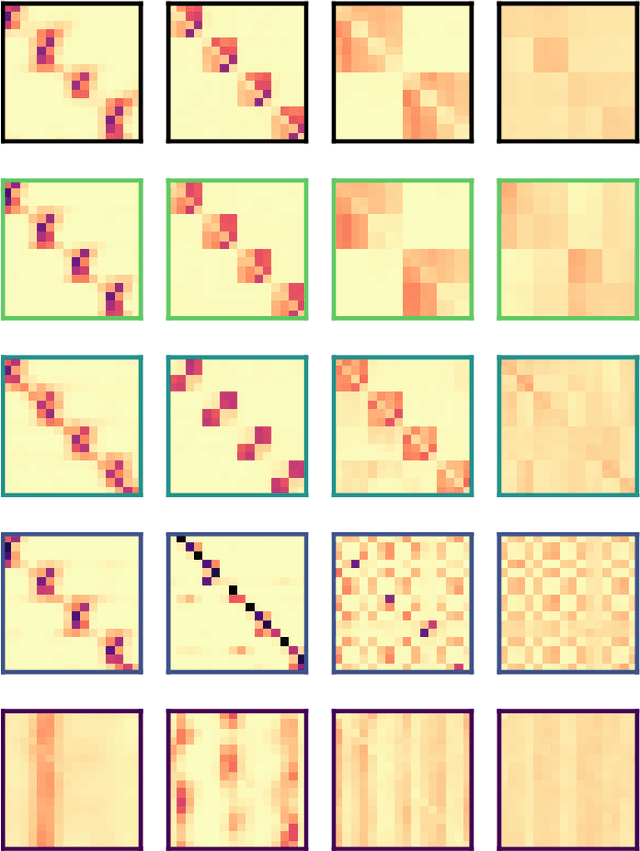
We introduce a hierarchical filtering procedure for generative models of sequences on trees, enabling control over the range of positional correlations in the data. Leveraging this controlled setting, we provide evidence that vanilla encoder-only transformer architectures can implement the optimal Belief Propagation algorithm on both root classification and masked language modeling tasks. Correlations at larger distances corresponding to increasing layers of the hierarchy are sequentially included as the network is trained. We analyze how the transformer layers succeed by focusing on attention maps from models trained with varying degrees of filtering. These attention maps show clear evidence for iterative hierarchical reconstruction of correlations, and we can relate these observations to a plausible implementation of the exact inference algorithm for the network sizes considered.