 Add to Chrome
 Add to Firefox
 Add to Edge
ConceptCF: Concept-based Counterfactuals for the Explainability of Time Series
Jul 21, 2026
This paper proposes ConceptCF, a method for counterfactual generation that operates on human-interpretable concepts. In high-stakes domains such as healthcare and predictive maintenance, artificial intelligence models can increase efficiency and safety. Explainability is key to ensure these models rely on causal relationships rather than spurious correlations. Counterfactual explanations identify minimal modifications that would change a model's predictions. Existing methods for time series operate on individual points or subsequences without ensuring interpretability of the mutations. ConceptCF instead modifies meaningful concepts. As a result we can provide explanations in terms of these concepts, for example ``the model's prediction would be `Sit' instead of `Walk' if you increase the scale of the movement''. In this paper, the concepts are constructed through time series decomposition, resulting in concepts such as scale, and frequency bands. Counterfactuals are generated using a genetic algorithm that optimizes the concept mutations. Evaluation against five state-of-the-art approaches demonstrates that ConceptCF consistently achieves top-tier performance across validity, confidence, proximity, sparsity and plausibility metrics.

C-SHAP for time series: An approach to high-level temporal explanations
Apr 15, 2025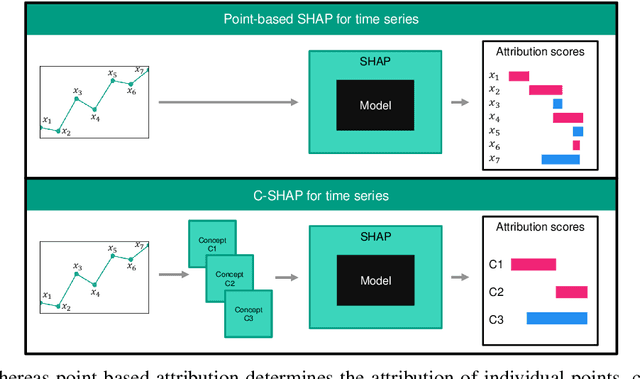
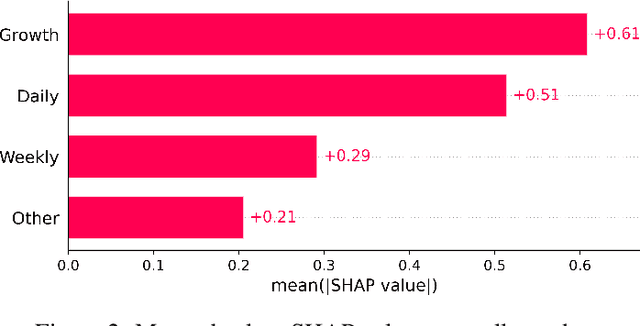
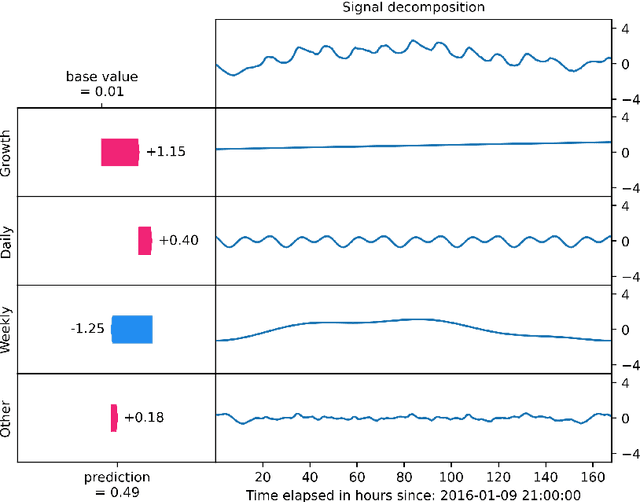
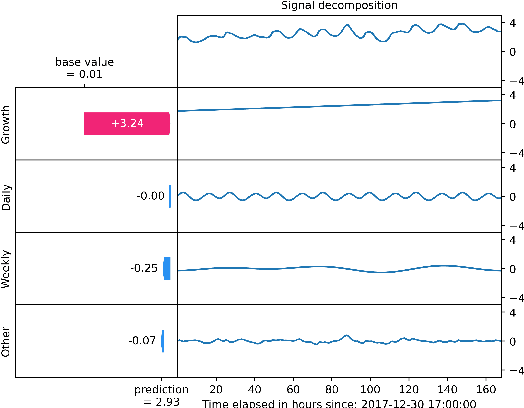
Time series are ubiquitous in domains such as energy forecasting, healthcare, and industry. Using AI systems, some tasks within these domains can be efficiently handled. Explainable AI (XAI) aims to increase the reliability of AI solutions by explaining model reasoning. For time series, many XAI methods provide point- or sequence-based attribution maps. These methods explain model reasoning in terms of low-level patterns. However, they do not capture high-level patterns that may also influence model reasoning. We propose a concept-based method to provide explanations in terms of these high-level patterns. In this paper, we present C-SHAP for time series, an approach which determines the contribution of concepts to a model outcome. We provide a general definition of C-SHAP and present an example implementation using time series decomposition. Additionally, we demonstrate the effectiveness of the methodology through a use case from the energy domain.