 Add to Chrome
 Add to Firefox
 Add to Edge
Beyond Calibration: Confounding Pathology Limits Foundation Model Specificity in Abdominal Trauma CT
Feb 10, 2026
Purpose: Translating foundation models into clinical practice requires evaluating their performance under compound distribution shift, where severe class imbalance coexists with heterogeneous imaging appearances. This challenge is relevant for traumatic bowel injury, a rare but high-mortality diagnosis. We investigated whether specificity deficits in foundation models are associated with heterogeneity in the negative class. Methods: This retrospective study used the multi-institutional, RSNA Abdominal Traumatic Injury CT dataset (2019-2023), comprising scans from 23 centres. Two foundation models (MedCLIP, zero-shot; RadDINO, linear probe) were compared against three task-specific approaches (CNN, Transformer, Ensemble). Models were trained on 3,147 patients (2.3% bowel injury prevalence) and evaluated on an enriched 100-patient test set. To isolate negative-class effects, specificity was assessed in patients without bowel injury who had concurrent solid organ injury (n=58) versus no abdominal pathology (n=50). Results: Foundation models achieved equivalent discrimination to task-specific models (AUC, 0.64-0.68 versus 0.58-0.64) with higher sensitivity (79-91% vs 41-74%) but lower specificity (33-50% vs 50-88%). All models demonstrated high specificity in patients without abdominal pathology (84-100%). When solid organ injuries were present, specificity declined substantially for foundation models (50-51 percentage points) compared with smaller reductions of 12-41 percentage points for task-specific models. Conclusion: Foundation models matched task-specific discrimination without task-specific training, but their specificity deficits were driven primarily by confounding negative-class heterogeneity rather than prevalence alone. Susceptibility to negative-class heterogeneity decreased progressively with labelled training, suggesting adaptation is required before clinical implementation.

Multi-modal 3D Pose and Shape Estimation with Computed Tomography
Mar 25, 2025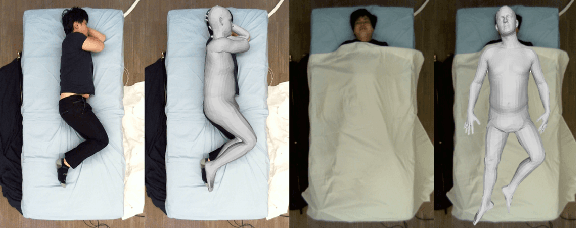
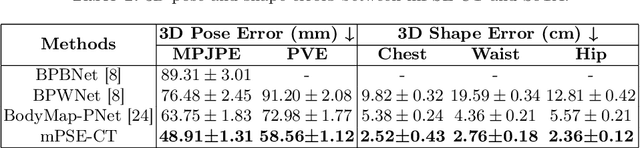
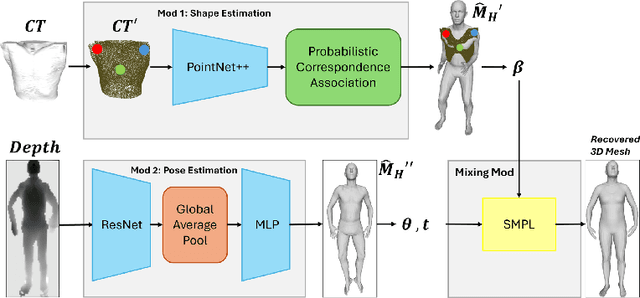
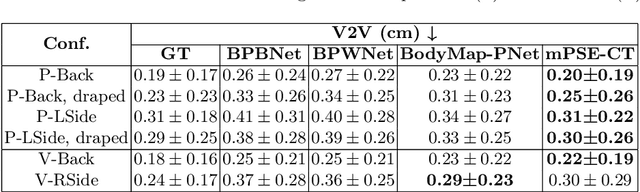
In perioperative care, precise in-bed 3D patient pose and shape estimation (PSE) can be vital in optimizing patient positioning in preoperative planning, enabling accurate overlay of medical images for augmented reality-based surgical navigation, and mitigating risks of prolonged immobility during recovery. Conventional PSE methods relying on modalities such as RGB-D, infrared, or pressure maps often struggle with occlusions caused by bedding and complex patient positioning, leading to inaccurate estimation that can affect clinical outcomes. To address these challenges, we present the first multi-modal in-bed patient 3D PSE network that fuses detailed geometric features extracted from routinely acquired computed tomography (CT) scans with depth maps (mPSE-CT). mPSE-CT incorporates a shape estimation module that utilizes probabilistic correspondence alignment, a pose estimation module with a refined neural network, and a final parameters mixing module. This multi-modal network robustly reconstructs occluded body regions and enhances the accuracy of the estimated 3D human mesh model. We validated mPSE-CT using proprietary whole-body rigid phantom and volunteer datasets in clinical scenarios. mPSE-CT outperformed the best-performing prior method by 23% and 49.16% in pose and shape estimation respectively, demonstrating its potential for improving clinical outcomes in challenging perioperative environments.