 Add to Chrome
 Add to Firefox
 Add to Edge
Predicting Drug-Drug Interactions Using Knowledge Graphs
Aug 11, 2023
In the last decades, people have been consuming and combining more drugs than before, increasing the number of Drug-Drug Interactions (DDIs). To predict unknown DDIs, recently, studies started incorporating Knowledge Graphs (KGs) since they are able to capture the relationships among entities providing better drug representations than using a single drug property. In this paper, we propose the medicX end-to-end framework that integrates several drug features from public drug repositories into a KG and embeds the nodes in the graph using various translation, factorisation and Neural Network (NN) based KG Embedding (KGE) methods. Ultimately, we use a Machine Learning (ML) algorithm that predicts unknown DDIs. Among the different translation and factorisation-based KGE models, we found that the best performing combination was the ComplEx embedding method with a Long Short-Term Memory (LSTM) network, which obtained an F1-score of 95.19% on a dataset based on the DDIs found in DrugBank version 5.1.8. This score is 5.61% better than the state-of-the-art model DeepDDI. Additionally, we also developed a graph auto-encoder model that uses a Graph Neural Network (GNN), which achieved an F1-score of 91.94%. Consequently, GNNs have demonstrated a stronger ability to mine the underlying semantics of the KG than the ComplEx model, and thus using higher dimension embeddings within the GNN can lead to state-of-the-art performance.

Multi-stream Data Analytics for Enhanced Performance Prediction in Fantasy Football
Dec 16, 2019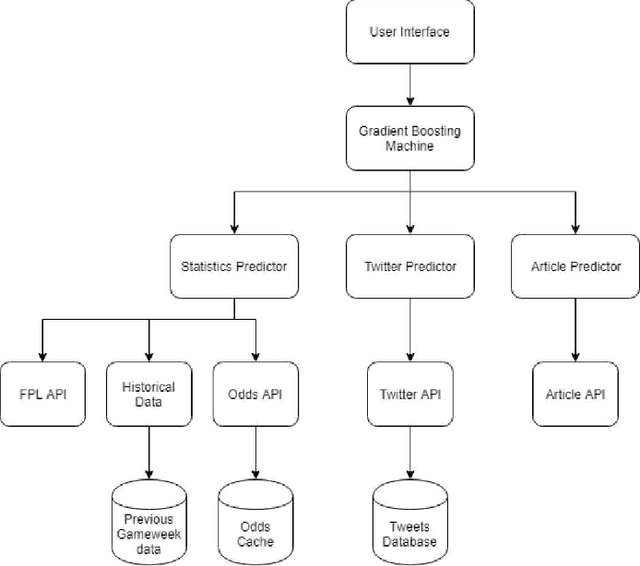
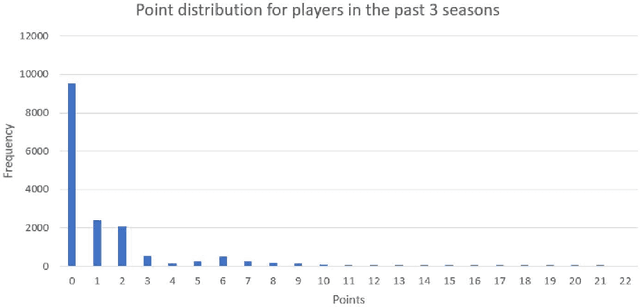
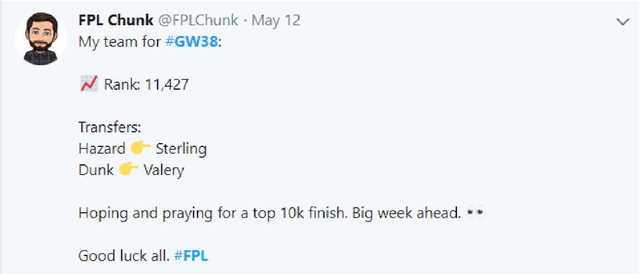
Fantasy Premier League (FPL) performance predictors tend to base their algorithms purely on historical statistical data. The main problems with this approach is that external factors such as injuries, managerial decisions and other tournament match statistics can never be factored into the final predictions. In this paper, we present a new method for predicting future player performances by automatically incorporating human feedback into our model. Through statistical data analysis such as previous performances, upcoming fixture difficulty ratings, betting market analysis, opinions of the general-public and experts alike via social media and web articles, we can improve our understanding of who is likely to perform well in upcoming matches. When tested on the English Premier League 2018/19 season, the model outperformed regular statistical predictors by over 300 points, an average of 11 points per week, ranking within the top 0.5% of players rank 30,000 out of over 6.5 million players.