 Add to Chrome
 Add to Firefox
 Add to Edge
Battery health reporting fails independent validation across manufacturers
Mar 23, 2026
Battery state-of-health (SOH) reported by on-board battery management systems (BMS) is the primary metric available to electric vehicle (EV) owners and regulators, yet no study has validated its reliability across manufacturers against independent measurements. Here we show, through an epidemiological study of 1,114 EVs spanning five manufacturers and 375 days, that battery health reporting is fundamentally unreliable: real capacity differences of 12-25% exist within every model, but BMS SOH fails to track them, with correlations ranging from \r{ho} = 0.10 (non-significant) to \r{ho} = 0.62 only under restrictive filtering, while 384 vehicles do not expose SOH at all. A manufacturer-independent electrochemical marker achieves 74-89% degradation classification accuracy across all platforms without requiring BMS data, and a controlled laboratory validation on cells identical to those in the fleet confirms that partial-voltage-window charge measurements track reference capacity with \r{ho} > 0.80 across all 60 voltage windows (p < 0.001). These findings reveal a structural information asymmetry with direct implications for the EU Battery Regulation's 2027 SOH transparency mandate, California's Advanced Clean Cars (ACC) II durability requirements, warranty enforcement, used-vehicle valuation, right-to-repair legislation, and second-life battery markets.

Dual-sided Peltier Elements for Rapid Thermal Feedback in Wearables
May 20, 2024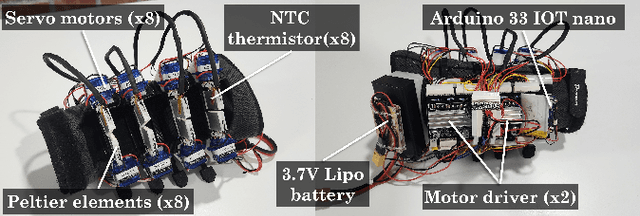
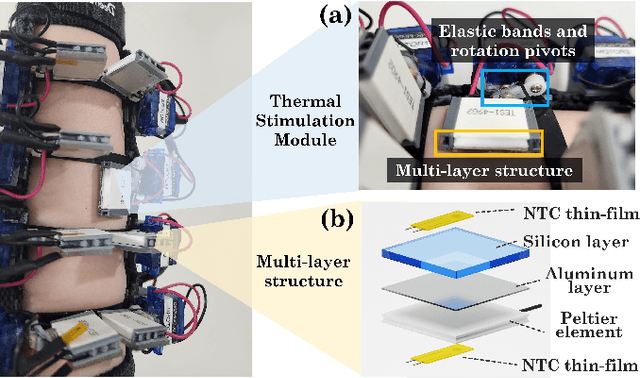
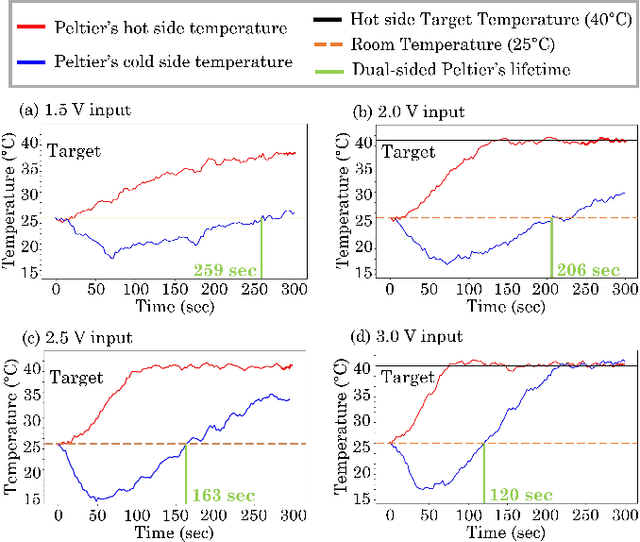
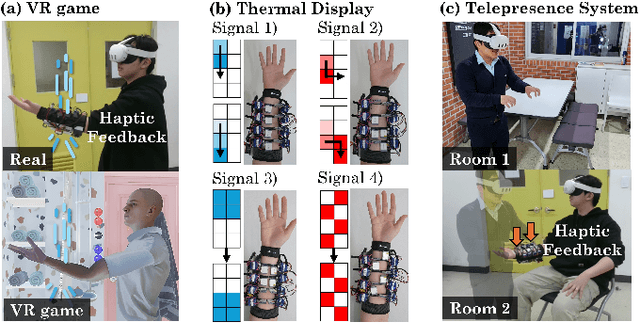
This paper introduces a motor-driven Peltier device designed to deliver immediate thermal sensations within extended reality (XR) environments. The system incorporates eight motor-driven Peltier elements, facilitating swift transitions between warm and cool sensations by rotating preheated or cooled elements to opposite sides. A multi-layer structure, comprising aluminum and silicone layers, ensures user comfort and safety while maintaining optimal temperatures for thermal stimuli. Time-temperature characteristic analysis demonstrates the system's ability to provide warm and cool sensations efficiently, with a dual-sided lifetime of up to 206 seconds at a 2V input. Our system design is adaptable to various body parts and can be synchronized with corresponding visual stimuli to enhance the immersive sensation of virtual object interaction and information delivery.