 Add to Chrome
 Add to Firefox
 Add to Edge
An Agentic AI Framework for Training General Practitioner Student Skills
Dec 20, 2025
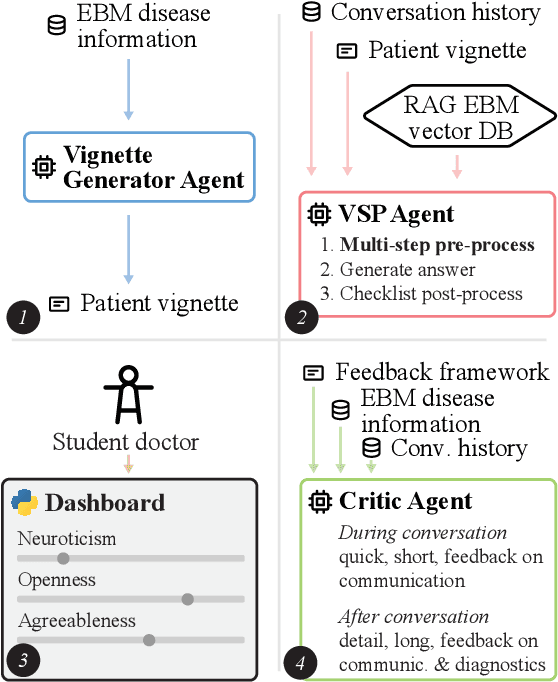
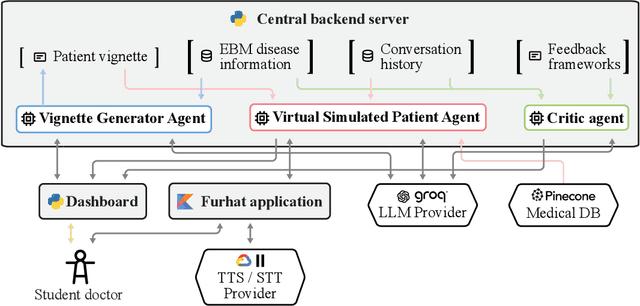
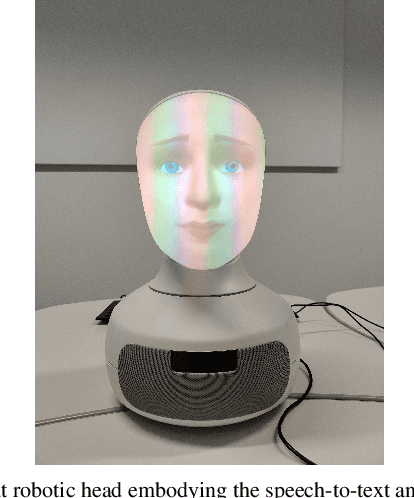
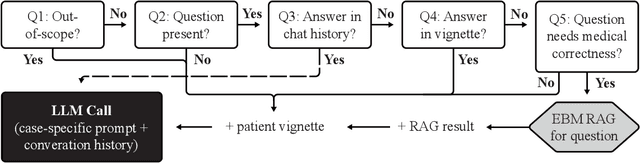
Advancements in large language models offer strong potential for enhancing virtual simulated patients (VSPs) in medical education by providing scalable alternatives to resource-intensive traditional methods. However, current VSPs often struggle with medical accuracy, consistent roleplaying, scenario generation for VSP use, and educationally structured feedback. We introduce an agentic framework for training general practitioner student skills that unifies (i) configurable, evidence-based vignette generation, (ii) controlled persona-driven patient dialogue with optional retrieval grounding, and (iii) standards-based assessment and feedback for both communication and clinical reasoning. We instantiate the framework in an interactive spoken consultation setting and evaluate it with medical students ($\mathbf{N{=}14}$). Participants reported realistic and vignette-faithful dialogue, appropriate difficulty calibration, a stable personality signal, and highly useful example-rich feedback, alongside excellent overall usability. These results support agentic separation of scenario control, interaction control, and standards-based assessment as a practical pattern for building dependable and pedagogically valuable VSP training tools.

CoNTACT: A Dutch COVID-19 Adapted BERT for Vaccine Hesitancy and Argumentation Detection
Mar 14, 2022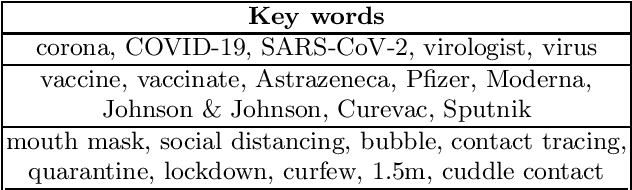
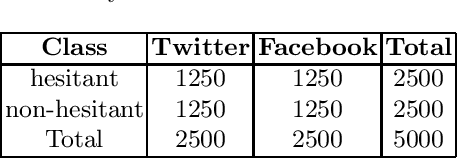
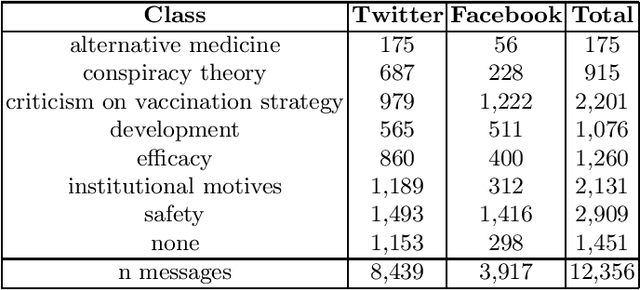
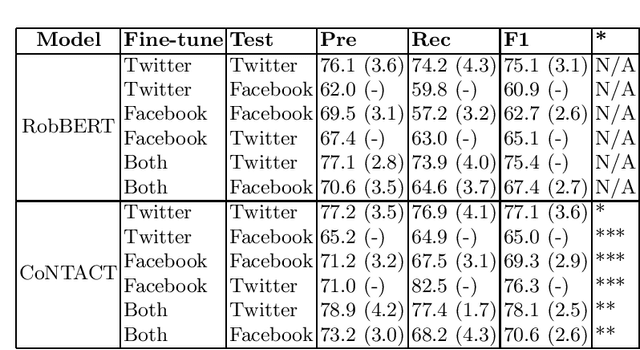
We present CoNTACT: a Dutch language model adapted to the domain of COVID-19 tweets. The model was developed by continuing the pre-training phase of RobBERT (Delobelle, 2020) by using 2.8M Dutch COVID-19 related tweets posted in 2021. In order to test the performance of the model and compare it to RobBERT, the two models were tested on two tasks: (1) binary vaccine hesitancy detection and (2) detection of arguments for vaccine hesitancy. For both tasks, not only Twitter but also Facebook data was used to show cross-genre performance. In our experiments, CoNTACT showed statistically significant gains over RobBERT in all experiments for task 1. For task 2, we observed substantial improvements in virtually all classes in all experiments. An error analysis indicated that the domain adaptation yielded better representations of domain-specific terminology, causing CoNTACT to make more accurate classification decisions.