 Add to Chrome
 Add to Firefox
 Add to Edge
Integration of Visual SLAM into Consumer-Grade Automotive Localization
Nov 10, 2025
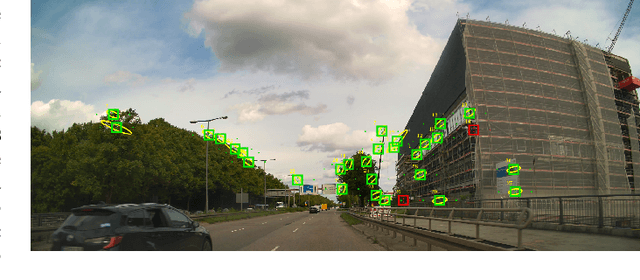

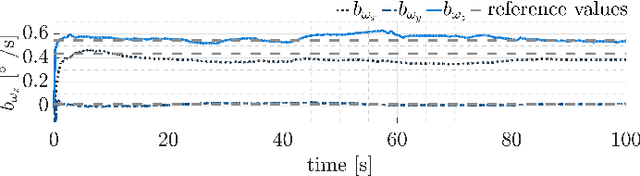
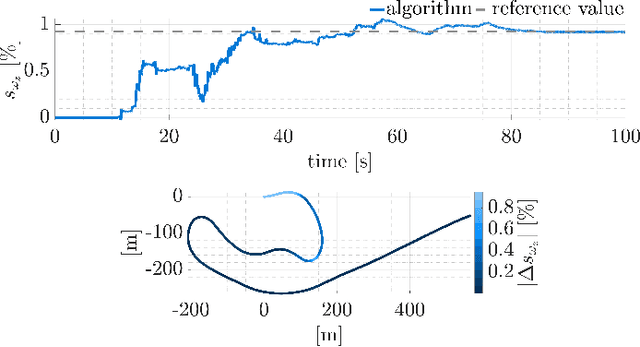
Accurate ego-motion estimation in consumer-grade vehicles currently relies on proprioceptive sensors, i.e. wheel odometry and IMUs, whose performance is limited by systematic errors and calibration. While visual-inertial SLAM has become a standard in robotics, its integration into automotive ego-motion estimation remains largely unexplored. This paper investigates how visual SLAM can be integrated into consumer-grade vehicle localization systems to improve performance. We propose a framework that fuses visual SLAM with a lateral vehicle dynamics model to achieve online gyroscope calibration under realistic driving conditions. Experimental results demonstrate that vision-based integration significantly improves gyroscope calibration accuracy and thus enhances overall localization performance, highlighting a promising path toward higher automotive localization accuracy. We provide results on both proprietary and public datasets, showing improved performance and superior localization accuracy on a public benchmark compared to state-of-the-art methods.

Robust Radar SLAM for Vehicle Parking Applications
Sep 10, 2025We address ego-motion estimation for automated parking, where centimeter-level accuracy is crucial due to tight spaces and nearby obstacles. Traditional methods using inertial-measurement units and wheel encoders require calibration, making them costly and time-consuming. To overcome this, we propose a radar-based simultaneous localization and mapping (SLAM) approach that leverages the robustness of radar to adverse weather and support for online calibration. Our robocentric formulation fuses feature positions and Doppler velocities for robust data association and filter convergence. Key contributions include a Doppler-augmented radar SLAM method, multi-radar support and an information-based feature-pruning strategy. Experiments demonstrate high-accuracy localization and improved robustness over state-of-the-art methods, meeting the demands of automated parking.