 Add to Chrome
 Add to Firefox
 Add to Edge
Quality-Driven Selective Mutation for Deep Learning
Apr 24, 2026
Mutants support testing and debugging in two roles: (i) as test goals and (ii) as substitutes for real faults. Hard-to-kill mutants provide better guidance for test improvement, while realism is essential when mutants are used to simulate real bugs. Building on these roles, selective mutation for deep learning (DL) aims to reduce the cost of mutant generation and execution by choosing operator configurations that yield resistant and realistic mutants. However, the DL literature lacks a unified measure that captures both aspects. This study presents a probabilistic framework to quantify mutant quality along two complementary axes: resistance and realism. Resistance adapts the classical notion of hard-to-kill mutants to the DL setting using statistical killing probabilities, while realism is measured via the generalized Jaccard similarity between mutant and real-fault detectability patterns. The framework enables ranking and filtering of low-quality mutation-operator configurations without assuming a specific use case. We empirically evaluate the approach on four datasets of real DL faults. Three datasets (CleanML, DeepFD, and DeepLocalize) are used to estimate and select high-quality operator configurations, and the held-out defect4ML dataset is used for validation. Results show that quality-driven selection reduces the number of generated mutants by up to 55.6% while preserving typical levels of resistance and realism under baseline-aligned selection thresholds. These findings confirm that dual-objective selection can lower cost without compromising the usefulness of mutants for either role.

When Data Quality Issues Collide: A Large-Scale Empirical Study of Co-Occurring Data Quality Issues in Software Defect Prediction
Dec 19, 2025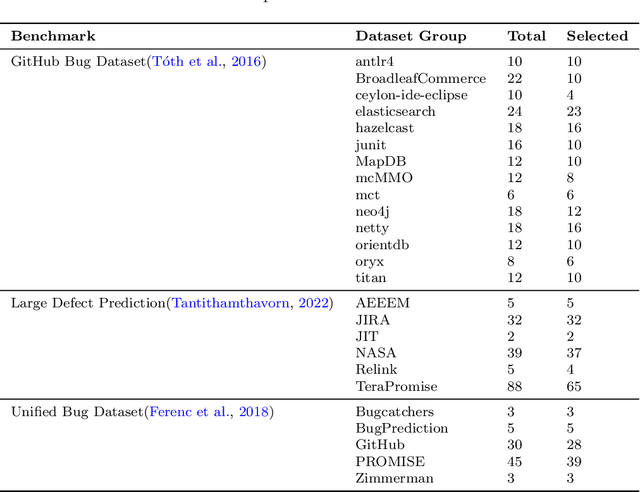
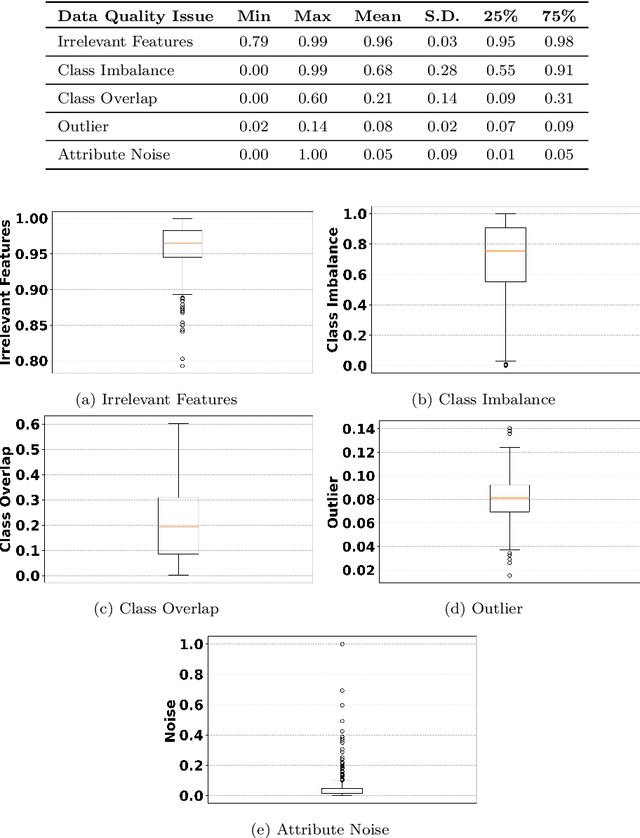
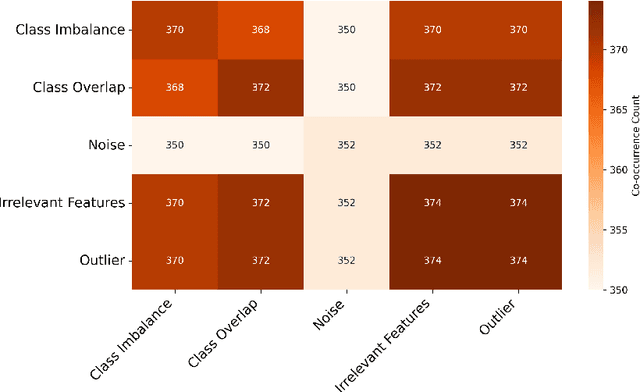
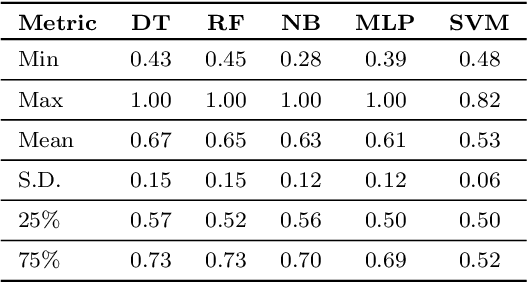
Software Defect Prediction (SDP) models are central to proactive software quality assurance, yet their effectiveness is often constrained by the quality of available datasets. Prior research has typically examined single issues such as class imbalance or feature irrelevance in isolation, overlooking that real-world data problems frequently co-occur and interact. This study presents, to our knowledge, the first large-scale empirical analysis in SDP that simultaneously examines five co-occurring data quality issues (class imbalance, class overlap, irrelevant features, attribute noise, and outliers) across 374 datasets and five classifiers. We employ Explainable Boosting Machines together with stratified interaction analysis to quantify both direct and conditional effects under default hyperparameter settings, reflecting practical baseline usage. Our results show that co-occurrence is nearly universal: even the least frequent issue (attribute noise) appears alongside others in more than 93% of datasets. Irrelevant features and imbalance are nearly ubiquitous, while class overlap is the most consistently harmful issue. We identify stable tipping points around 0.20 for class overlap, 0.65-0.70 for imbalance, and 0.94 for irrelevance, beyond which most models begin to degrade. We also uncover counterintuitive patterns, such as outliers improving performance when irrelevant features are low, underscoring the importance of context-aware evaluation. Finally, we expose a performance-robustness trade-off: no single learner dominates under all conditions. By jointly analyzing prevalence, co-occurrence, thresholds, and conditional effects, our study directly addresses a persistent gap in SDP research. Hence, moving beyond isolated analyses to provide a holistic, data-aware understanding of how quality issues shape model performance in real-world settings.