 Add to Chrome
 Add to Firefox
 Add to Edge
Guidelines for Designing AI Technologies to Support Adult Learning
May 06, 2026
AI-powered educational technologies have demonstrated measurable benefits for learners, but their design and evaluation have largely centered on K-12 contexts. As a result, many AI-supported learning systems remain poorly aligned with the needs, constraints, and goals of adult learners. To better understand how AI systems function in adult education, this paper examines the deployment of several AI learning technologies developed within a multidisciplinary, national research institute in the United States focused on adult learning and online education. Drawing on longitudinal deployment data, we conducted a reflexive thematic analysis to identify recurring challenges and design considerations across systems. These insights were synthesized into a set of 19 design guidelines intended to inform future AI-supported adult learning technologies. We demonstrate the utility of these guidelines through a heuristic evaluation of the deployed systems. Lastly, we present a guideline exploration tool that aids in the ideation of technologies by connecting the guidelines to stakeholder statements surfaced in the analysis process.

HTN-Based Tutors: A New Intelligent Tutoring Framework Based on Hierarchical Task Networks
May 23, 2024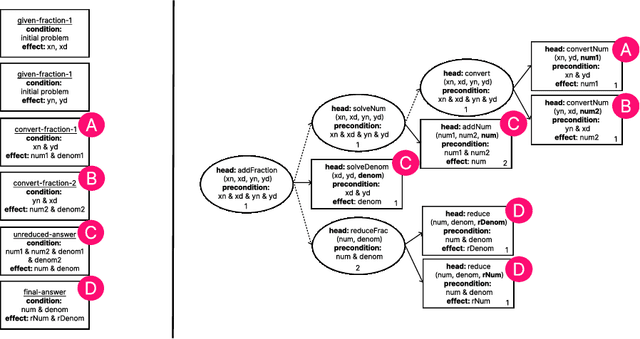
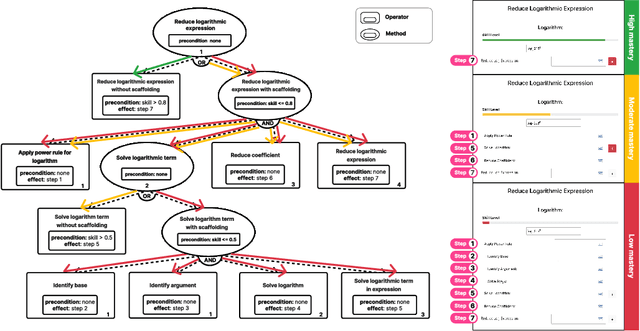
Intelligent tutors have shown success in delivering a personalized and adaptive learning experience. However, there exist challenges regarding the granularity of knowledge in existing frameworks and the resulting instructions they can provide. To address these issues, we propose HTN-based tutors, a new intelligent tutoring framework that represents expert models using Hierarchical Task Networks (HTNs). Like other tutoring frameworks, it allows flexible encoding of different problem-solving strategies while providing the additional benefit of a hierarchical knowledge organization. We leverage the latter to create tutors that can adapt the granularity of their scaffolding. This organization also aligns well with the compositional nature of skills.