 Add to Chrome
 Add to Firefox
 Add to Edge
Medical Image Understanding Improves Survival Prediction via Visual Instruction Tuning
Apr 20, 2026
Accurate prognostication and risk estimation are essential for guiding clinical decision-making and optimizing patient management. While radiologist-assessed features from CT scans provide valuable indicators of disease severity and outcomes, interpreting such images requires expert knowledge, and translating rich visual information into textual summaries inevitably leads to information loss. In this work, we propose a vision-language framework for 3D CT image understanding that leverages large-scale open-sourced CT images paired with radiology reports through visual instruction tuning. This pre-training enables the model to learn clinically meaningful visual-textual representations, which can then be adapted to downstream survival prediction tasks. By incorporating a survival prediction head on top of the pre-trained model, our approach improves survival prediction from CT images and clinical data while generating clinically meaningful language responses to predefined questions. Experimental results demonstrate that our method outperforms baseline methods in survival prediction, particularly, when clinical data alone is less predictive. The code will be released upon acceptance.

Weakly-Supervised Lung Nodule Segmentation via Training-Free Guidance of 3D Rectified Flow
Apr 09, 2026Dense annotations, such as segmentation masks, are expensive and time-consuming to obtain, especially for 3D medical images where expert voxel-wise labeling is required. Weakly supervised approaches aim to address this limitation, but often rely on attribution-based methods that struggle to accurately capture small structures such as lung nodules. In this paper, we propose a weakly-supervised segmentation method for lung nodules by combining pretrained state-of-the-art rectified flow and predictor models in a plug-and-play manner. Our approach uses training-free guidance of a 3D rectified flow model, requiring only fine-tuning of the predictor using image-level labels and no retraining of the generative model. The proposed method produces improved-quality segmentations for two separate predictors, consistently detecting lung nodules of varying size and shapes. Experiments on LUNA16 demonstrate improvements over baseline methods, highlighting the potential of generative foundation models as tools for weakly supervised 3D medical image segmentation.
Exemplar Diffusion: Improving Medical Object Detection with Opportunistic Labels
Mar 16, 2026We present a framework to take advantage of existing labels at inference, called \textit{exemplars}, in order to improve the performance of object detection in medical images. The method, \textit{exemplar diffusion}, leverages existing diffusion methods for object detection to enable a training-free approach to adding information of known bounding boxes at test time. We demonstrate that for medical image datasets with clear spatial structure, the method yields an across-the-board increase in average precision and recall, and a robustness to exemplar quality, enabling non-expert annotation. Moreover, we demonstrate how our method may also be used to quantify predictive uncertainty in diffusion detection methods. Source code and data splits openly available online: https://github.com/waahlstrand/ExemplarDiffusion
Explainable vertebral fracture analysis with uncertainty estimation using differentiable rule-based classification
Jul 03, 2024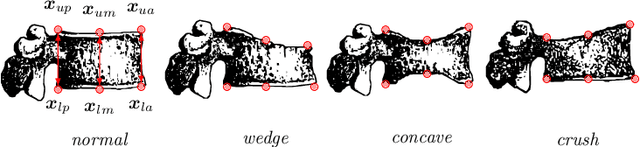
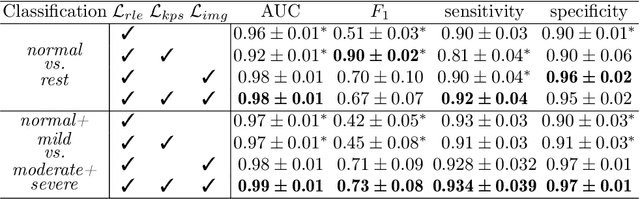
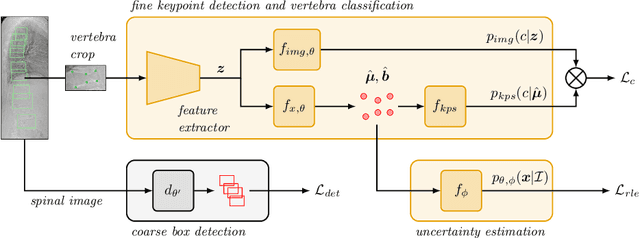
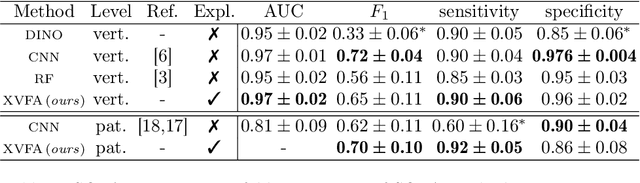
We present a novel method for explainable vertebral fracture assessment (XVFA) in low-dose radiographs using deep neural networks, incorporating vertebra detection and keypoint localization with uncertainty estimates. We incorporate Genant's semi-quantitative criteria as a differentiable rule-based means of classifying both vertebra fracture grade and morphology. Unlike previous work, XVFA provides explainable classifications relatable to current clinical methodology, as well as uncertainty estimations, while at the same time surpassing state-of-the art methods with a vertebra-level sensitivity of 93% and end-to-end AUC of 97% in a challenging setting. Moreover, we compare intra-reader agreement with model uncertainty estimates, with model reliability on par with human annotators.