 Add to Chrome
 Add to Firefox
 Add to Edge
Location Aware Embedding for Geotargeting in Sponsored Search Advertising
Mar 14, 2026
Web search has become an inevitable part of everyday life. Improving and monetizing web search has been a focus of major Internet players. Understanding the context of web search query is an important aspect of this task as it represents unobserved facts that add meaning to an otherwise incomplete query.The context of a query consists of user's location, local time, search history, behavioral segments, installed apps on their phone and so on. Queries that either explicitly use location context (eg: "best hotels in New York City") or implicitly refer to the user's physical location (e.g. "coffee shops near me") are becoming increasingly common on mobile devices. Understanding and representing the user's interest location and/or physical location is essential for providing a relevant user experience. In this study, we developed a simple and powerful neural embedding based framework to represent a user's query and their location in a single low-dimensional space. We show that this representation is able to capture the subtle interactions between the user's query intent and query/physical location, while improving the ad ranking and query-ad relevance scores over other location-unaware approaches and location-aware approaches.

Time-Aware Prospective Modeling of Users for Online Display Advertising
Nov 12, 2019
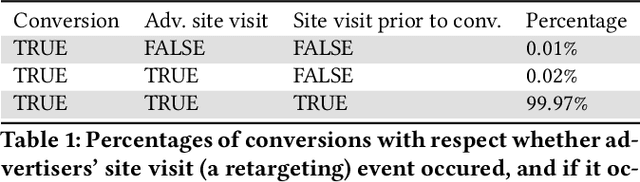
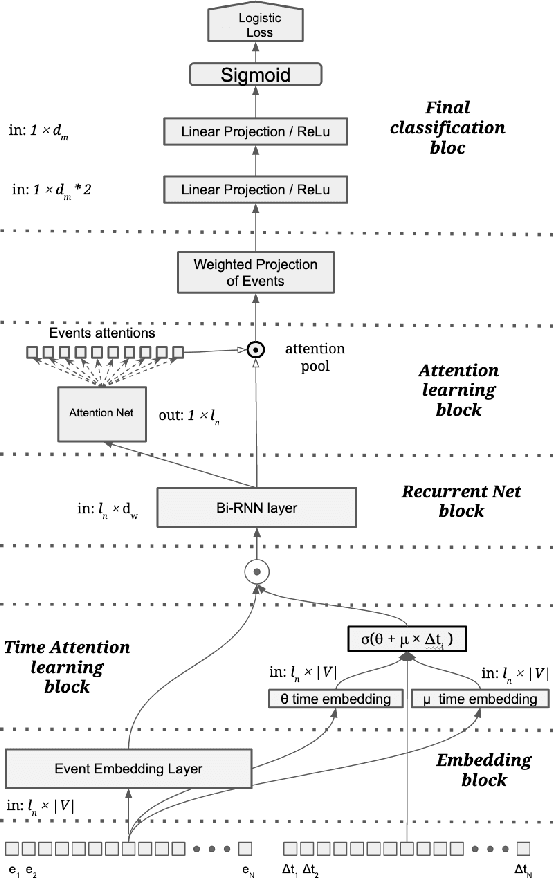
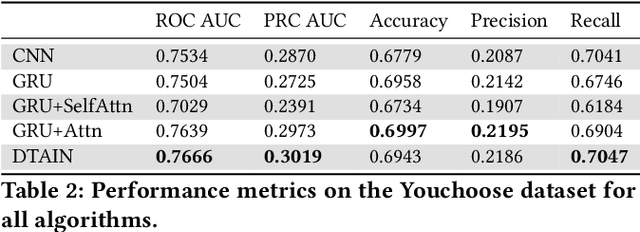
Prospective display advertising poses a great challenge for large advertising platforms as the strongest predictive signals of users are not eligible to be used in the conversion prediction systems. To that end efforts are made to collect as much information as possible about each user from various data sources and to design powerful models that can capture weaker signals ultimately obtaining good quality of conversion prediction probability estimates. In this study we propose a novel time-aware approach to model heterogeneous sequences of users' activities and capture implicit signals of users' conversion intents. On two real-world datasets we show that our approach outperforms other, previously proposed approaches, while providing interpretability of signal impact to conversion probability.
Learning from Multi-User Activity Trails for B2B Ad Targeting
Aug 29, 2019
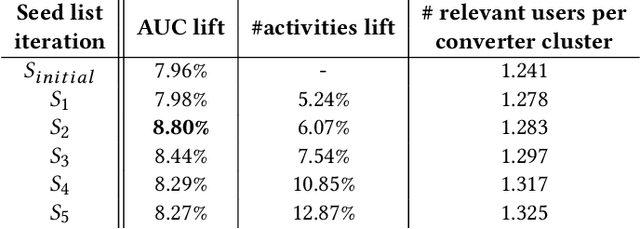


Online purchase decisions in organizations can go through a complex journey with multiple agents involved in the decision making process. Depending on the product being purchased, and the organizational structure, the process may involve employees who first conduct market research, and then influence decision makers who place the online purchase order. In such cases, the online activity trail of a single individual in the organization may only provide partial information for predicting purchases (conversions). To refine conversion prediction for business-to-business (B2B) products using online activity trails, we introduce the notion of relevant users in an organization with respect to a given B2B advertiser, and leverage the collective activity trails of such relevant users to predict conversions. In particular, our notion of relevant users is tied to a seed list of relevant activities for a B2B advertiser, and we propose a method using distributed activity representations to build such a seed list. Experiments using data from Yahoo Gemini demonstrate that the proposed methods can improve conversion prediction AUC by 8.8%, and provide an interpretable advertiser specific list of activities useful for B2B ad targeting.