 Add to Chrome
 Add to Firefox
 Add to Edge
ReasonBreak: Probing Vulnerabilities in Reasoning-Enabled Vision-Language-Action Models for Autonomous Driving
May 27, 2026
Vision-Language-Action (VLA) models with integrated reasoning have been proposed for end-to-end autonomous driving, assuming a tight coupling between reasoning and trajectory generation. However, the robustness of such systems under realistic input perturbations remains largely unexplored. We show that these models are highly vulnerable to realistic input perturbations, achieving up to 89% attack success rate (ASR) on reasoning and up to 72% on trajectory manipulation in closed-loop simulation, leading to increased collision rates and degraded safety metrics. Using NVIDIA's recent Alpamayo models as representative industry-developed VLAs, we conduct the first systematic black-box study of reasoning-enabled VLA models under realistic textual input corruptions, evaluating their impact on reasoning and driving behavior. We introduce a reasoning-aware evaluation framework capturing both semantic and structural aspects of reasoning, along with safety-centric measures. We also introduce a benchmark for evaluating attacks and defenses on reasoning-trajectory interactions in autonomous driving. Our results highlight the need for rigorous evaluation and improved defenses to ensure the safety of reasoning-enabled VLA systems in autonomous driving.

Codec-Robust Attacks on Audio LLMs
May 19, 2026Prior attacks on Audio Large Language Models (Audio LLMs) demonstrated that carefully crafted waveform-domain perturbations can force targeted adversarial outputs. As a defense mechanism against these attacks, real-world codec compression preprocessing has been studied to both detect and remove the perturbations. Yet no existing attack has demonstrated robustness against these compressions. We introduce CodecAttack, which optimizes a perturbation in a neural audio codec's continuous latent space rather than directly perturbing the audio waveform. We show that the codec's compression channel, which discards waveform perturbations, transmits perturbations crafted in its own latent space. To further harden the attack across real-world compression channels, we apply multi-bitrate straight-through Expectation-over-Transformation (EoT), all without modifying the target model. Across three realistic Audio LLM deployment scenarios and three target models, CodecAttack achieves an average 85.5% target-substring attack success rate (ASR) on Opus at moderate bitrates, while the waveform baseline trained with identical EoT hardening does not exceed 26% at any bitrate. The attack transfers to held-out codecs, reaching up to 100% ASR on MP3 and 84% on AAC-LC without retraining. A per-band energy analysis shows that the latent perturbation concentrates below 4kHz, exactly where codecs allocate the most bits, while the waveform baseline spreads into higher frequencies that codecs discard. These results demonstrate that lossy compression is not a reliable defense against adversarial audio and that codec-aware attacks pose a practical threat to deployed Audio LLM systems.
Systematic Discovery of Semantic Attacks in Online Map Construction through Conditional Diffusion
May 14, 2026Autonomous vehicles depend on online HD map construction to perceive lane boundaries, dividers, and pedestrian crossings -- safety-critical road elements that directly govern motion planning. While existing pixel perturbation attacks can disrupt the mapping, they can be neutralized by standard adversarial defenses. We present MIRAGE, a framework for systematic discovery of semantic attacks that bypass adversarial defenses and degrade mapping predictions by finding plausible environmental variation (e.g. shadows, wet roads). MIRAGE exploits the latent manifold of real-world data learned by diffusion models, and searches for semantically mutated scenes neighboring the ground truth with the same road topology yet mislead the mapping predictions. We evaluate MIRAGE on nuScenes and demonstrate two attacks: (1) boundary removal, suppressing 57.7% of detections and corrupting 96% of planned trajectories; and (2) boundary injection, the only method that successfully injects fictitious boundaries, while pixel PGD and AdvPatch fail entirely. Both attacks remain potent under various adversarial defenses. We use two independent VLM judges to quantify realism, where MIRAGE passes as realistic 80--84% of the time (vs. 97--99% for clean nuScenes), while AdvPatch only 0--9%. Our findings expose a categorical gap in current adversarial defenses: semantic-level perturbations that manifest as legitimate environmental variation are substantially harder to mitigate than pixel-level perturbations.
The Great Pretender: A Stochasticity Problem in LLM Jailbreak
May 14, 2026"Oh-Oh, yes, I'm the great pretender. Pretending that I'm doing well. My need is such, I pretend too much..." summarizes the state in the area of jailbreak creation and evaluation. You find this method to generate adversarial attacks proposed by a reputable institution (e.g., BoN from Anthropic or Crescendo from Microsoft Research). However, this method does not deliver on the promise claimed in the paper despite having top ASR scores against industry-grade LLMs. You successfully generate the jailbreak prompts against your target (open) model. However, the generated jailbreak prompt works against the target model with a 50% consecutive success rate (5 out of 10 attempts) despite having an 80% ASR (on paper) on the latest closed-source model (with a guardrail system)! This observation leads us to think. First, Attack Success Rate (ASR), the primary metric for LLM jailbreak benchmarking, is not a stable quantity. Second, published ASR numbers are therefore systematically inflated and incomparable across papers. Therefore, we wonder "Why a successful jailbreak prompt does not perform consistently well against a target model on which the prompts have been optimized?". To answer this question, we study the impact of stochasticity not only during attack evaluation but also during attack generation. Our evaluation includes several jailbreak attacks, models (different sizes and providers), and judges. In addition, we propose a new metric and two new frameworks (CAS-eval and CAS-gen). Our evaluation framework, CAS-eval, shows that an attack can have an ASR drop of up to 30 percentage points when a jailbreak prompt needs to succeed on more than one attempt. Thankfully, our attack generation framework (CAS-gen) improves previous jailbreak methods and helps them recover this loss of 30 percentage points!
Uncertainty Quantification for Collaborative Object Detection Under Adversarial Attacks
Feb 04, 2025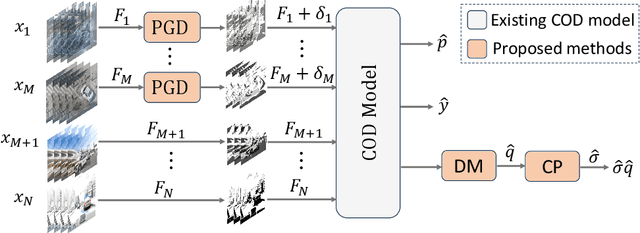
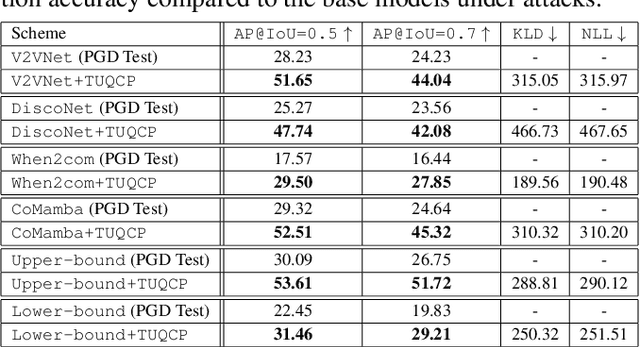
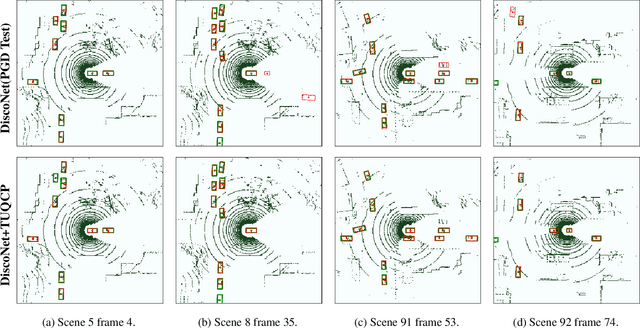
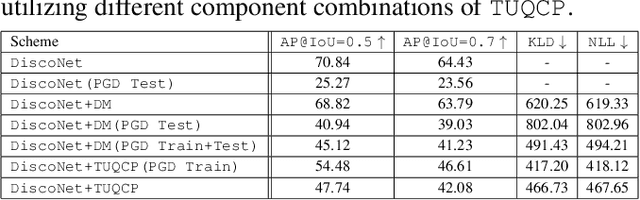
Collaborative Object Detection (COD) and collaborative perception can integrate data or features from various entities, and improve object detection accuracy compared with individual perception. However, adversarial attacks pose a potential threat to the deep learning COD models, and introduce high output uncertainty. With unknown attack models, it becomes even more challenging to improve COD resiliency and quantify the output uncertainty for highly dynamic perception scenes such as autonomous vehicles. In this study, we propose the Trusted Uncertainty Quantification in Collaborative Perception framework (TUQCP). TUQCP leverages both adversarial training and uncertainty quantification techniques to enhance the adversarial robustness of existing COD models. More specifically, TUQCP first adds perturbations to the shared information of randomly selected agents during object detection collaboration by adversarial training. TUQCP then alleviates the impacts of adversarial attacks by providing output uncertainty estimation through learning-based module and uncertainty calibration through conformal prediction. Our framework works for early and intermediate collaboration COD models and single-agent object detection models. We evaluate TUQCP on V2X-Sim, a comprehensive collaborative perception dataset for autonomous driving, and demonstrate a 80.41% improvement in object detection accuracy compared to the baselines under the same adversarial attacks. TUQCP demonstrates the importance of uncertainty quantification to COD under adversarial attacks.