 Add to Chrome
 Add to Firefox
 Add to Edge
Not Just After One: Sleep-Inspired Replay Prevents Catastrophic Forgetting After Sequential Tasks
Jun 07, 2026
One of the critical limitations of artificial neural networks is their lack of ability to continually learn: training on new tasks often leads to interference and forgetting of the previous ones. While several algorithms have been proposed to protect old memories from interference, they are typically applied during or immediately after each new episode of training. In contrast, humans and animals can learn continuously, acquiring multiple new memories during active learning before consolidating all of them into long-term storage. Here we show that multiple new tasks can be trained sequentially before an unsupervised sleep-like replay phase is applied to partially restore performance across all previously learned tasks. Our study further suggests that task-specific information remains resilient to new training but decays gradually as network is trained on new tasks. These findings point to novel principles for developing a broad range of continual learning AI solutions.

Context is All You Need
Apr 06, 2026Artificial Neural Networks (ANNs) are increasingly deployed across diverse real-world settings, where they must operate under data distributions that differ from those seen during training. This challenge is central to Domain Generalization (DG), which trains models to generalize to unseen domains without target data, and Test-Time Adaptation (TTA), which improves robustness by adapting to unlabeled test data at deployment. Existing approaches to address these challenges are often complex, resource-intensive, and difficult to scale. We introduce CONTXT (Contextual augmentatiOn for Neural feaTure X Transforms), a simple and intuitive method for contextual adaptation. CONTXT modulates internal representations using simple additive and multiplicative feature transforms. Within a TTA setting, it yields consistent gains across discriminative tasks (e.g., ANN/CNN classification) and generative models (e.g., LLMs). The method is lightweight, easy to integrate, and incurs minimal overhead, enabling robust performance under domain shift without added complexity. More broadly, CONTXT provides a compact way to steer information flow and neural processing without retraining.
Slumbering to Precision: Enhancing Artificial Neural Network Calibration Through Sleep-like Processes
Mar 09, 2026Artificial neural networks are often overconfident, undermining trust because their predicted probabilities do not match actual accuracy. Inspired by biological sleep and the role of spontaneous replay in memory and learning, we introduce Sleep Replay Consolidation (SRC), a novel calibration approach. SRC is a post-training, sleep-like phase that selectively replays internal representations to update network weights and improve calibration without supervised retraining. Across multiple experiments, SRC is competitive with and complementary to standard approaches such as temperature scaling. Combining SRC with temperature scaling achieves the best Brier score and entropy trade-offs for AlexNet and VGG19. These results show that SRC provides a fundamentally novel approach to improving neural network calibration. SRC-based calibration offers a practical path toward more trustworthy confidence estimates and narrows the gap between human-like uncertainty handling and modern deep networks.
Unsupervised Replay Strategies for Continual Learning with Limited Data
Oct 21, 2024Artificial neural networks (ANNs) show limited performance with scarce or imbalanced training data and face challenges with continuous learning, such as forgetting previously learned data after new tasks training. In contrast, the human brain can learn continuously and from just a few examples. This research explores the impact of 'sleep', an unsupervised phase incorporating stochastic activation with local Hebbian learning rules, on ANNs trained incrementally with limited and imbalanced datasets, specifically MNIST and Fashion MNIST. We discovered that introducing a sleep phase significantly enhanced accuracy in models trained with limited data. When a few tasks were trained sequentially, sleep replay not only rescued previously learned information that had been catastrophically forgetting following new task training but often enhanced performance in prior tasks, especially those trained with limited data. This study highlights the multifaceted role of sleep replay in augmenting learning efficiency and facilitating continual learning in ANNs.
Sleep-Like Unsupervised Replay Improves Performance when Data are Limited or Unbalanced
Feb 12, 2024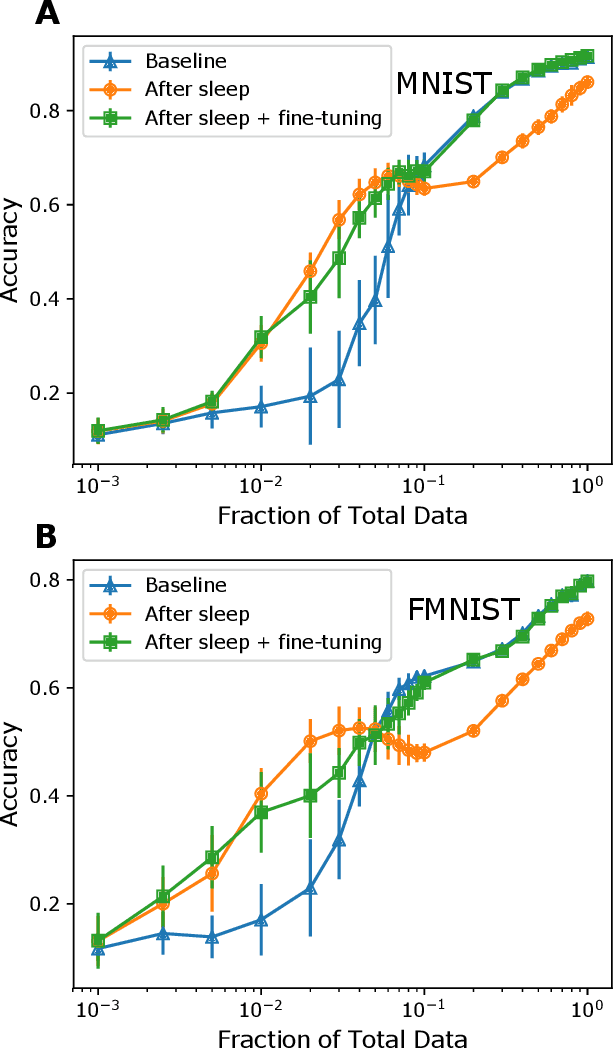
The performance of artificial neural networks (ANNs) degrades when training data are limited or imbalanced. In contrast, the human brain can learn quickly from just a few examples. Here, we investigated the role of sleep in improving the performance of ANNs trained with limited data on the MNIST and Fashion MNIST datasets. Sleep was implemented as an unsupervised phase with local Hebbian type learning rules. We found a significant boost in accuracy after the sleep phase for models trained with limited data in the range of 0.5-10% of total MNIST or Fashion MNIST datasets. When more than 10% of the total data was used, sleep alone had a slight negative impact on performance, but this was remedied by fine-tuning on the original data. This study sheds light on a potential synaptic weight dynamics strategy employed by the brain during sleep to enhance memory performance when training data are limited or imbalanced.