 Add to Chrome
 Add to Firefox
 Add to Edge
Pre-process for segmentation task with nonlinear diffusion filters
Apr 23, 2026
This paper deals with the case of using nonlinear diffusion filters to obtain piecewise constant images as a previous process for segmentation techniques. We first show an intrinsic formulation for the nonlinear diffusion equation to provide some design conditions on the diffusion filters. According to this theoretical framework, we propose a new family of diffusivities; they are obtained from nonlinear diffusion techniques and are related with backward diffusion. Their goal is to split the image in closed contours with a homogenized grey intensity inside and with no blurred edges. We also prove that our filters satisfy the well-posedness semi-discrete and full discrete scale-space requirements. This shows that by using semi-implicit schemes, a forward nonlinear diffusion equation is solved, instead of a backward nonlinear diffusion equation, connecting with an edge-preserving process. Under the conditions established for the diffusivity and using a stopping criterion for the diffusion time, we get piecewise constant images with a low computational effort. Finally, we test our filter with real images and we illustrate the effects of our diffusivity function as a method to get piecewise constant images. The code is available at https://github.com/cplatero/NonlinearDiffusion.

Dissecting Performative Prediction: A Comprehensive Survey
Feb 10, 2026The field of performative prediction had its beginnings in 2020 with the seminal paper "Performative Prediction" by Perdomo et al., which established a novel machine learning setup where the deployment of a predictive model causes a distribution shift in the environment, which in turn causes a mismatch between the distribution expected by the predictive model and the real distribution. This shift is defined by a so-called distribution map. In the half-decade since, a literature has emerged which has, among other things, introduced new solution concepts to the original setup, extended the setup, offered new theoretical analyses, and examined the intersection of performative prediction and other established fields. In this survey, we first lay out the performative prediction setting and explain the different optimization targets: performative stability and performative optimality. We introduce a new way of classifying different performative prediction settings, based on how much information is available about the distribution map. We survey existing implementations of distribution maps and existing methods to address the problem of performative prediction, while examining different ways to categorize them. Finally, we point out known and previously unknown connections that can be drawn to other fields, in the hopes of stimulating future research.
The Decoupled Risk Landscape in Performative Prediction
Jun 10, 2025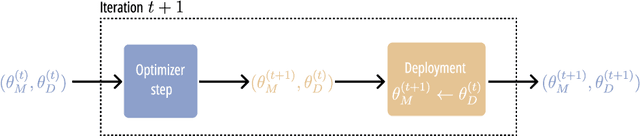
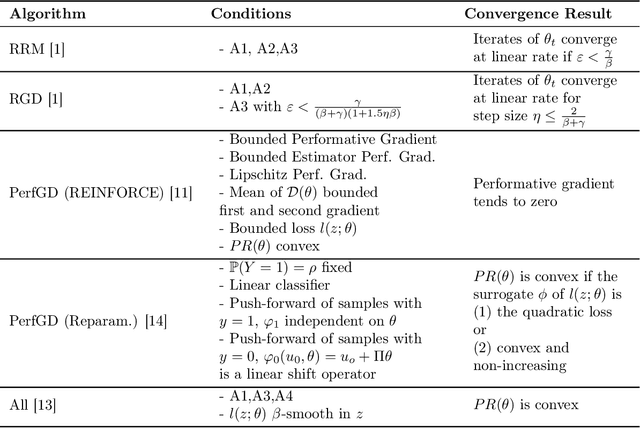
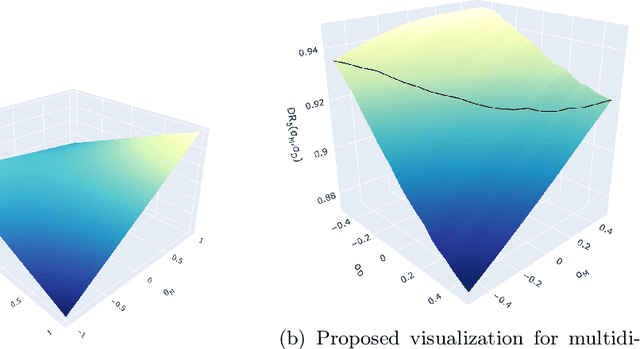
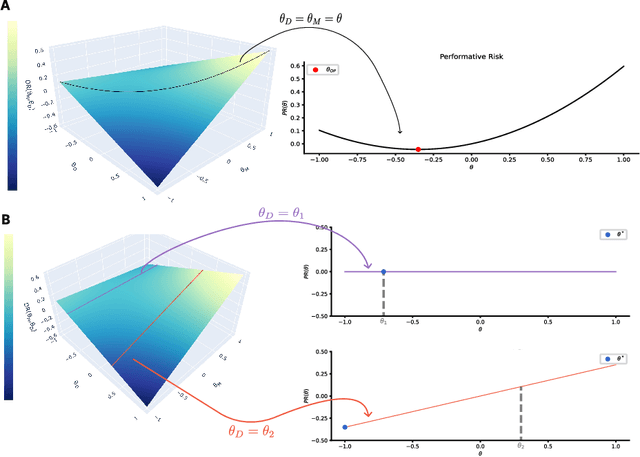
Performative Prediction addresses scenarios where deploying a model induces a distribution shift in the input data, such as individuals modifying their features and reapplying for a bank loan after rejection. Literature has had a theoretical perspective giving mathematical guarantees for convergence (either to the stable or optimal point). We believe that visualization of the loss landscape can complement this theoretical advances with practical insights. Therefore, (1) we introduce a simple decoupled risk visualization method inspired in the two-step process that performative prediction is. Our approach visualizes the risk landscape with respect to two parameter vectors: model parameters and data parameters. We use this method to propose new properties of the interest points, to examine how existing algorithms traverse the risk landscape and perform under more realistic conditions, including strategic classification with non-linear models. (2) Building on this decoupled risk visualization, we introduce a novel setting - extended Performative Prediction - which captures scenarios where the distribution reacts to a model different from the decision-making one, reflecting the reality that agents often lack full access to the deployed model.