 Add to Chrome
 Add to Firefox
 Add to Edge
Size Transferability of Graph Transformers with Convolutional Positional Encodings
Feb 16, 2026
Transformers have achieved remarkable success across domains, motivating the rise of Graph Transformers (GTs) as attention-based architectures for graph-structured data. A key design choice in GTs is the use of Graph Neural Network (GNN)-based positional encodings to incorporate structural information. In this work, we study GTs through the lens of manifold limit models for graph sequences and establish a theoretical connection between GTs with GNN positional encodings and Manifold Neural Networks (MNNs). Building on transferability results for GNNs under manifold convergence, we show that GTs inherit transferability guarantees from their positional encodings. In particular, GTs trained on small graphs provably generalize to larger graphs under mild assumptions. We complement our theory with extensive experiments on standard graph benchmarks, demonstrating that GTs exhibit scalable behavior on par with GNNs. To further show the efficiency in a real-world scenario, we implement GTs for shortest path distance estimation over terrains to better illustrate the efficiency of the transferable GTs. Our results provide new insights into the understanding of GTs and suggest practical directions for efficient training of GTs in large-scale settings.

A Constrained Optimization Perspective of Unrolled Transformers
Jan 24, 2026We introduce a constrained optimization framework for training transformers that behave like optimization descent algorithms. Specifically, we enforce layerwise descent constraints on the objective function and replace standard empirical risk minimization (ERM) with a primal-dual training scheme. This approach yields models whose intermediate representations decrease the loss monotonically in expectation across layers. We apply our method to both unrolled transformer architectures and conventional pretrained transformers on tasks of video denoising and text classification. Across these settings, we observe constrained transformers achieve stronger robustness to perturbations and maintain higher out-of-distribution generalization, while preserving in-distribution performance.
Loss Shaping Constraints for Long-Term Time Series Forecasting
Feb 14, 2024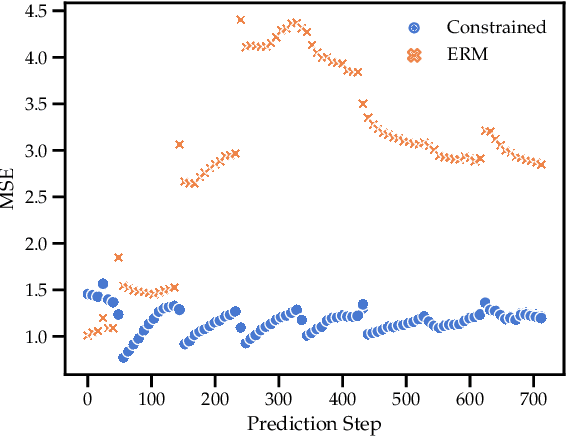
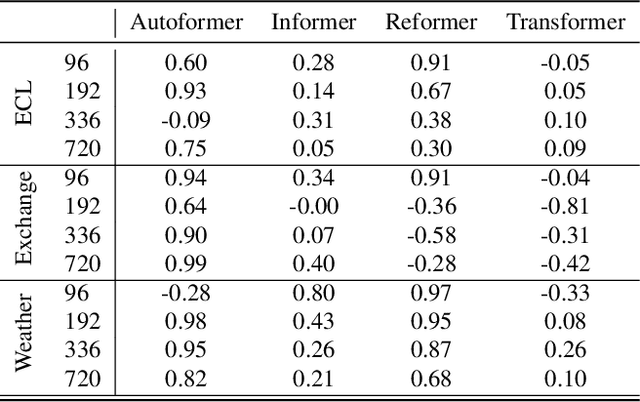
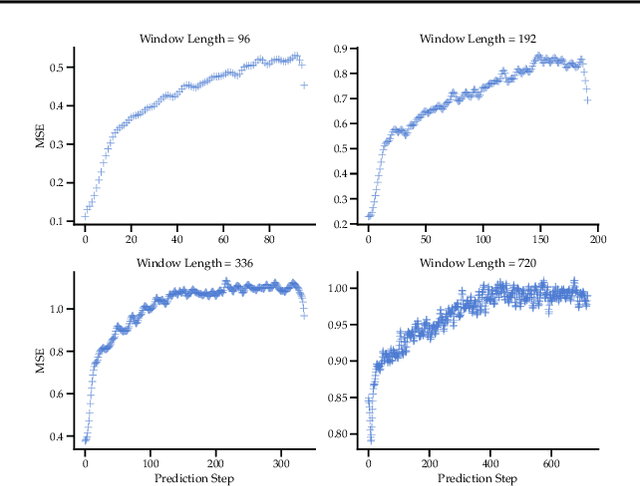
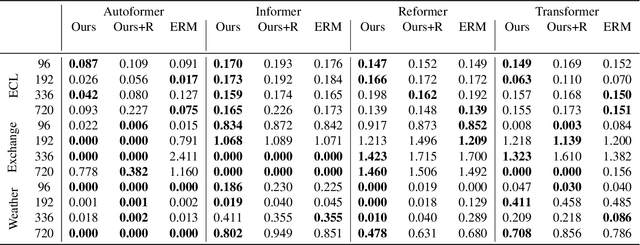
Several applications in time series forecasting require predicting multiple steps ahead. Despite the vast amount of literature in the topic, both classical and recent deep learning based approaches have mostly focused on minimising performance averaged over the predicted window. We observe that this can lead to disparate distributions of errors across forecasting steps, especially for recent transformer architectures trained on popular forecasting benchmarks. That is, optimising performance on average can lead to undesirably large errors at specific time-steps. In this work, we present a Constrained Learning approach for long-term time series forecasting that aims to find the best model in terms of average performance that respects a user-defined upper bound on the loss at each time-step. We call our approach loss shaping constraints because it imposes constraints on the loss at each time step, and leverage recent duality results to show that despite its non-convexity, the resulting problem has a bounded duality gap. We propose a practical Primal-Dual algorithm to tackle it, and demonstrate that the proposed approach exhibits competitive average performance in time series forecasting benchmarks, while shaping the distribution of errors across the predicted window.