 Add to Chrome
 Add to Firefox
 Add to Edge
Which Way from B to A: The role of embedding geometry in image interpolation for Stable Diffusion
Nov 16, 2025
It can be shown that Stable Diffusion has a permutation-invariance property with respect to the rows of Contrastive Language-Image Pretraining (CLIP) embedding matrices. This inspired the novel observation that these embeddings can naturally be interpreted as point clouds in a Wasserstein space rather than as matrices in a Euclidean space. This perspective opens up new possibilities for understanding the geometry of embedding space. For example, when interpolating between embeddings of two distinct prompts, we propose reframing the interpolation problem as an optimal transport problem. By solving this optimal transport problem, we compute a shortest path (or geodesic) between embeddings that captures a more natural and geometrically smooth transition through the embedding space. This results in smoother and more coherent intermediate (interpolated) images when rendered by the Stable Diffusion generative model. We conduct experiments to investigate this effect, comparing the quality of interpolated images produced using optimal transport to those generated by other standard interpolation methods. The novel optimal transport--based approach presented indeed gives smoother image interpolations, suggesting that viewing the embeddings as point clouds (rather than as matrices) better reflects and leverages the geometry of the embedding space.

Consistency of Feature Attribution in Deep Learning Architectures for Multi-Omics
Jul 30, 2025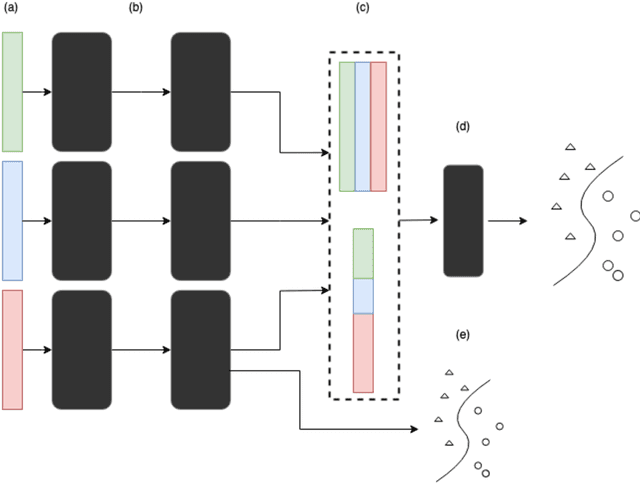
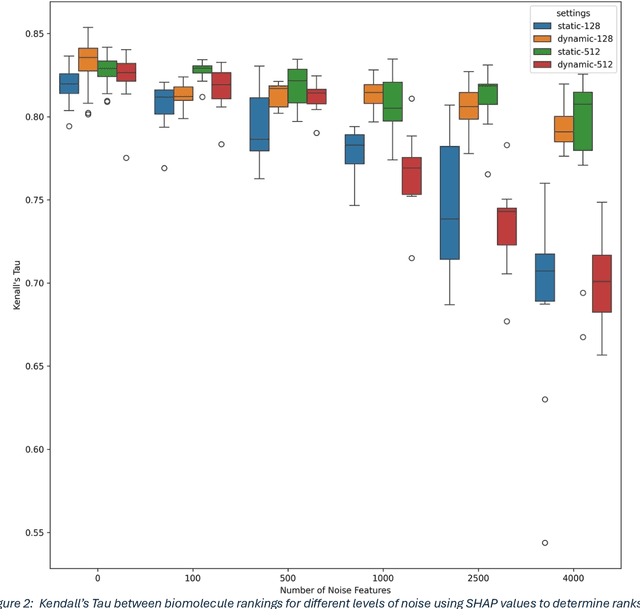
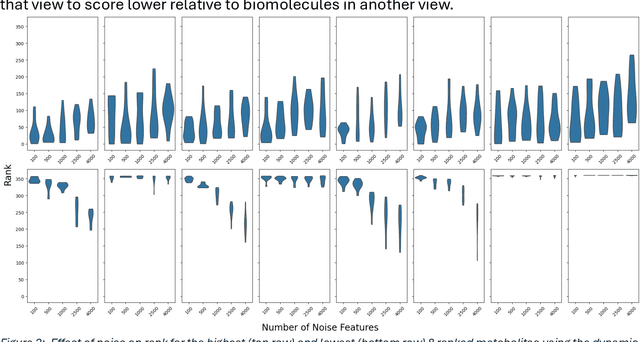
Machine and deep learning have grown in popularity and use in biological research over the last decade but still present challenges in interpretability of the fitted model. The development and use of metrics to determine features driving predictions and increase model interpretability continues to be an open area of research. We investigate the use of Shapley Additive Explanations (SHAP) on a multi-view deep learning model applied to multi-omics data for the purposes of identifying biomolecules of interest. Rankings of features via these attribution methods are compared across various architectures to evaluate consistency of the method. We perform multiple computational experiments to assess the robustness of SHAP and investigate modeling approaches and diagnostics to increase and measure the reliability of the identification of important features. Accuracy of a random-forest model fit on subsets of features selected as being most influential as well as clustering quality using only these features are used as a measure of effectiveness of the attribution method. Our findings indicate that the rankings of features resulting from SHAP are sensitive to the choice of architecture as well as different random initializations of weights, suggesting caution when using attribution methods on multi-view deep learning models applied to multi-omics data. We present an alternative, simple method to assess the robustness of identification of important biomolecules.