 Add to Chrome
 Add to Firefox
 Add to Edge
On Out-of-sample Embedding in UMAP
Jun 03, 2026
Neighbor embedding algorithms reveal correlations in high-dimensional data by constructing an equivalent graph representation in a lower-dimensional space. An increasingly popular algorithm is Uniform Manifold Learning and Projection (UMAP), which uses algebraic topology to map distances between the two spaces. While it works well on many types of data sets, UMAP has trouble adding out-of-sample points to a pre-existing mapping. In particular, UMAP often places new points on the periphery of the found clusters, rather than in their interiors with their correlated neighbors. Here, we overcome this ``repulsion effect'' by optimizing pairwise interactions within the original k-nearest-neighbor graph. Moreover, we show that parameterizing UMAP obtains better embeddings than non-parametric algorithms, particularly as the data gets more complex (e.g., medical images). We also show that the repulsion effect is naturally mitigated when a parameterized UMAP is employed to embed the data. We characterize different UMAP approaches using trustworthiness, nearest neighbor classifiers, and by analyzing attractive and repulsive forces in the embeddings.

The Shape of Attraction in UMAP: Exploring the Embedding Forces in Dimensionality Reduction
Mar 12, 2025Uniform manifold approximation and projection (UMAP) is among the most popular neighbor embedding methods. The method relies on attractive and repulsive forces among high-dimensional data points to obtain a low-dimensional embedding. In this paper, we analyze the forces to reveal their effects on cluster formations and visualization. Repulsion emphasizes differences, controlling cluster boundaries and inter-cluster distance. Attraction is more subtle, as attractive tension between points can manifest simultaneously as attraction and repulsion in the lower-dimensional mapping. This explains the need for learning rate annealing and motivates the different treatments between attractive and repulsive terms. Moreover, by modifying attraction, we improve the consistency of cluster formation under random initialization. Overall, our analysis makes UMAP and similar embedding methods more interpretable, more robust, and more accurate.
Outlier Detection in Large Radiological Datasets using UMAP
Aug 01, 2024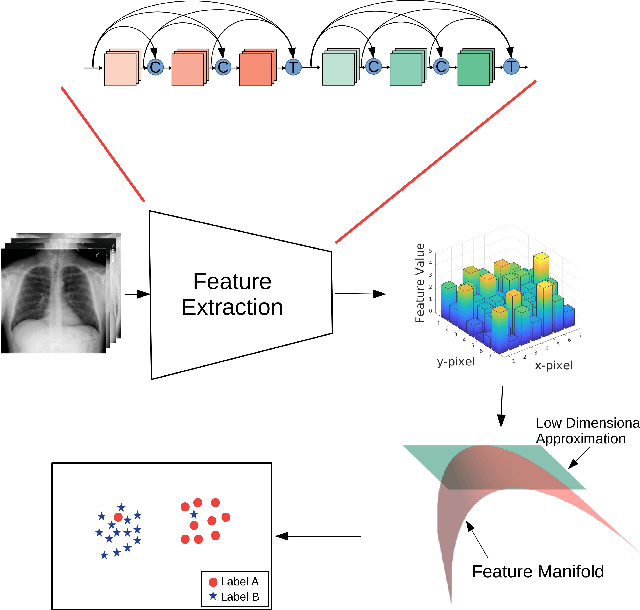
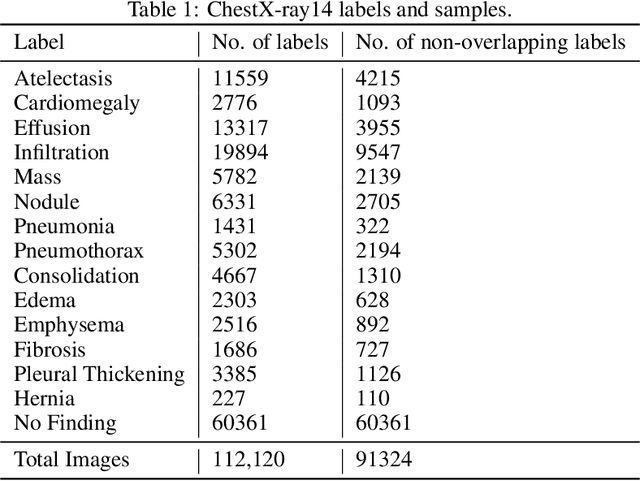
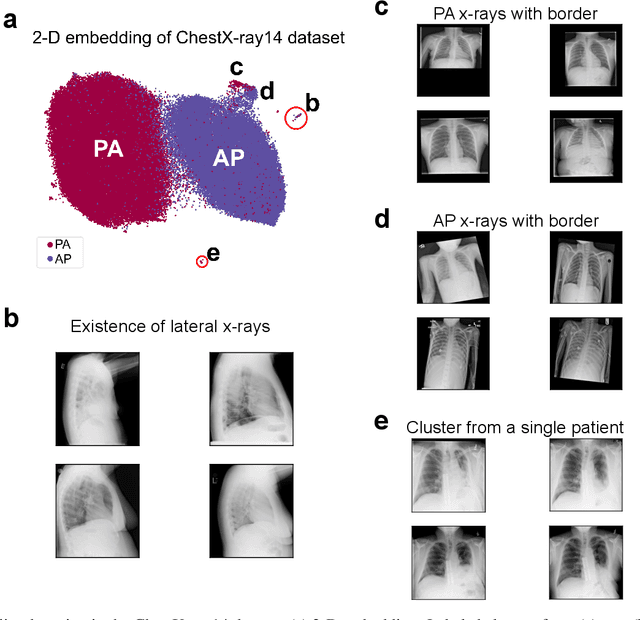
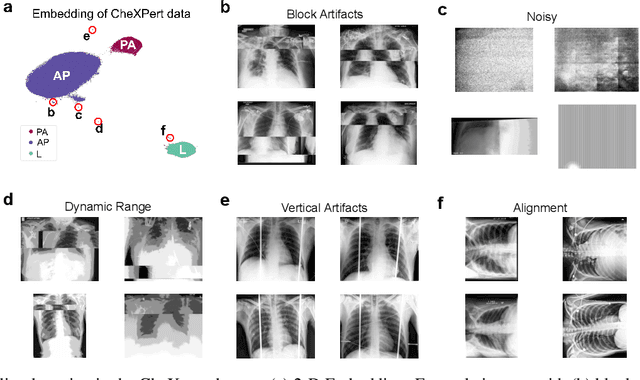
The success of machine learning algorithms heavily relies on the quality of samples and the accuracy of their corresponding labels. However, building and maintaining large, high-quality datasets is an enormous task. This is especially true for biomedical data and for meta-sets that are compiled from smaller ones, as variations in image quality, labeling, reports, and archiving can lead to errors, inconsistencies, and repeated samples. Here, we show that the uniform manifold approximation and projection (UMAP) algorithm can find these anomalies essentially by forming independent clusters that are distinct from the main (good) data but similar to other points with the same error type. As a representative example, we apply UMAP to discover outliers in the publicly available ChestX-ray14, CheXpert, and MURA datasets. While the results are archival and retrospective and focus on radiological images, the graph-based methods work for any data type and will prove equally beneficial for curation at the time of dataset creation.
Manifold-aligned Neighbor Embedding
May 19, 2022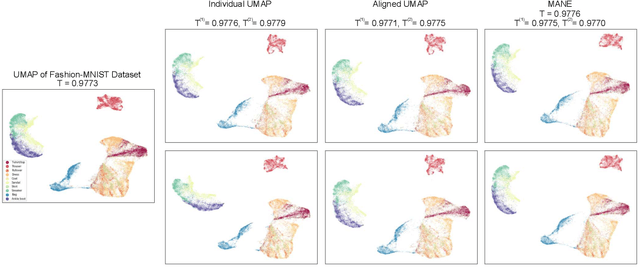
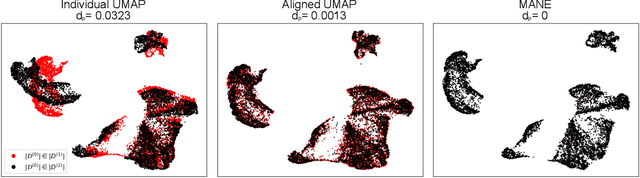
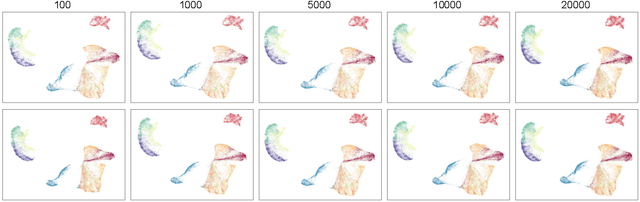

In this paper, we introduce a neighbor embedding framework for manifold alignment. We demonstrate the efficacy of the framework using a manifold-aligned version of the uniform manifold approximation and projection algorithm. We show that our algorithm can learn an aligned manifold that is visually competitive to embedding of the whole dataset.
When deep denoising meets iterative phase retrieval
Mar 03, 2020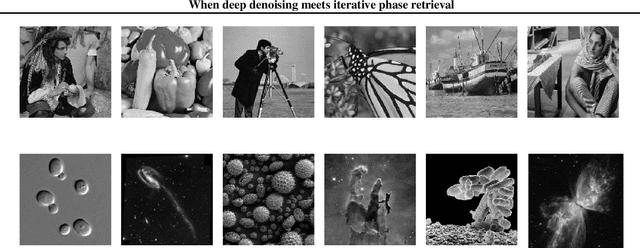
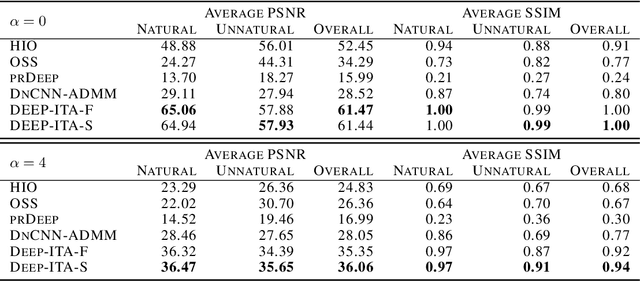
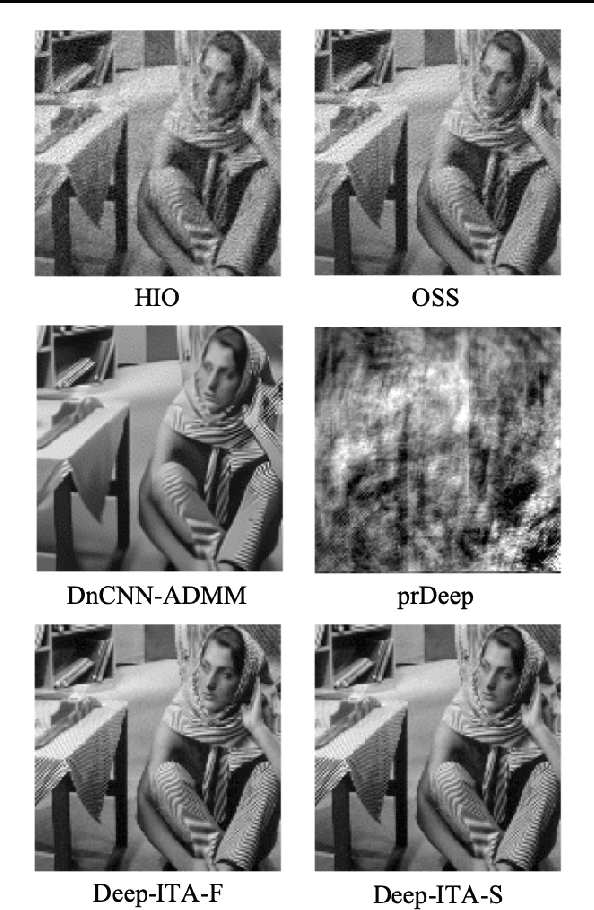
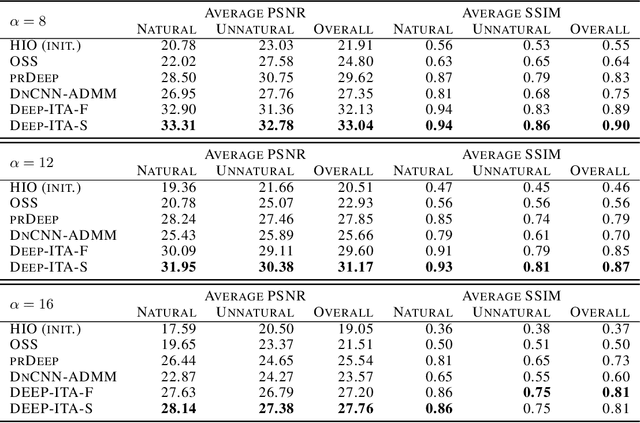
Recovering a signal from its Fourier intensity underlies many important applications, including lensless imaging and imaging through scattering media. Conventional algorithms for retrieving the phase suffer when noise is present but display global convergence when given clean data. Neural networks have been used to improve algorithm robustness, but efforts to date are sensitive to initial conditions and give inconsistent performance. Here, we combine iterative methods from phase retrieval with image statistics from deep denoisers, via regularization-by-denoising. The resulting methods inherit the advantages of each approach and outperform other noise-robust phase retrieval algorithms. Our work paves the way for hybrid imaging methods that integrate machine-learned constraints in conventional algorithms.