 Add to Chrome
 Add to Firefox
 Add to Edge
Grounded Event Extraction from SEC 8-K Filings with a Fine-Grained Taxonomy
Jul 09, 2026
Form 8-K filings are the primary channel through which U.S. public companies disclose material events, but the SEC item codes attached to them are coarse: a single item spans routine administrative changes and chief executive departures, and many of the most market-moving disclosures fall into a catch-all item. Large language models make fine-grained labelling feasible at corpus scale, but only if the labels can be traced to the source text and shown to be reliable. We present a two-stage system that tags 8-K disclosures against a three-tier taxonomy of 119 event types. The first stage constrains output to valid taxonomy entries and anchors every tag to a verbatim quote via fuzzy n-gram validation; the second re-grades each cited quote against the category definition to produce a quality score. Applying the system to 292,984 filings from 2022 to 2026 yields 601,088 grounded event tags, which we release. Over 5,125 stratified tags, an LLM judge finds precision rises monotonically with the quality score, from 12% to 96%, while unsupported tags fall from 8% to near zero. Ablation shows the score is calibrated only when assigned in a dedicated second pass. An event study on unsigned abnormal returns confirms, without any language model, that the taxonomy separates economically distinct events sharing an item code.

Taxonomy-Aligned Risk Extraction from 10-K Filings with Autonomous Improvement Using LLMs
Jan 21, 2026We present a methodology for extracting structured risk factors from corporate 10-K filings while maintaining adherence to a predefined hierarchical taxonomy. Our three-stage pipeline combines LLM extraction with supporting quotes, embedding-based semantic mapping to taxonomy categories, and LLM-as-a-judge validation that filters spurious assignments. To evaluate our approach, we extract 10,688 risk factors from S&P 500 companies and examine risk profile similarity across industry clusters. Beyond extraction, we introduce autonomous taxonomy maintenance where an AI agent analyzes evaluation feedback to identify problematic categories, diagnose failure patterns, and propose refinements, achieving 104.7% improvement in embedding separation in a case study. External validation confirms the taxonomy captures economically meaningful structure: same-industry companies exhibit 63% higher risk profile similarity than cross-industry pairs (Cohen's d=1.06, AUC 0.82, p<0.001). The methodology generalizes to any domain requiring taxonomy-aligned extraction from unstructured text, with autonomous improvement enabling continuous quality maintenance and enhancement as systems process more documents.
Extracting Structured Insights from Financial News: An Augmented LLM Driven Approach
Jul 22, 2024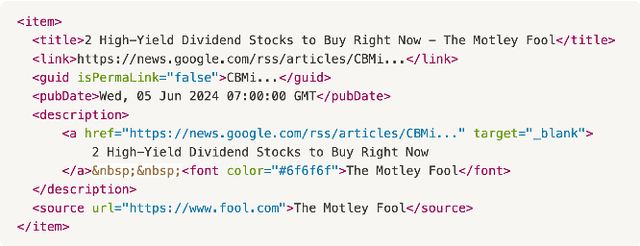
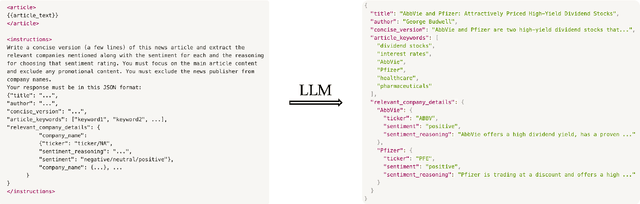
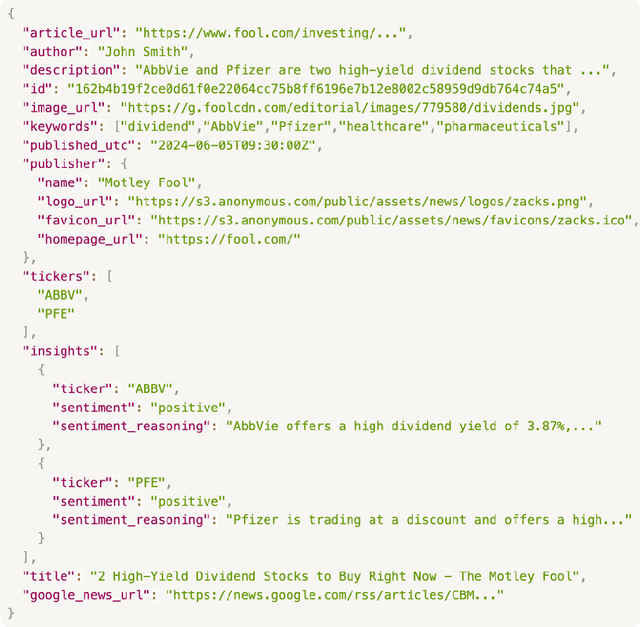
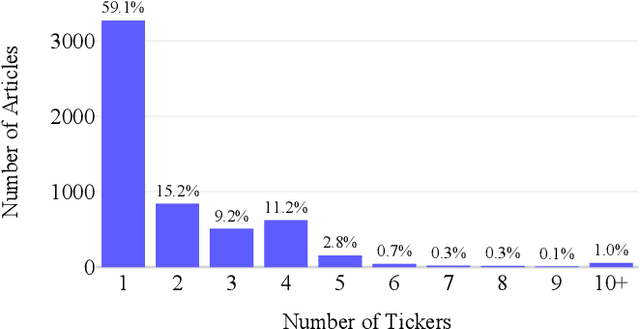
Financial news plays a crucial role in decision-making processes across the financial sector, yet the efficient processing of this information into a structured format remains challenging. This paper presents a novel approach to financial news processing that leverages Large Language Models (LLMs) to overcome limitations that previously prevented the extraction of structured data from unstructured financial news. We introduce a system that extracts relevant company tickers from raw news article content, performs sentiment analysis at the company level, and generates summaries, all without relying on pre-structured data feeds. Our methodology combines the generative capabilities of LLMs, and recent prompting techniques, with a robust validation framework that uses a tailored string similarity approach. Evaluation on a dataset of 5530 financial news articles demonstrates the effectiveness of our approach, with 90% of articles not missing any tickers compared with current data providers, and 22% of articles having additional relevant tickers. In addition to this paper, the methodology has been implemented at scale with the resulting processed data made available through a live API endpoint, which is updated in real-time with the latest news. To the best of our knowledge, we are the first data provider to offer granular, per-company sentiment analysis from news articles, enhancing the depth of information available to market participants. We also release the evaluation dataset of 5530 processed articles as a static file, which we hope will facilitate further research leveraging financial news.