 Add to Chrome
 Add to Firefox
 Add to Edge
Single-Channel Tissue Segmentation via Cross-Modal Distillation from Foundation Models
May 30, 2026
Multiplexed fluorescence microscopy improves tissue segmentation by providing complementary channels including nuclear (DAPI) and membrane (E-cadherin), that together encode richer spatial context than single-channel imaging alone. However, multiplexed models require all channels at inference, limiting deployment where only a subset is available. This work proposes a cross-modal knowledge distillation framework that transfers semantic information from a frozen foundation model teacher processing multiplexed input to a lightweight student operating on the nuclear channel only. The distillation objective combines MSE-based probability matching, boundary-aware supervision, and learnable uncertainty weighting. SAM ViT-H and CellSAM are evaluated as teachers across four U-Net students: Swin-Tiny (27M), ResNet18 (11M), EfficientNet-B0 (5.3M), and MobileNetV3 (1.5M), on TissueNet and BBBC038. On TissueNet, the SAM-distilled Swin-Tiny student achieves Dice 78.36 (plus or minus 1.44), a 13.05-point improvement over the no-KD baseline (65.31 plus or minus 1.35) and 87.9% recovery of teacher oracle performance (89.12 plus or minus 1.21) at a 23x parameter reduction. KD consistently improves all four students by approximately 12 Dice points, confirming architecture-agnostic distillation. SAM ViT-H outperforms CellSAM as teacher across all settings. Cross-dataset evaluation on BBBC038 shows consistent gains without teacher retraining.

Quantitative Measures for Passive Sonar Texture Analysis
Apr 21, 2025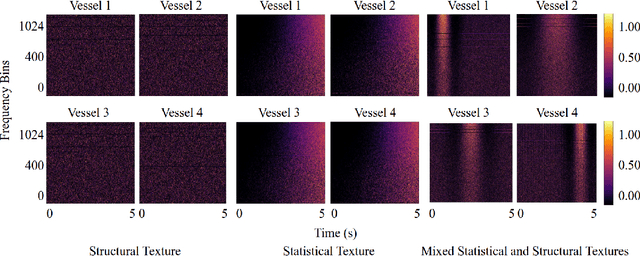
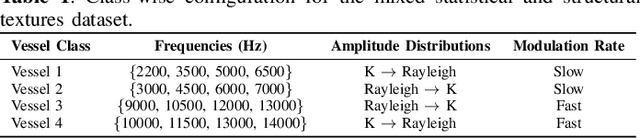
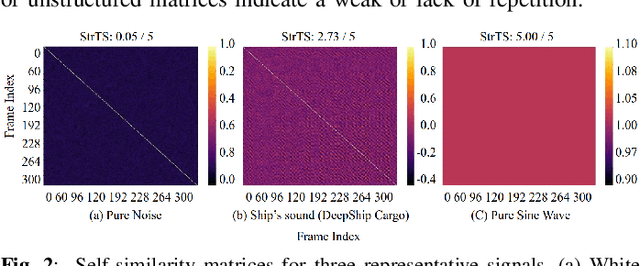
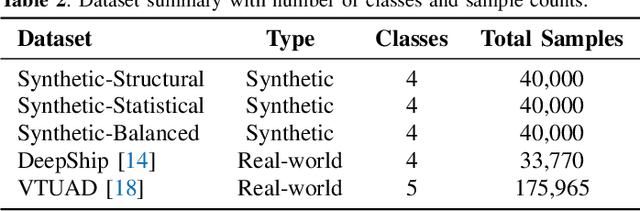
Passive sonar signals contain complex characteristics often arising from environmental noise, vessel machinery, and propagation effects. While convolutional neural networks (CNNs) perform well on passive sonar classification tasks, they can struggle with statistical variations that occur in the data. To investigate this limitation, synthetic underwater acoustic datasets are generated that centered on amplitude and period variations. Two metrics are proposed to quantify and validate these characteristics in the context of statistical and structural texture for passive sonar. These measures are applied to real-world passive sonar datasets to assess texture information in the signals and correlate the performances of the models. Results show that CNNs underperform on statistically textured signals, but incorporating explicit statistical texture modeling yields consistent improvements. These findings highlight the importance of quantifying texture information for passive sonar classification.
Structural and Statistical Audio Texture Knowledge Distillation (SSATKD) for Passive Sonar Classification
Jan 03, 2025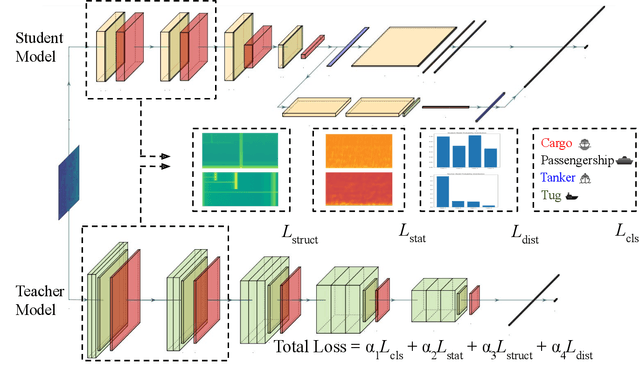
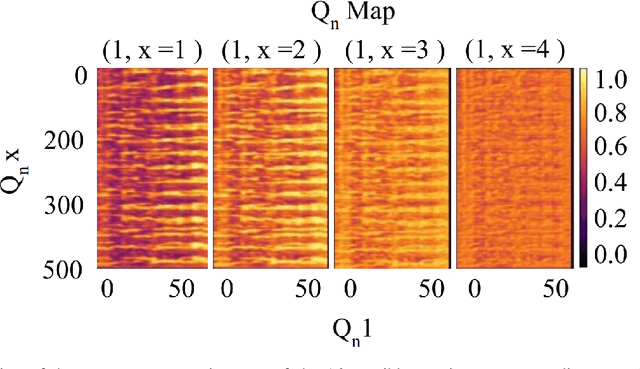
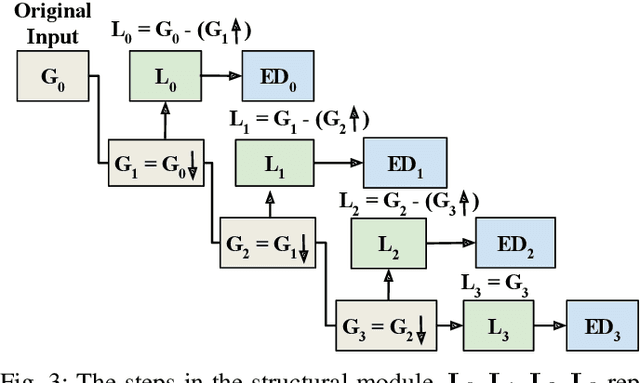
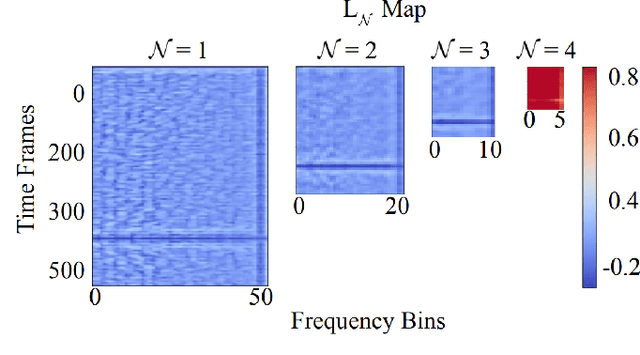
Knowledge distillation has been successfully applied to various audio tasks, but its potential in underwater passive sonar target classification remains relatively unexplored. Existing methods often focus on high-level contextual information while overlooking essential low-level audio texture features needed to capture local patterns in sonar data. To address this gap, the Structural and Statistical Audio Texture Knowledge Distillation (SSATKD) framework is proposed for passive sonar target classification. SSATKD combines high-level contextual information with low-level audio textures by utilizing an Edge Detection Module for structural texture extraction and a Statistical Knowledge Extractor Module to capture signal variability and distribution. Experimental results confirm that SSATKD improves classification accuracy while optimizing memory and computational resources, making it well-suited for resource-constrained environments.
Histogram Layer Time Delay Neural Networks for Passive Sonar Classification
Jul 25, 2023Underwater acoustic target detection in remote marine sensing operations is challenging due to complex sound wave propagation. Despite the availability of reliable sonar systems, target recognition remains a difficult problem. Various methods address improved target recognition. However, most struggle to disentangle the high-dimensional, non-linear patterns in the observed target recordings. In this work, a novel method combines a time delay neural network and histogram layer to incorporate statistical contexts for improved feature learning and underwater acoustic target classification. The proposed method outperforms the baseline model, demonstrating the utility in incorporating statistical contexts for passive sonar target recognition. The code for this work is publicly available.